

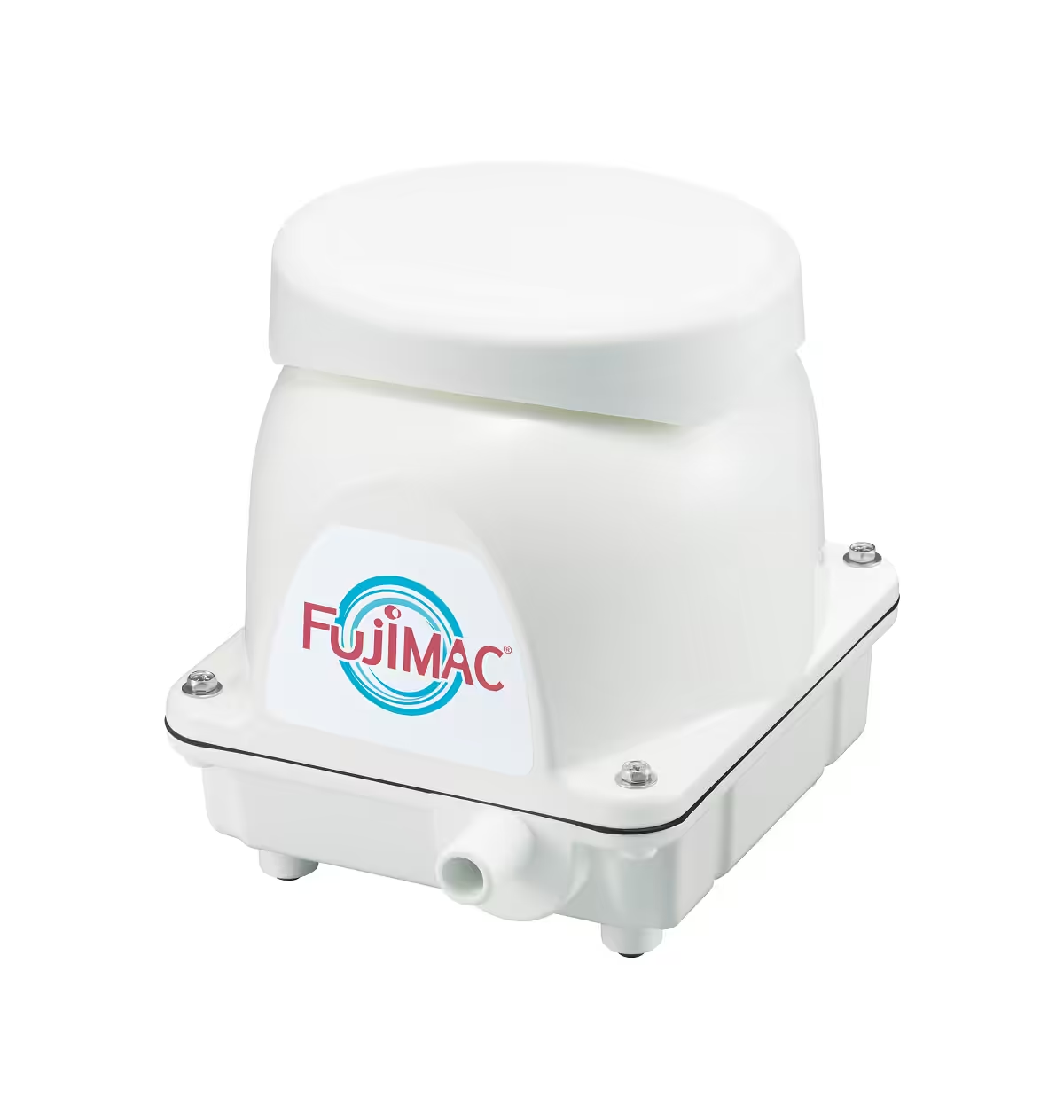
FujiMac Air Pumps MAC60 R II
All Shipments insured against damage and loss.

FujiMac’s RII series air pump is engineered for reliable, quiet operation after five years of rigorous testing, sized to match your aquarium’s aeration needs.
Description
Long Life
Air Flow : 60 Litre per minute.
Power Consumption : 35 watt
Noise Level : 35 dB
The new RII series air pumps have undergone over five years of rigorous testing by FujiMAC research and development staff. These pumps are designed to withstand the elements with a durable cast aluminum housing employing the latest paint finishes. Final assembly is done in a highly controlled environment by skilled Japanese staff with continuous oversight and numerous quality control checks. Each individual pump is then tested and performance measured prior to packaging.

- Extreme duty testing
- FujiMAC employs many testing techniques to ensure our pumps will stand up to such harsh environments as Southeast Asia humidity and the hot Texas sun. Shown here are pumps being run continuously for years in an uncontrolled outdoor environment, and also paint adhesion testing every day to ensure the baked on automotive quality finish will stand the test of time.
Energy Efficient
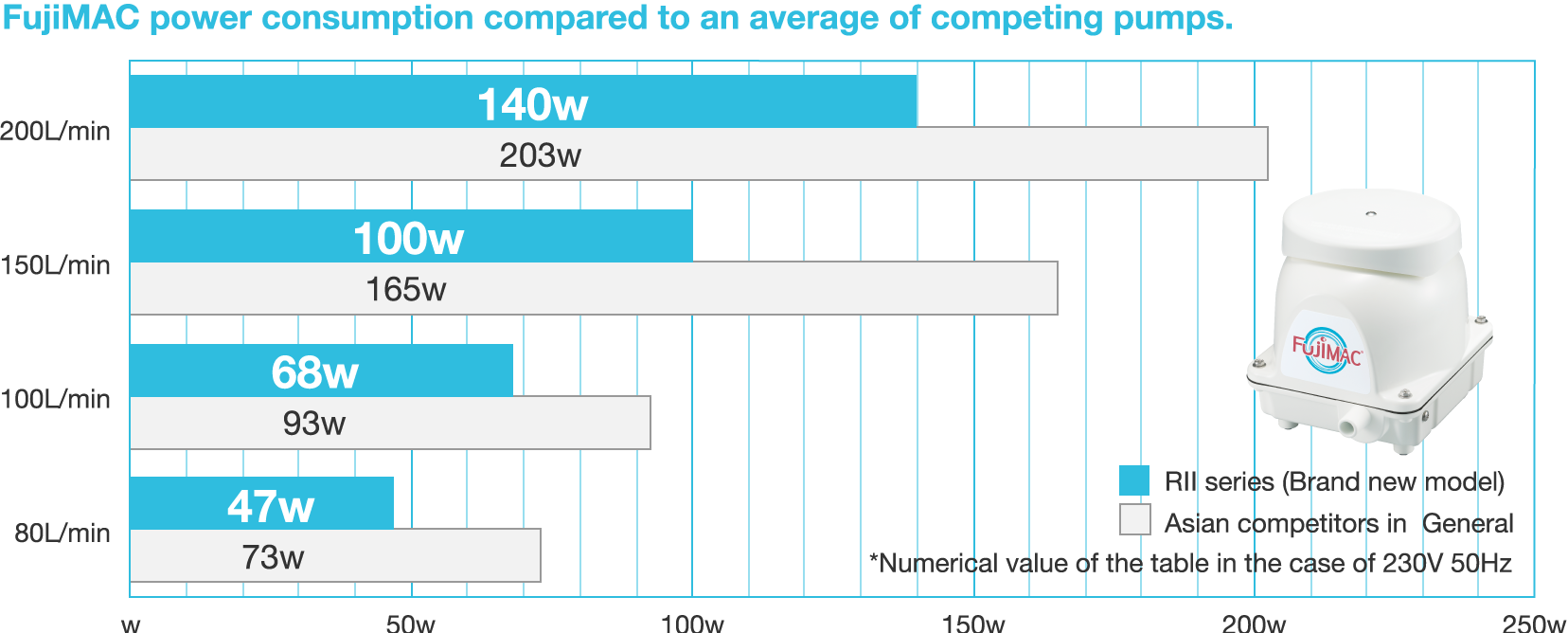
Engineering design breakthroughs make FujiMAC the best choice for energy conservation and economical operation.
FujiMAC has the lowest operating cost of any wastewater air pump.
Low Noise Level
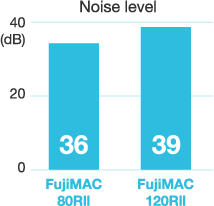
Best in class noise level is achieved through our proprietary sound reduction technologies, including a unique noise barrier aluminum housing and anti vibration rubber technology.
- [Reference]
- The most severe environmental standard related to noise.
- 40 dB or less
- Especially the nighttime reference value of the area requiring quietness (environmental standard AA area)
Extraordinary Structure





Setup & Use
What it is. An oil-free linear diaphragm pump. FujiMAC
describe the mechanism themselves: two opposing fixed electromagnets drive an
axially vibrating oscillator rod carrying permanent magnets, with a diaphragm
on each end working against inlet and outlet valves. There is no motor, no
bearing and no oil in the air path. It is built to push air under water and
FujiMAC say plainly it must not be used for anything else.
Power supply. This is the AC 230-240 V, 50/60 Hz
machine, which is the right side of FujiMAC’s catalogue for Indian
mains. We can say that with confidence because the 35 W on this listing is
exactly FujiMAC’s 50 Hz figure for this model in their 230-240 V table
(38 W at 60 Hz); their 120 V version of the same pump draws 37 W.
Check the label against your supply before plugging it in, and note FujiMAC’s
own caveat: a 230-240 V pump will run on 220 V, but it will move less air than
its rating. All electrical work must be done by a licensed
electrician, and the pump must be earthed.
Where to put it. FujiMAC’s installation rules, and they
are not optional if you want the warranty to mean anything:
- Well ventilated, out of direct sunlight, preferably under a cover.
- Level, on a stable base, with easy access for servicing.
- Above the water level, so water cannot siphon back into
the pump. - Never directly above the tank — so it cannot fall
in. - Dry, dust-free, and protected from rain, splashing, flooding and snow.
- Not under a kitchen extractor or anywhere oily air gets drawn in.
- Not in a bedroom or anywhere the noise will be a nuisance.
- Run the cord so water cannot track along it to the socket —
FujiMAC’s own diagram shows a U-shaped drip loop below the outlet.
Chlorine will destroy it, and that damage is not covered.
FujiMAC are explicit: diaphragms and valves are damaged by chlorine gas and
similar fumes, any conduit or air pipe through which chlorine gas could reach
the pump must be sealed completely with silicone or equivalent, and diaphragm
and valve damage from that cause is excluded from warranty. The same applies
to oil drawn in through the filter.
Connecting it. FujiMAC publish an 18 mm outlet pipe diameter for this family of pumps. Use the rubber hose supplied and
tighten the hose band; do not hard-pipe straight onto the outlet.
Back pressure is the number that decides how long the diaphragms
last. FujiMAC rate this pump at 15 kPa and
specify a working range of the nameplate pressure ±20%. Outside that
band, in either direction, the diaphragm tears early. Their own fault list:
pressure too high means a clogged diffuser, a closed valve, or piping that is
too long or too narrow; pressure too low means damaged or loose piping. It
draws 35 W at rated pressure and about 67 W at open flow, so a
pump reading close to the open-flow figure is telling you it is not working
against anything.
First run. Fill the tank to its normal working level
before plugging the pump in. Then check that aeration actually starts
and that there is no abnormal noise or vibration.
Servicing, on FujiMAC’s intervals:
- Air filter — inspect and clean every three to four
months, replace annually. More often in dusty air. A clogged filter starves
the pump, overheats the solenoid and kills the diaphragm quickly. If the
filter cover is screwed on, torque the screws to 1.4 N·m; over-tightening
strips them. - Diaphragm and valve — replace annually, before
they fail rather than after. These are consumables and are not covered
by warranty. - Power plug — check at least once a year for dust
build-up and a firm connection.
Auto-stop. If a diaphragm or valve fails, this pump shuts itself down rather than running on with a torn diaphragm. Do not leave it sitting in that state — FujiMAC’s own warning is that a stopped aerator lets the tank it serves go anaerobic and start smelling. Replace the part and re-check the auto-stop afterwards; FujiMAC ask you to test it every single time you change a diaphragm assembly.
Service parts. FujiMAC group this pump with their MAC40RII to MAC120RII family, which takes one set of service parts per pump. When ordering a filter cover, note their instruction that the 230-240 V machines take the cover without a hole — the holed cover is the 120 V part.
If it is louder than you expected, it is almost always the
installation. FujiMAC’s own list of noise-prone installs: a narrow
slot between a building and a wall or any space closed on three sides, a base
in contact with the building’s foundation, a base that is not level, and
pipework touching the building or other pipes. Their fixes are to move it,
level it, isolate it, or fit a chamber if the sound is travelling down the
pipe.
Operating environment: −20 °C to
40 °C, humidity 90% or less.
It gets hot, and the underside gets hottest. Do not touch
it bare-handed while running, and let it cool before opening the cover. Never
lift it by the filter cover or by the cord, and never throw water on it.
What’s in the Box
FujiMAC’s own accessory list is three items: a rubber
hose, a hose band, and the manual. That is what ships with the pump, and their
first instruction on opening the carton is to check the outside of the pump
for damage and confirm those accessories are all there. Do that before you
install it, not after.
- The air pump.
- Rubber hose.
- Hose band.
- Manual.
Not included: no diffuser or air stone, no additional
pipework, no spare air filter, no spare diaphragm kit, no timer, and no alarm
unit — the alarm is a separate RIIA model line, not an accessory you can
add to this one.
Which plug is in the carton is not something FujiMAC’s
documentation answers. They list five plug types against the
230-240 V models — SE, BF, A, O (GB) and O (AS) —
and do not map any of them to a market. Cord length follows the plug: 1.5 m on
most of them, 0.75 m on O (AS). If you need a particular pin pattern or a
specific cord length, ask us before ordering and we will look at the carton
rather than guess.
Service parts for this pump are ordered as a single set. Note FujiMAC’s instruction that the 230-240 V machines take the filter cover without a centre hole.
Made in Japan.
Warranty & Support
This product is covered by warranty as per the manufacturer policy, against material and manufacturing defects from the date of purchase.
Warranty support is handled by us directly. Message our WhatsApp support with your order number and we will diagnose the fault first. Most cases are solved by replacing a single part, so you rarely need to send the whole unit. If the item does need to come back, it ships to our Delhi or Pune warehouse, whichever one served your order, and courier cost in both directions is borne by the customer. Your GST invoice is valid proof of purchase for the claim.
Returns & Replacement
Returns are accepted within 7 days of delivery, provided the item is unused and in its original packaging. Manufacturer-sealed items cannot be returned once the seal is broken, and sale-priced items are not refundable.
If your item arrives defective or damaged, message us on WhatsApp with your order number, or email us if you would rather, and we will replace it. Approved replacements are delivered within 3 to 5 business days. Transit damage is covered by insurance on every shipment. If tracking shows delivered but nothing reached you, tell us within 72 hours, which is the reporting window Indian couriers allow. Damage caused during installation or use is not covered; replacement spares for such cases are chargeable.
Full terms are on our Cancellation & Returns page.
Related Products





Reviews
Sorry, no reviews match your current selections
Q & A
Ask a question