

Filter Socks 4 X 14 Inches 200 Microns
Out of stock
Frequently Bought Together

All Shipments insured against damage and loss.

This filter sock traps free-floating debris for crystal-clear tank water, with plastic rings for quick, easy replacement.
Description
Filter socks give the best qualities of trapping free-floating debris to give your tanks water that crystal clear appearance. Filter socks with plastic rings make replacement quick and easy, and most sumps will readily accept the felt filter sock. In most cases, we will always put felt filter socks in our sumps.
Filter Socks are used on overflows to remove small floating particles from aquarium water. This can dramatically improve water quality and reduce maintenance on filters that would otherwise become clogged.
Filter Sock is better at removing particles than mesh but can clog faster. The plastic ring fits common sump holders.
Filter socks come in mesh or felt and with a plastic ring or drawstring.
- Mesh: Thin, doesn’t clog as easily as felt.
- Felt: Thicker, better at removing particles, but can clog faster.
- Plastic Ring: attaches via ring that fits common sump holders.
- Draw String: attaches directly to plumbing.
- recommends starting with felt socks and switching to mesh if they clog faster than desired.
Filter sock benefits:
- Regular use will result in crystal clear water most convenient form of mechanical filtration.
- Remove excess food, detritus, organic waste, dust and other particulates.
- A convenient form of mechanical filtration.
- Prevents larger objects like sand, crabs, and snails from damaging pump motors.
- Reduces ammonia and nitrate producing organic waste.
- Increases filter life.
Specifications
Size: 4 × 14 in: a 4 in (about 10 cm) collar and a 14 in (about 36 cm) body. On a filter sock the first figure is always the diameter of the mouth and the second the length of the bag.
Filtration rating: 200 micron.
Material: non-woven felt.
Mouth: rigid plastic collar.
Our item code: FS-100micron-1.
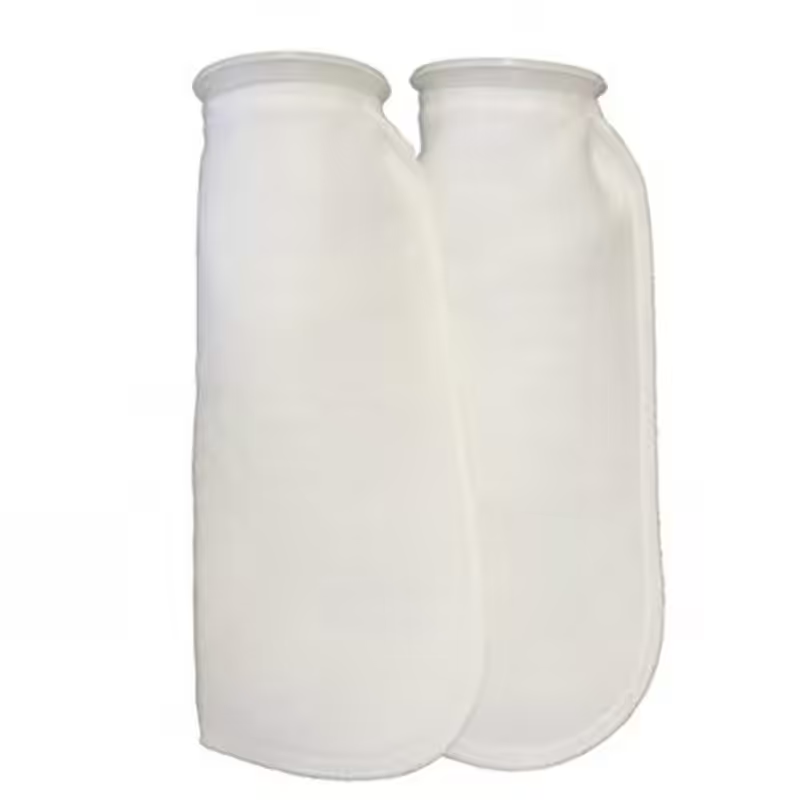
What the photograph on this page shows: an opaque white non-woven felt bag with an overlocked seam and a moulded plastic collar at the mouth. Felt filters by depth rather than by a woven pore: particles are caught throughout the thickness of the material, not just at the surface.
Felt or mesh? We sell both in this size. Felt traps finer material than mesh at the same nominal rating and gives noticeably clearer water, but it clogs sooner and needs changing more often. Mesh flows more freely, washes out more easily and lasts longer. Neither is the right answer for every tank; a common approach is to start with felt and move to mesh if it clogs faster than you want to keep up with.
How many in a pack: this listing does not state a quantity and the photograph shows two socks, which is how these are usually photographed rather than how they are necessarily sold. Message us before ordering if the number matters: we would rather answer than have you guess.
Check your sump depth before you order. At 14 in the body of this sock is two inches longer than the 4 × 12 in size a lot of sumps are built around. In a shallow first chamber a 14 in sock sits on the floor, which stops it draining freely and makes it clog faster. Measure from the underside of your sock holder to the bottom of the chamber; you want a few inches of clearance.
Setup & Use
Where it goes: in the first chamber of your sump, directly under the drain from the display, so every drop coming down the overflow passes through it before it reaches your skimmer, media and return pump. That is the whole point: the sock takes the solids out while they are still solids, instead of letting them break down into ammonia and nitrate in the sump.
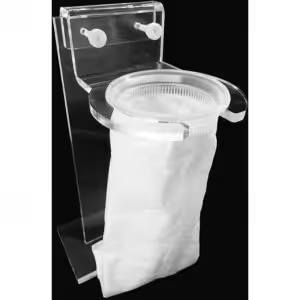
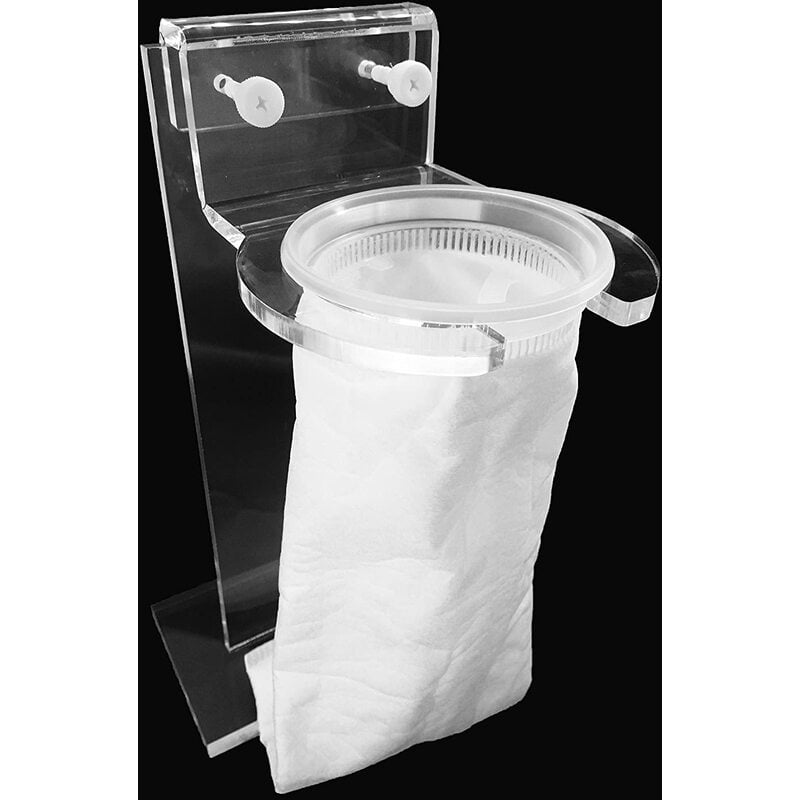
You need something to hang it from. A filter sock is not self-supporting: the 4 in collar has to sit in a holder or a moulded sump shelf, with the drain line discharging into the mouth. We stock acrylic sock holders in single and double versions; the double lets you swap one sock while the other keeps working, which is the difference between a five-minute job and a wet floor. If your sump already has a sock bracket, check it takes a 4 in ring: most do, because 4 in is the near-universal collar size.
Fitting it: drop the collar into the holder, check that the drain line ends inside the mouth of the sock rather than above it or against the fabric, and make sure the bag hangs free rather than resting against the chamber wall. A sock pressed against acrylic uses only half its area.
Felt clogs sooner than mesh, and that is the trade. You get clearer water for it. Plan on changing more often rather than less, and keep a spare so a change never has to wait.
It also protects the pump. A sock under the drain catches the things that damage impellers: sand carried over from an aquascape, a snail that went over the weir, fragments of shell. That job alone justifies it on a tank with a sand bed.
Changing it: our advice, not a manufacturer instruction. There is no manufacturer schedule for this product because there is no brand behind it. In practice a sock at this fineness on a normally stocked tank needs changing every two to four days. You are not waiting for it to look dirty; you are changing it before the trapped detritus starts breaking down inside it. A sock left in place for a fortnight stops being mechanical filtration and becomes a nitrate source sitting in your highest-flow chamber.
The other reason to change it on time: a clogged sock does not stop the water, it just makes it go round. Once the fabric blinds over, the sock fills and overflows the collar, and everything you were trying to catch goes straight into the sump unfiltered: usually without any obvious sign that it has happened.
Washing and reusing. Rinse it under a tap the moment it comes out, before the detritus dries into the fabric: inside out, from the clean side, so you push the muck out rather than deeper in. It can then go through a washing machine on a cold cycle with no detergent, no fabric softener and no bleach; softener coats the fibres and closes the pores, and detergent residue goes straight into your tank next time. Dry it completely before storing. Buy at least two so one is always ready.
When to throw it away: when the seam opens, when the collar cracks, or when it no longer flows freely after washing. A sock that bypasses at the seam is doing nothing at all.
One thing worth knowing if you keep corals. Mechanical filtration this fine removes suspended particles indiscriminately, and some of those particles are food. Many reef keepers run socks continuously and feed accordingly; others run them for a day or two after a big feed or a stir-up and leave them out the rest of the time. Both work. What does not work is leaving a dirty one in.
Freshness & Storage
Every batch we dispatch carries a minimum of 6 months’ remaining shelf life. Store this product in a cool, dry place away from direct sunlight, with the cap or inner foil closed tightly after each use.
Filter media and substrates carry no manufacturing or expiry date: their working life begins on first contact with water, not on the shelf.
Returns & Replacement
Returns are accepted within 7 days of delivery, provided the item is unused and in its original packaging. Manufacturer-sealed items cannot be returned once the seal is broken, and sale-priced items are not refundable.
If your item arrives defective or damaged, message us on WhatsApp with your order number, or email us if you would rather, and we will replace it. Approved replacements are delivered within 3 to 5 business days. Transit damage is covered by insurance on every shipment. If tracking shows delivered but nothing reached you, tell us within 48 hours, which is the reporting window Indian couriers allow. Damage caused during installation or use is not covered; replacement spares for such cases are chargeable.
Full terms are on our Cancellation & Returns page.
Related Products
Reviews
Sorry, no reviews match your current selections
Q & A
Ask a question