

 Fluval M Heater 200 Watt


Seachem De Nitrate 1000 ml
Out of stock
Frequently Bought Together

All Shipments insured against damage and loss.

Seachem De*Nitrate is a high-porosity biological media that removes nitrate, nitrite, ammonia, and organics without risk of hydrogen sulfide production.
Description
Description
de*nitrate is an economical, natural, porous material with a pore distribution and geometry that promotes both aerobic nitrification within the first few millimeters of depth and anaerobic denitrification at the core. The material has a high surface area and supports a high density of bacteria. Although de*nitrate has capacity to trap nitrate, this, as with other nitrate retaining materials, such as certain zeolites and synthetic resins, is quite limited and the primary mechanism of nitrate removal is anaerobic.
“Live” rocks or reef rocks remove nitrate by anaerobic denitrification. de*nitrate removes nitrate by the same process. Efficiency is magnified several folds by forcing the water to filter through the porous de*nitrate™. As with reef rock, anaerobic conditions are achieved by the porosity and the depletion of oxygen by the aerobic process at the surface. Excessive flow rates should, therefore, be avoided, as they may impede development of an adequate anaerobic environment to support denitrifying bacteria.
de*nitrate is also an excellent media for aerobic nitrification and it makes an ideal biological filter in drip trays, canister filters, sumps, or even box filters. At high flow rates (greater than 100 US gallons per hour), it will function solely as an aerobic filter. At slow flow rates (less than 50 US gallons per hour), it will function as both an aerobic filter and an anaerobic denitrifying filter.
Directions
For best results, de*nitrate™ should be placed to assure the flow of water through it, such as in a canister filter, chemical filtration module, or box filter. Flow rate should not exceed 200 L (50 US gallons) per hour. If higher flow rates are unavoidable, use Matrix or Pond Matrix. It is best to rinse off dust before use. Once de*nitrate™ has been in use for several days, nitrate concentrations should start to fall and level off gradually at a concentration of about 4–5 mg/L as nitrate. As long as nitrate concentrations remain under control, the product is not exhausted. Each 500 mL of de*nitrate™ treats about 100–200 L (25–50 US gallons), depending on initial nitrate concentration and the current biological load. Enough should be used to remove nitrate at a rate at least as fast as the rate of formation. If very high nitrates are initially present, they should be brought down to less than 20 mg/L with water changes.
Sizes
250 mL, 500 mL & 1000 mL
Setup & Use
What it is. De-Nitrate is Seachem’s porous biological media built specifically for nitrate removal — its pore geometry supports aerobic nitrification in the outer few millimetres and anaerobic denitrification at the core, without the hydrogen-sulfide risk of sulfur-based denitrifying media.
Where this sits in the Seachem range. The slow-flow counterpart to Matrix: De-Nitrate needs flow kept low to do its anaerobic work, where Matrix is built to keep working at normal canister-filter flow.
How it goes in. Place in a canister filter, chemical filtration module, box filter, drip tray or sump — anywhere water is forced through it. Pre-filter with a sponge or filter floss to keep detritus from clogging the pores early, and rinse off dust before first use.
Specifications
Flow rate is the whole mechanism. Above 100 US gph, De-Nitrate works only as an aerobic (nitrifying) filter. Kept under 50 US gph, it works as both aerobic and anaerobic, which is what actually pulls nitrate down. Seachem’s own ceiling for denitrification is 200 L (50 US gallons) per hour — for faster flow, Seachem points to Matrix or Pond Matrix instead.
What to expect. After several days running, nitrate should decline and settle around 4-5 mg/L. If starting nitrate is high, Seachem recommends bringing it below 20 mg/L with water changes first, rather than asking the media to do that drop on its own.
Dosage & Directions
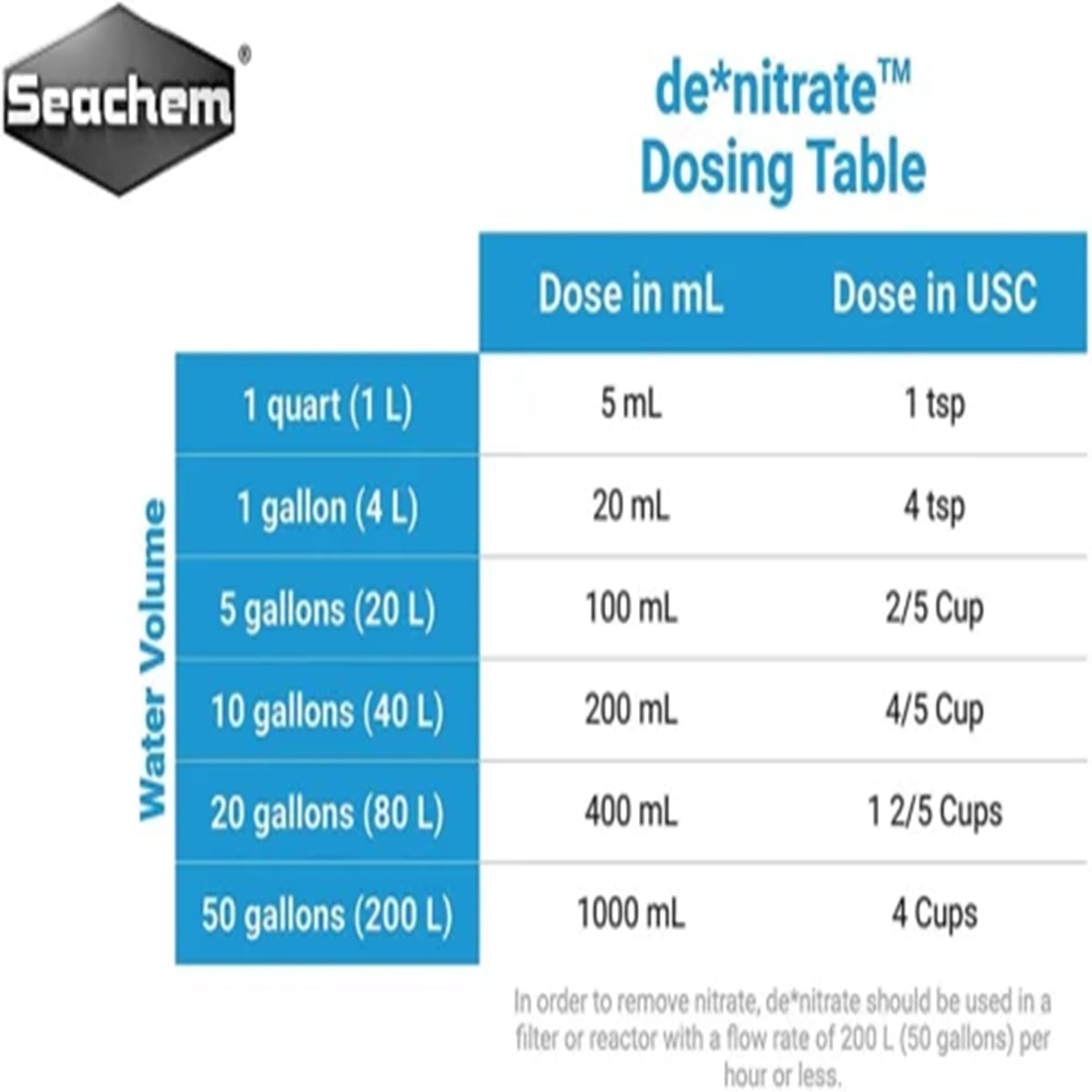
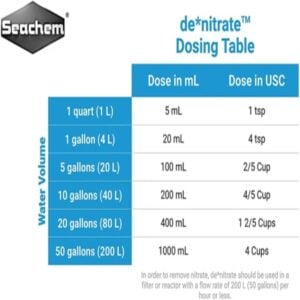
Seachem’s own dosing table: 20 mL per 4 L (1 US gal); 200 mL per 40 L (10 US gal); 400 mL per 80 L (20 US gal); 1,200 mL per 200 L (listed on Seachem’s own table as 60 US gal). Each 500 mL treats roughly 100-200 L (25-50 US gallons), depending on starting nitrate and bioload.
Pack size. Sold from 100 mL up to 4 L; dosing scales with tank volume rather than bottle size, so the same ratio applies at 500 mL or 1 L.
Freshness & Storage
Every batch we dispatch carries a minimum of 6 months’ remaining shelf life. Store this product in a cool, dry place away from direct sunlight, with the cap or inner foil closed tightly after each use.
Filter media and substrates carry no manufacturing or expiry date — their working life begins on first contact with water, not on the shelf.
Returns & Replacement
Returns are accepted within 7 days of delivery, provided the item is unused and in its original packaging. Manufacturer-sealed items cannot be returned once the seal is broken, and sale-priced items are not refundable.
If your item arrives defective or damaged, message us on WhatsApp with your order number, or email us if you would rather, and we will replace it. Approved replacements are delivered within 3 to 5 business days. Transit damage is covered by insurance on every shipment. If tracking shows delivered but nothing reached you, tell us within 72 hours, which is the reporting window Indian couriers allow. Damage caused during installation or use is not covered; replacement spares for such cases are chargeable.
Full terms are on our Cancellation & Returns page.
Related Products


Reviews
Sorry, no reviews match your current selections
Q & A
Ask a question