A pond’s health depends on balance, clarity, and long-term water quality as much as on its fish and plants. A good pond filter is one of the most important parts of maintaining that balance, because it keeps water clean, oxygenated, and safe for fish. This guide covers how pond filtration actually works, what to check before buying, and real specs, prices, and stock status across IndieFur’s pond filter range. Last updated August 2026.
How pond filtration actually works
A pond stays healthy only when waste is removed and beneficial bacteria are given somewhere to establish. Pond filtration generally happens in three stages:
- Mechanical filtration removes visible debris: leaves, fish waste, uneaten food.
- Biological filtration relies on beneficial bacteria that colonize the filter media and break down ammonia and nitrite into far less harmful nitrate.
- UV clarification, on filters that include it, uses a UV-C lamp to kill free-floating algae cells as water passes through. This is what actually clears green water, not mechanical filtration alone.
When these work together, pond water stays clear and stable rather than needing constant manual intervention.
What to check before choosing a pond filter
Every pond is different, so the right filter depends on a few pond-specific factors rather than a single “best” model:
- Pond volume is the single biggest factor: manufacturers publish different maximum-volume ratings depending on stocking level (see below).
- Fish load matters too: koi in particular produce far more waste than a lightly stocked goldfish pond, which is why the same filter is often rated for a much smaller koi pond than an unstocked or lightly planted one.
- Water movement plays a role as well: poor circulation lets debris settle and encourages algae, even with a correctly sized filter.
- Maintenance tolerance is worth considering too: some systems need weekly backwashing or media rinsing, while others are designed for longer intervals between cleans.
IndieFur’s pond filters compared: real prices, real ratings
Manufacturers rate pond filters differently depending on how heavily the pond is stocked: the same filter handles a much larger unstocked pond than a heavily stocked koi pond. Here’s what’s actually available at IndieFur right now, with each manufacturer’s full set of volume ratings:
| Model | Price | Flow Rate | Unstocked Pond | Fish Pond | Koi Pond | Stock |
|---|---|---|---|---|---|---|
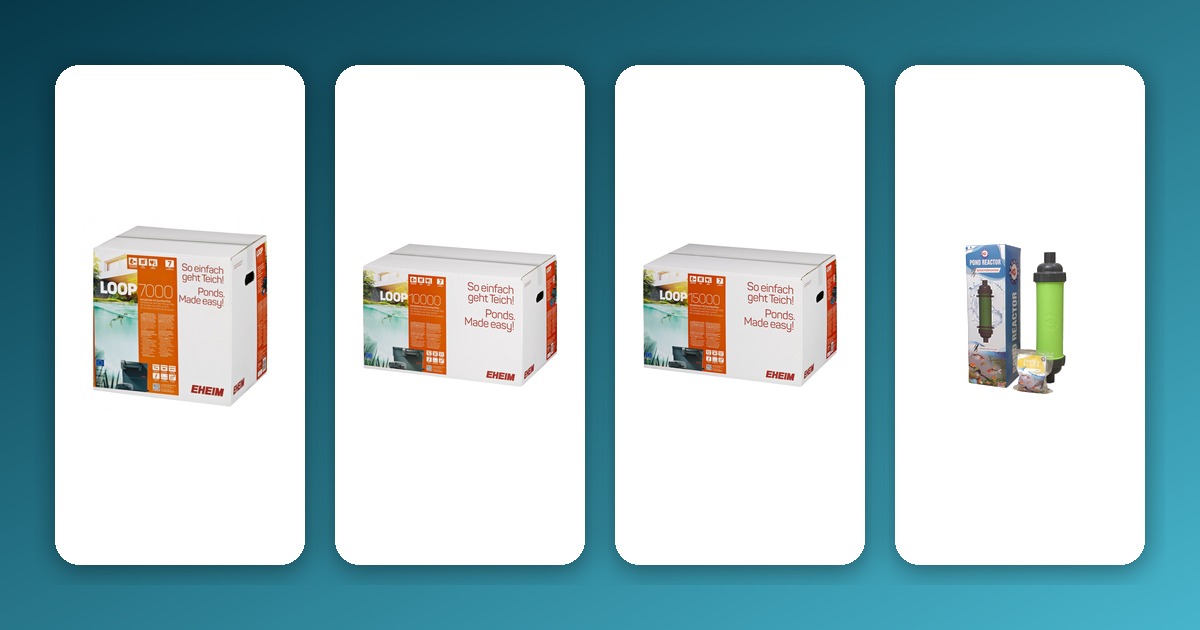
| Eheim Loop 7000 | ₹30,266 | 2,300 L/h | 7,000L | 3,500L | 1,800L | In stock |
| Eheim Loop 10000 | ₹40,933 | 3,200 L/h | 10,000L | 5,000L | 2,600L | In stock |
| Eheim Loop 15000 | ₹45,732 | 4,600 L/h | 15,000L | 7,500L | 3,900L | In stock |
| Messner TFS 5000 | ₹34,000 | N/A | 5,000L | 3,000 to 4,000L* | N/A | Out of stock |
| Messner TFS 10000 | ₹43,499 | N/A | 10,000L | 5,000 to 7,000L* | N/A | Out of stock |
| Messner TFS 15000 | ₹60,499 | N/A | 15,000L | 8,000 to 10,000L* | N/A | Out of stock |
*Messner rates the TFS range by pond type rather than a single fish-pond figure: the lower number is for an unplanted fish pond, the higher for a planted fish pond.
All three Eheim Loop units are pressure filters with a built-in UV clarifier and pump, and are currently in stock across all three sizes. The Messner TFS range is a multi-chamber gravity filter system, also with UV-C included, but all three sizes are currently out of stock, so it’s worth checking back on or asking us for an ETA if that’s the style you want.
Note the gap between “unstocked” and “koi pond” ratings: the Eheim Loop 15000 covers a 15,000L unstocked pond but only 3,900L once it’s a heavily stocked koi pond, nearly a 4x difference. Buy for your actual stocking plan, not just your pond’s water volume.
New or recently stocked pond? Consider an ammonia reactor too
A new pond’s biological filtration hasn’t matured yet, which is when ammonia spikes are most likely to harm or kill fish. The RP Aquatics Pond Reactor (₹25,900, in stock) is a supplementary reactor (not a replacement for your main filter) that uses a replaceable ammonia-removal block to protect fish for up to 12 weeks while your filter’s bacterial colony establishes itself. Worth considering alongside a new filter setup, or if you’re restocking an established pond with a lot of new fish at once.
Natural ways to keep water clear
Even the right filter can’t do the job alone. A few habits make a real difference:
- Avoid overfeeding: uneaten food breaks down into the same waste your filter has to process.
- Remove fallen leaves and debris before they decay in the water.
- Add aquatic plants to help absorb excess nutrients and compete with algae for them.
- Keep water moving: stagnant zones collect debris and are slower to clear even with a correctly sized filter running elsewhere in the pond.
Installation tips for outdoor systems
A pond filter needs proper installation to perform at its rated capacity:
- Position it somewhere maintenance is genuinely easy to reach. A filter that’s a hassle to service gets serviced less often.
- Keep pump and pipe runs free of tight bends that reduce actual flow below the rated figure.
- Protect the unit from extreme weather where the manufacturer specifies it (check whether your model is rated for direct sun/frost exposure).
Buying guide by pond type
Small garden pond, light stocking:
The Eheim Loop 7000 (₹30,266) covers up to 1,800L with koi, or considerably more with goldfish or an unstocked/planted setup, likely more filter than a small garden pond needs unless you’re planning to stock heavily.
Medium fish pond:
The Eheim Loop 10000 (₹40,933, 2,600L koi-rated / 5,000L fish-rated) sits in the middle of the in-stock range and suits most home ponds with a moderate koi or goldfish population.
Large or heavily stocked koi pond:
The Eheim Loop 15000 (₹45,732, 3,900L koi-rated) is the largest in-stock option. For anything bigger, the Messner TFS 15000 rates higher on paper (15,000L unstocked) but is currently out of stock.
New pond, or adding a lot of fish at once:
Pair your main filter with the RP Aquatics Pond Reactor (₹25,900) to protect fish from ammonia spikes while biological filtration matures.
Setting up an indoor aquarium instead?
This guide covers outdoor pond filtration specifically. If you’re filtering an indoor fish tank rather than a pond, internal and submersible filters work differently. See our guide to choosing the right aquarium filtration system for tank-specific models, flow rates, and buying advice.
Frequently asked questions
How often should pond filters be cleaned?
Most systems need media rinsed or backwashed every 2 to 4 weeks depending on fish load and pond conditions. Avoid over-cleaning biological media: a hard scrub can wipe out the bacterial colony you’re relying on.
Why does pond water turn green even with a filter running?
Green water is usually free-floating algae rather than debris, which mechanical filtration alone won’t clear. A filter with a UV clarifier (like the Eheim Loop or Messner TFS ranges) is specifically designed to kill algae cells as water passes the UV lamp.
Can a pond survive without filtration?
Yes, but only with a very light fish load, heavy planting, and regular partial water changes to compensate for the biological processing a filter would otherwise handle.
Are all nine listings in IndieFur’s pond filter category actually filters?
No: two of them (Seachem Pond Health Guard and Seachem Pond Clarigen) are water treatment chemicals, not filtration hardware, and are filed under this category by product type rather than function. Of the seven that are actual filter systems, three (all Eheim Loop sizes) are currently in stock and three (all Messner TFS sizes) are currently out of stock.
What’s the difference between the Eheim Loop and Messner TFS ranges?
The Eheim Loop is a compact pressure filter with an integrated pump and UV clarifier in one unit. The Messner TFS is a larger multi-chamber gravity system with a separate UV-C head, generally suited to bigger ponds where the higher volume ratings matter more than compact footprint.
What’s the most important part of ongoing pond care?
Regular filter maintenance, avoiding overfeeding, and good water circulation matter more than any single piece of equipment: a correctly sized filter still needs these basics to keep water clear.
About this guide
This guide was compiled and reviewed by the IndieFur content team using live WooCommerce stock and pricing data and each manufacturer’s published product specifications (Eheim, Messner, RP Aquatics). Stock status and pricing reflect a point-in-time check as of August 2026 and may change, so always confirm current availability before purchase.