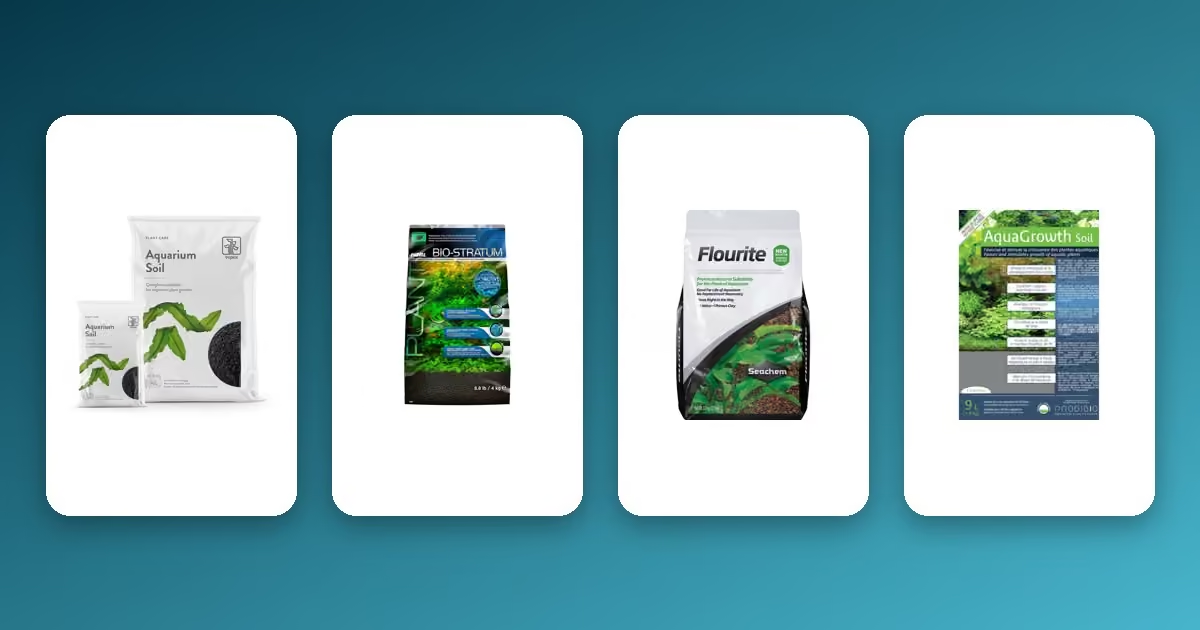
Aquasoil is a nutrient-rich planted-tank substrate, and Tropica and Fluval both say theirs lowers pH. Gravel, sand and Seachem Flourite leave pH alone. So the choice comes down to your plants and your tap water: a demanding carpet suits aquasoil, and a community tank with robust plants usually does fine on an inert base.
That’s our glossary’s rule of thumb, and the makers’ own pages back the chemistry. Here’s what each soil we carry says about itself.
What each soil says about itself
| Soil | What it’s made of | Effect on water | Other maker notes |
|---|---|---|---|
| Tropica Aquarium Soil (also 3 L) | Naturally occurring volcanic minerals, 2 to 3 mm grain | Lowers pH and slightly affects water chemistry | Complete substrate; needs no other bottom layer |
| Fluval Bio Stratum (also 4 kg, 8 kg) | Volcanic soil from Mount Aso in Japan, 1 mm granules, with dormant nitrifying bacteria | Supports neutral to slightly acidic pH; reduces carbonate hardness | Used alone or as a top layer; Fluval says it suits shrimp |
| Seachem Flourite and Flourite Dark | Porous clay gravel | Will not alter pH | Seachem says it’s good for the life of the aquarium and works best alone |
| Seachem Onyx Gravel | Natural substrate | Slight buffering capacity | Seachem pitches it at cichlid tanks |
Two rows need a warning. Flourite is not an aquasoil. It leaves your water as it is, which is the point of it. Seachem pitches Onyx at cichlid tanks and notes a slight buffering capacity.
We also sell Prodibio AquaGrowth Soil.
My rule for any of these: judge a product from use and from hobbyist reviews. Don’t talk it down because the shop doesn’t sell it. We don’t sell ADA Amazonia, Dennerle or Aquario soil, and that’s no reason to call them bad.
The soil I use in my own planted tanks is Tropica.
Tropica or Fluval
Both are volcanic soils, and both lower pH. The grain differs: Tropica’s is 2 to 3 mm, Fluval’s is 1 mm.
Their pitches differ too. Tropica sells its soil as a complete bottom layer. Fluval says Bio Stratum suits smaller tanks or a top layer in larger ones, and it ships with dormant nitrifying bacteria. Fluval is also the one that names shrimp (more on that below).
Neither page gives a replacement date, so we don’t either.
The first weeks
New aquasoil can load the water with ammonia. ADA published a test of its Amazonia Version 2: ammonium sat at 5.0 mg/L at two weeks and was undetectable at one and a half months, while pH read 5.8 at two weeks and 6.2 at one and a half months (ADA). That’s one brand’s test and may not hold for other soils. Fluval takes the opposite line on Bio Stratum and says it rapidly reduces ammonia.
The makers give clearer steps. Tropica says to change 25 to 50% of the water at least twice a week for the first four weeks (Tropica), and its planting guide says to hold off on fish for three to four weeks until the plants have established (Tropica). If ammonia shows up anyway, Seachem Prime binds it until it’s consumed, and Seachem says it can be dosed every 24 to 48 hours.
My own routine for the first two weeks is simple: wait and watch. I do a water change every week and add a bottled bacteria dose. Tropica’s schedule above is heavier, so if your test kit shows ammonia, follow the maker and change water more often.
How much to buy
Tropica and Fluval give the same formula: length times width times depth, all in centimetres, divided by 1,000. Tropica reads the answer as litres and Fluval as kilograms.
Take a 2 ft tank, 60 cm long and 30 cm wide, with a 6 cm layer. That’s 60 x 30 x 6 = 10,800, so about 10.8 L. Their own example is bigger: 90 x 60 x 8 cm needs 43.2 L of Tropica or 43.2 kg of Fluval.
Depth is your call. Neither maker names a universal figure. Tropica’s guide does suggest gravel at least 3 to 4 cm deep at the front and 6 to 8 cm at the back, which is a useful picture of the slope even though it’s written for gravel.
Fluval says Bio Stratum works well in smaller tanks or as a top layer in larger ones. Tropica says its soil can go in without any other bottom layer.
Your tap water decides how strong the effect is
Test KH and GH before you buy. A soil that lowers pH and reduces carbonate hardness does more in soft water than in hard.
India’s drinking-water standard gives a reference point. BIS IS 10500:2012 sets acceptable total dissolved solids at 500 mg/L (up to 2,000 mg/L where there’s no alternative) and acceptable total hardness at 200 mg/L as calcium carbonate (BIS). That hardness figure is about 11 dGH. These are drinking-water limits, so they say little about your own tap. Our shrimp guide notes that tap water in India varies a lot between cities and changes with the season, so test your own.
Hard, high-KH water works against a pH-lowering soil. ADA notes that tap water with high KH can push the tank’s pH higher.
Shrimp
Fluval is the only maker here that states shrimp suitability: it calls Bio Stratum ideal for tropical fish and shrimp in planted tanks. Tropica and Seachem say nothing either way on the pages we read.
Our shrimp setup guide says a buffering soil pulls the water softer and more acidic, which suits Caridina. For Neocaridina it gives GH 6 to 8 and KH 2 to 4, and a strong soil can push a tank below that range. Our glossary adds that a shrimp tank still needs a full fishless cycle first.
Lights, feeding and what comes next
Aquasoil is nutrient-rich, but demanding plants still need light and feeding. Our lighting guide for planted tanks covers the first, and the fertilizer buying guide covers root tabs and the second. The substrate category and the glossary entry hold the rest.
Questions people ask
Do I need to cap aquasoil with sand?
The makers don’t say you must. Tropica says its soil needs no other bottom layer, and Fluval says Bio Stratum can be used alone or as a top layer. Capping is optional and mostly about looks.
Should I rinse aquasoil before using it?
For Fluval Bio Stratum, yes, gently. Fluval says to rinse in a large colander without agitating it. The Tropica page we read doesn’t give a rinsing instruction, so follow the pack.
How much aquasoil does a 2 ft tank need?
About 10.8 L for a 60 x 30 cm tank at 6 cm deep, using the formula above. Change the depth and the number changes with it.
Will aquasoil lower my tank’s pH?
Tropica and Fluval both say so. Seachem Flourite says it won’t alter pH. ADA’s own Amazonia test started at pH 5.8 and had risen to 6.2 by one and a half months.
Can I add fish straight away?
Tropica says wait three to four weeks, until the plants have established. ADA’s test found ammonium at 5.0 mg/L at two weeks, so test before the first fish goes in.