"Water conditioner" is one of the most overloaded terms in the marine hobby. Walk into the category and you’ll find dechlorinators, pH buffers, biological cycling starters, phosphate reducers, and slime-coat protectants all filed under the same heading, and they solve completely different problems. This guide sorts them by what they actually do, with real products currently stocked at IndieFur, so you can match the conditioner to the problem instead of grabbing whatever’s on the shelf.
If you’re also dialing in calcium, alkalinity, and magnesium for an established reef, our Reef Water Chemistry Guide covers the “big three” in depth. This guide focuses on the conditioning side: making water safe, cycling a new tank, and keeping day-to-day chemistry stable.
Step one: make tap water safe (every water change, no exceptions)
Before anything else, before buffers, before trace elements, before coral boosters, every drop of new water going into a marine tank needs to be dechlorinated and detoxified. Municipal water in most Indian cities carries chlorine or chloramine, and untreated tap water can also introduce ammonia depending on the source. Reef keepers who want that variable gone altogether skip tap water and mix salt into reverse-osmosis deionised (RODI) water instead.
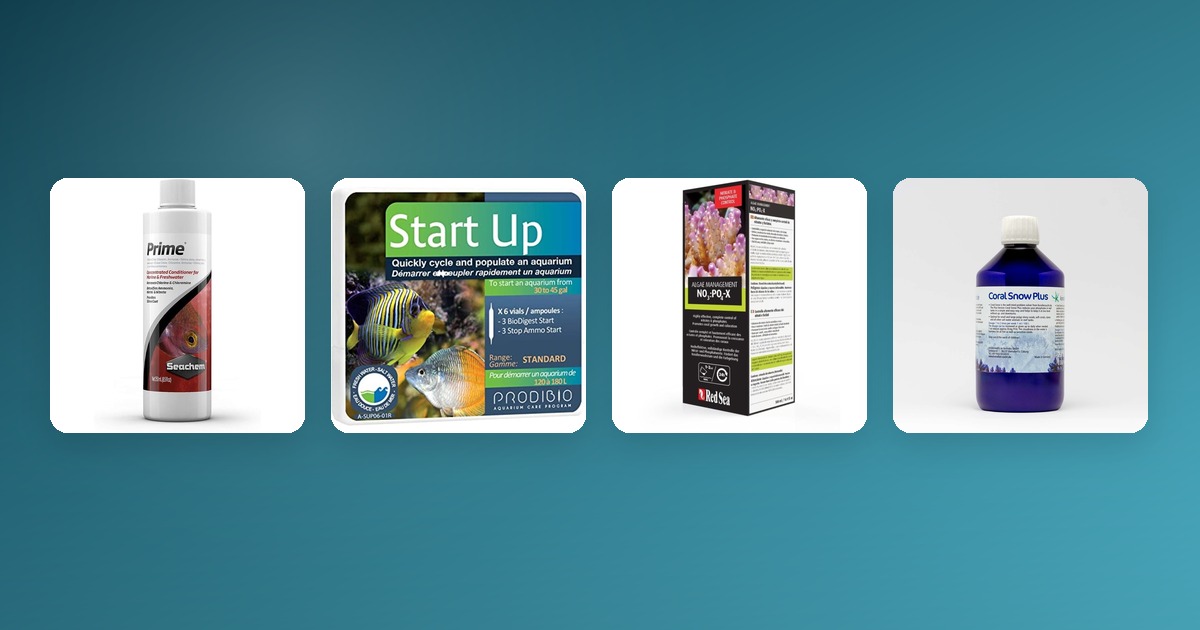
Seachem Prime is the category’s flagship product for a reason: it’s a single-dose conditioner that removes chlorine and chloramine while also detoxifying ammonia, nitrite, and nitrate, at roughly five times the concentration of competing brands. For hobbyists running multiple tanks or a larger system, the bulk 4-litre size brings the per-dose cost down significantly: if you’re topping off a 200+ gallon system weekly, it pays for itself quickly.
If your priority is specifically getting a new tank cycled rather than treating water changes, Easy Life Easy Start is a filter starter that purifies and stabilizes water quickly when setting up a fresh marine or freshwater system. It’s worth keeping alongside Prime rather than instead of it, since they solve different stages of the same problem.
Step two: establish biological filtration faster
A conditioner that only neutralizes chemicals doesn’t build the bacterial colony a marine tank needs to actually process waste long-term. This is where biological starter products earn their place, especially if you don’t want to wait the usual four-to-six weeks for a tank to cycle naturally.
ProdiBio Start Up combines BioDigest and Stop Ammo to cycle a new aquarium safely within hours rather than weeks, a genuinely useful option if you’re launching a display tank on a deadline. Once the tank is running, ProdiBio BioDigest introduces live heterotrophic bacterial strains on an ongoing basis to keep digesting waste and holding nitrate and phosphate down as the tank matures and bioload increases.
For a broader maintenance approach, ProdiBio BioKit Reef Regular bundles BioDigest, Bioptim, Reef Booster, Iodi, and Stronti into one kit, a sensible starting point if you’d rather not assemble five separate dosing products by trial and error in your first year of reefkeeping.
Step three: stabilize pH and alkalinity day to day
Marine pH drifts for reasons freshwater tanks rarely deal with: CO2 outgassing, protein skimming, and biological load all pull it around. A dedicated liquid buffer is the simplest way to correct this without overhauling your whole dosing routine.
Seachem Liquid Marine Buffer safely raises marine pH to 8.3 while adjusting alkalinity, with added borate for stability. It’s a good fit for hobbyists who want a quick, liquid-dosed correction rather than measuring out a dry powder buffer every time pH creeps low.
Step four: manage nutrients before they become algae problems
Rising nitrate and phosphate are usually the first visible sign that a tank’s biological load has outpaced its filtration, and by the time you see algae, the conditioning step should already be underway.
Red Sea NO3:PO4-X, also available in a bulk size for larger systems, is a NOPOX-based reducer that lowers both nitrate and phosphate in reef tanks, helping curb algae growth and support more stable coral health over time. On the Korallen-Zucht side, CoralSnow Plus reduces phosphate steadily without the sharp swings some other dosing methods cause, and ZEOstart 3 (also available in a smaller trial size) promotes nitrifying bacteria growth as a biological route to lowering phosphate, nitrate, and nitrite together. See our Nitrate & Phosphate glossary entry if you want the underlying chemistry before choosing a product.
Step five: protect livestock during handling and transport
Conditioners aren’t only for water: some are formulated for the fish themselves. Seachem StressGuard is a slime-coat protectant that reduces stress and ammonia toxicity while promoting healing, making it genuinely useful after shipping new fish home, moving livestock between tanks, or any handling that strips the protective coat.
Quick reference: what each conditioner solves
| Problem | Product |
|---|---|
| Detoxify tap water (chlorine, chloramine, ammonia) | Seachem Prime |
| Cycle a brand-new tank fast | ProdiBio Start Up, Easy Life Easy Start |
| Ongoing biological waste breakdown | ProdiBio BioDigest, ProdiBio BioKit Reef |
| Stabilize pH / alkalinity | Seachem Liquid Marine Buffer |
| Lower nitrate & phosphate | Red Sea NO3:PO4-X, Korallen-Zucht CoralSnow Plus, ZEOstart 3 |
| Protect fish during handling | Seachem StressGuard |
Building a conditioning routine, not a shopping list
The mistake most new marine keepers make is buying one conditioner and assuming it covers everything. In practice, a stable tank runs at least two of these categories simultaneously: a dechlorinator for every water change, plus either a biological starter (new tank) or a nutrient-reducer (established, algae-prone tank). Buffers and stress protectants get added as needed rather than on a fixed schedule.
Start with Seachem Prime, the one non-negotiable in this list, then layer in the product that matches whatever stage your tank is actually at: cycling, stabilizing, or nutrient control. If you’re also managing calcium, alkalinity, and trace elements for coral growth, that’s a separate (and larger) topic covered in our Reef Water Chemistry Guide.