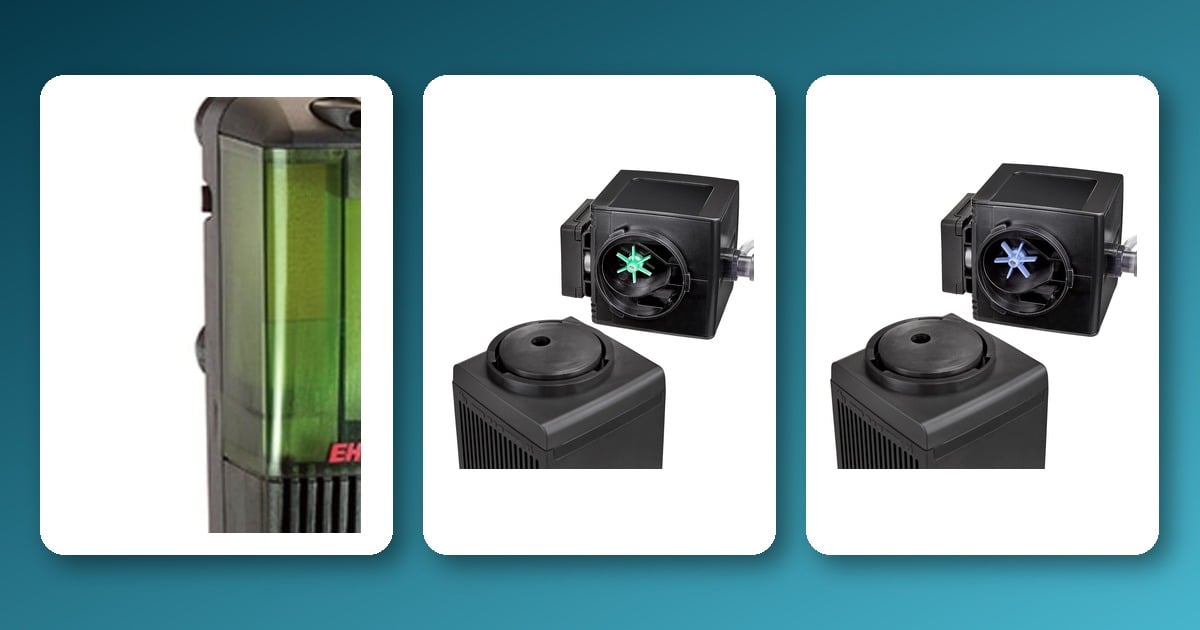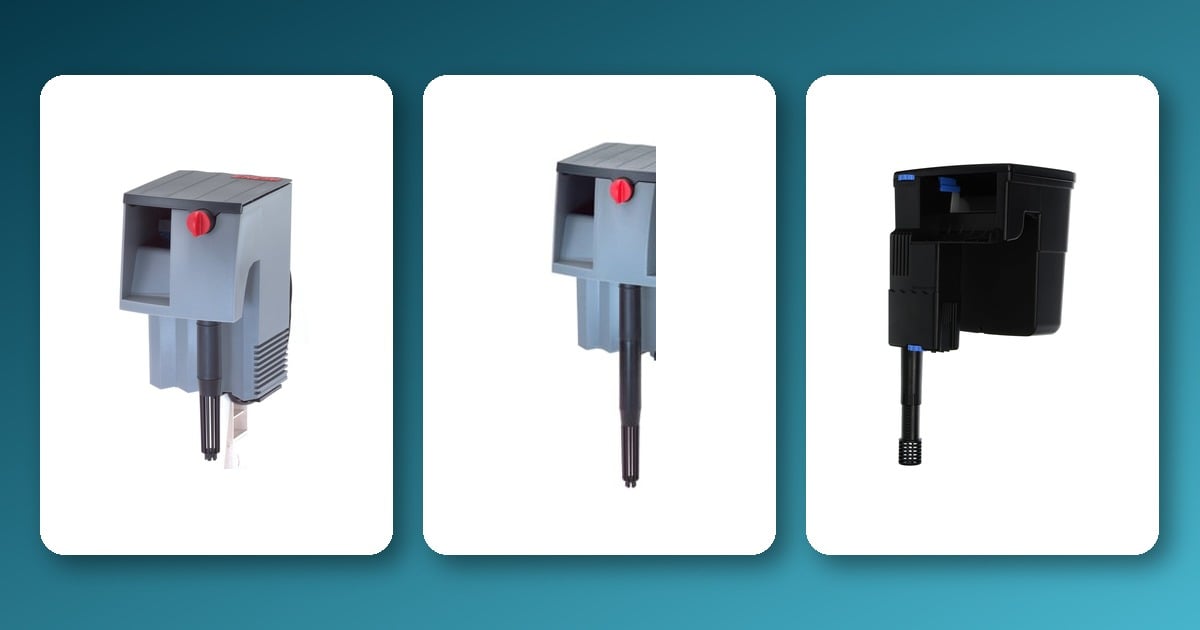
A hang-on-back filter, usually shortened to HOB, is an external aquarium filter that clips onto the tank rim, lifts water up through an intake tube, passes it through a media chamber, and returns it over a waterfall lip. It sits outside the tank like a canister filter, but holds far less media and needs no sealed hoses, which makes it the simplest external filtration you can fit to a freshwater tank. The practical dividing line is capacity: a HOB is the right answer up to roughly 150-200 litres with moderate stocking, and a canister takes over above that or wherever the bioload is heavy. This guide covers how a HOB actually moves water, where it beats a canister and where it loses, how to size one, and what maintenance really involves.
How a hang-on-back filter works
Every HOB follows the same four-stage path. An intake tube hangs into the tank and draws water from mid-level. An impeller, a small magnetically driven rotor, lifts that water up into the filter body. The water then passes through the media chamber, where it meets mechanical filtration (a sponge or floss pad catching visible debris), biological filtration (a porous surface hosting the nitrifying bacteria that convert ammonia to nitrite and then nitrate), and often chemical filtration (activated carbon or a resin). Finally it spills back into the tank across a wide plastic lip.
That waterfall return is doing more work than it looks. Water falling across a lip and breaking the surface drives gas exchange, oxygen in and carbon dioxide out, far more aggressively than a canister’s submerged spray bar. For a lightly planted or unplanted community tank, that is a genuine advantage. For a high-tech planted tank running injected CO2, it is the opposite: the same surface agitation strips out the CO2 you are paying to inject, which is one of the clearest reasons to choose a canister for a planted setup.
Two design details separate the better HOBs from the cheap ones. The first is self-priming: whether the filter can restart on its own after a power cut without you pouring water into the chamber to re-seat the siphon. The second is whether the media chamber is a fixed moulded tray or removable baskets. Fixed trays force you to use the manufacturer’s cartridge; baskets let you choose your own media and, critically, let you keep mature biological media when you replace the mechanical layer.
Hang-on-back vs. canister filter
The honest comparison comes down to media volume. A canister filter is a sealed bucket sitting in the cabinet, and even a mid-range unit holds several litres of media across stacked baskets. A HOB holds a fraction of that in a single open chamber. Media volume is what determines how much bacterial colony a filter can support, so this single difference cascades into everything else: stocking capacity, how long the filter goes between services, and how well it copes when something goes wrong.
Where the HOB wins is access and cost of entry. There are no hoses to prime, no O-rings to seat, no risk of a leak under the cabinet, and servicing means lifting a lid rather than disconnecting a filter and carrying it to a sink. For a first tank, a quarantine tank, a shrimp tank, or a second tank you did not plan on owning, that simplicity is worth more than raw capacity.
Where it loses is at scale. Above about 200 litres, or on any tank with messy stock (cichlids, goldfish, a heavily fed community), a HOB will need servicing so often that the convenience advantage disappears. It also cannot run the media diversity a canister can: no room for a dedicated phosphate resin alongside a full biological load alongside fine polishing floss.
If you are weighing the two seriously for a larger tank, our canister filter buying guide covers sizing, media capacity and brand differences in detail, and the canister filter comparison puts specific models side by side.
The honest pros and cons
A HOB does a number of things well. It is cheap to run and cheap to fail, since nothing is under pressure, so a seal failure means a drip rather than a flooded cabinet. Servicing takes minutes without shutting anything down, and surface agitation is excellent, which matters in warm rooms where dissolved oxygen drops. Because the chamber is open, you can also see the media condition at a glance rather than guessing from flow rate.
A HOB also has real downsides. Media capacity is the hard ceiling, and no amount of clever packing gets around it. Flow rate on the box is measured with an empty chamber and drops substantially once real media is loaded, so plan for meaningfully less than the rated figure. Intake tubes are a hazard for small fish and shrimp unless you fit a sponge guard, and the waterfall makes noise that gets worse as the tank’s water level drops through evaporation, so you will hear it most in dry months. A HOB also cannot run below the tank water line, which rules it out for sumps and for tanks with a tight-fitting lid or a rimless cabinet with no rear clearance.
EHEIM LiBERTY: cartridge-based, self-priming
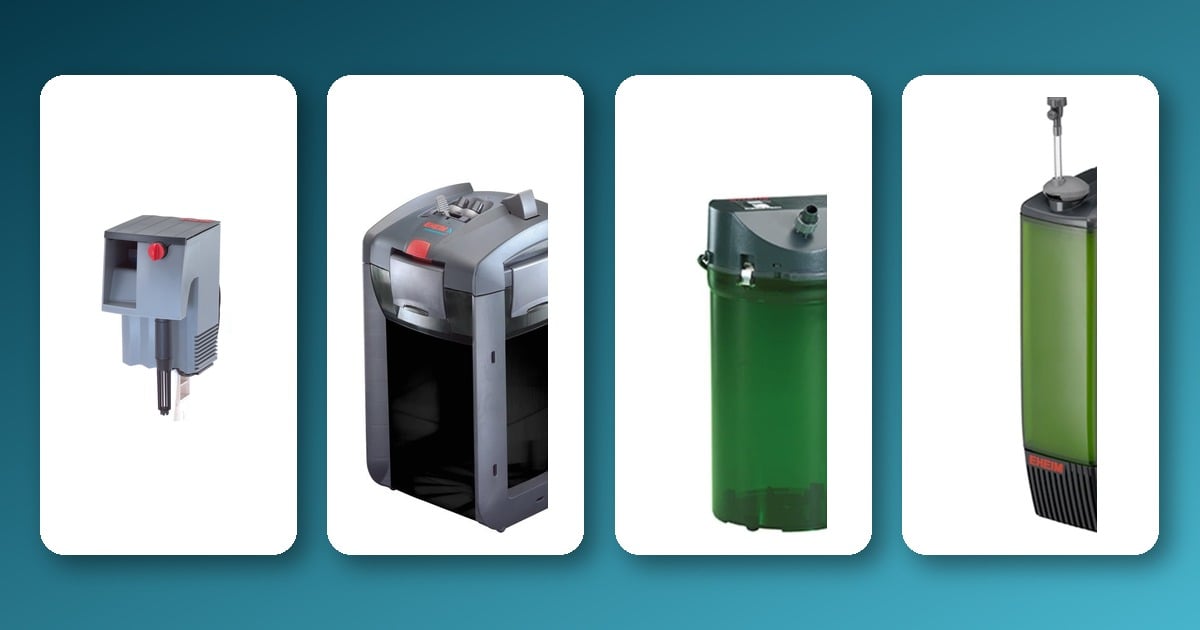
The EHEIM LiBERTY 75 is built around a removable cartridge system rather than loose media, and it is fully self-priming: it restarts on its own after a power interruption, which matters in Indian conditions where cuts are routine. The cartridge design trades media flexibility for consistency: you are not choosing what goes in, but you also cannot pack it wrong.
The range steps up through the LiBERTY 130 for tanks in the 100-130 litre band. EHEIM rates each model to a litre figure directly, which sidesteps the usual flow-rate arithmetic. The build is the usual EHEIM story: quiet, mechanically conservative, and priced for longevity rather than headline specification.
The LiBERTY suits someone who wants filtration to be a non-event: fit it, change the cartridge on schedule, and stop thinking about it. It suits an experimenter less well, because the cartridge format resists the media tinkering that some aquarists genuinely enjoy.
Seachem Tidal: basket media and adjustable flow
The Seachem Tidal 35 takes the opposite approach: a large open media basket you fill yourself, a surface skimmer built into the intake, and a flow control that actually works across its range rather than choking the pump. The basket volume is unusually generous for a HOB of its rating, which partly offsets the category’s main weakness.
The range scales through the Tidal 55 and up to the Tidal 110, whose rated throughput puts it into territory normally handled by an entry canister. The integrated surface skimmer is the feature that earns the Tidal its reputation: it pulls the protein film off the water surface continuously, which is otherwise a manual job.
Choose the Tidal if you want to build your own media stack, run a specific resin, or keep mature biological media across a service. Choose the LiBERTY if you would rather not have that decision to make.
ISTA and AquaClear: the budget and mid-range options
The ISTA range runs five models from the 180 up to the 600, each named for its rated flow in litres per hour, with a bio-sponge over the intake as standard, useful if you keep fry or shrimp and don’t want to fit a guard separately. The smaller three (180, 280, 380) use a two-stage cartridge; the 450 and 600 step up to a detachable filter box that’s easier to service without disturbing the media bed, and both add a no-backflow valve so the chamber doesn’t drain back into the tank when the power cuts and restarts on its own when it returns. It’s a straightforward, no-frills cartridge design in the same vein as the LiBERTY, at a lower price point.
The AquaClear 70 is the one model in Hagen’s AquaClear line currently in stock here (the 20, 30 and 50 are not) and it is rated for 152 to 265 litre aquariums, larger than anything else in this section. Like the Tidal, it uses an open media basket rather than a fixed cartridge, so it suits the same experimenter who wants to choose their own media stack, just sized for a bigger tank.
Sizing a HOB to your tank
The working rule is four to six full water turnovers per hour. A 100-litre tank therefore wants 400-600 litres per hour of rated flow. Two corrections apply. First, the rated figure is measured with an empty chamber, so buy toward the upper end of the band rather than the lower. Second, rated flow assumes clean media; a filter two weeks into its service cycle is moving considerably less.
Adjust upward for heavy stocking, messy feeders, or a tank you know you will overstock. Adjust downward for shrimp, bettas and small nano stock that struggle in strong current, and in those tanks use a filter with real flow control rather than trying to baffle a fixed-output pump with sponge.
If your calculation puts you above roughly 1,200-1,500 litres per hour, you have reached the point where a canister does the job better for similar money. That is the practical upper edge of the format, not a strict rule.
Maintenance: what it actually involves
Rinse the mechanical layer (the sponge or floss catching visible debris) every two to four weeks, in a bucket of tank water, never under the tap. Chlorinated tap water kills the bacterial colony living in that sponge, and rebuilding it takes weeks.
Never replace all media at once. If you are changing a cartridge or a sponge, run the new one alongside the old for a week before removing the old one, so the colony transfers. This is the single most common cause of a mysterious ammonia spike in an established tank.
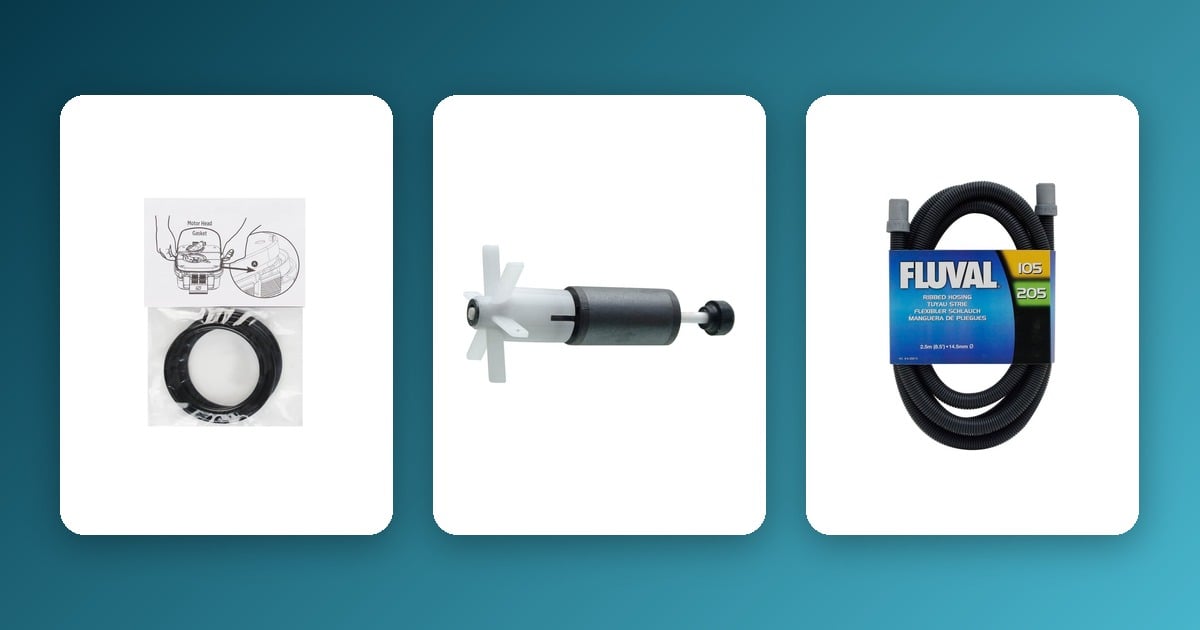
Clean the impeller every three to six months. Pull it out, check the shaft for mineral scale and the housing for trapped grit, and rinse it. Impeller noise is almost always grit or scale, not a failing motor.
Top up evaporation before it drops the water level below the intake. A HOB that loses its siphon can run dry and burn out the pump, and the noise increase as the waterfall drop grows is your early warning.
Frequently asked questions
Can a hang-on-back filter run a planted tank? A low-tech planted tank, yes. A high-tech tank with injected CO2, no: the waterfall return strips dissolved CO2 out of the water almost as fast as you inject it. Use a canister with a submerged outlet instead.
Is a HOB safe for shrimp? Only with an intake guard. A bare intake tube will draw in shrimplets and small fry. Fit a sponge pre-filter over the intake, which also doubles as extra mechanical filtration and extra biological surface. Our shrimp tank setup guide covers the rest of the setup.
Can I run a HOB alongside a canister? Yes, and it is a reasonable setup on a large tank: the canister handles the biological load while the HOB carries chemical media you swap regularly, so you are not opening the canister to change carbon.
Why is my HOB noisy? Three causes, in order of likelihood: the water level has dropped and the waterfall now has further to fall; the impeller has grit or scale on it; or the filter has lost prime and is drawing air. Check the water level first: it is the cause most of the time.
How long does a HOB take to cycle? Four to six weeks from new, the same as any filter, because the limiting factor is bacterial colonisation and not the hardware. Seeding it with media from an established filter cuts this dramatically.