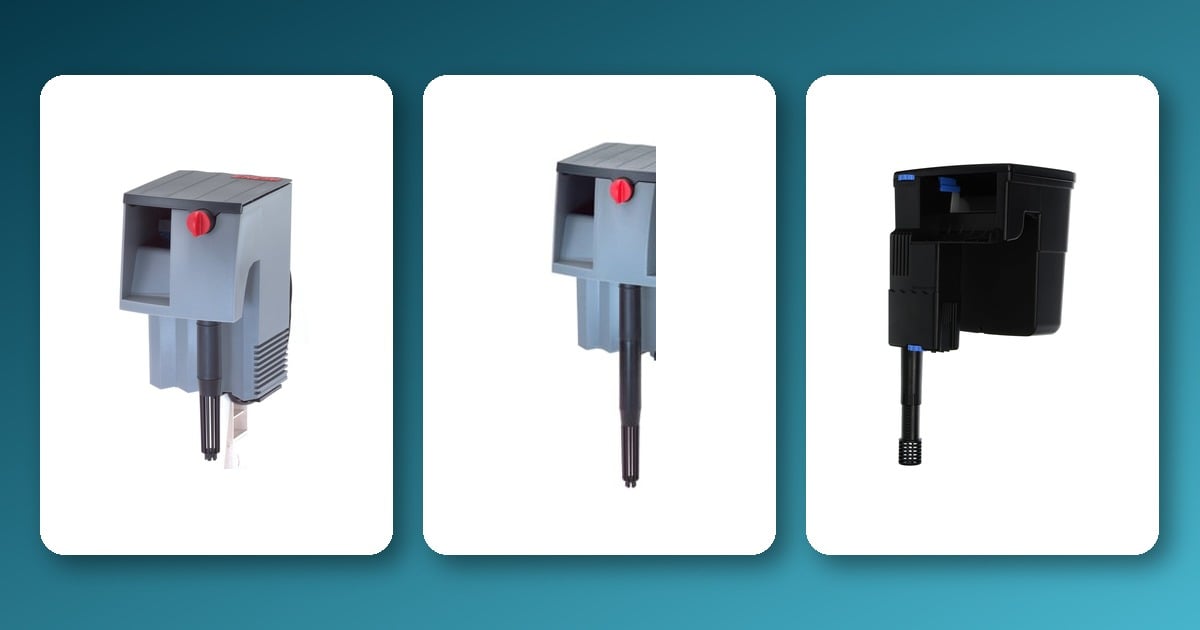
Canister, hang-on-back and internal filters get most of the attention, but three older formats are still the right tool for specific jobs: sponge filters, undergravel filters, and sumps. None of them are trying to be a general-purpose filter for a community tank. A sponge filter is built for livestock too small or too fragile to survive an impeller. An undergravel filter is a low-tech, low-cost approach that predates all three modern formats and still has a narrow place. A sump is not really a filter at all so much as a second tank that turns your entire reef system’s plumbing into a filtration and equipment platform. Knowing which of these three actually fits your situation (rather than defaulting to whichever one is most commonly recommended online) is the point of this guide.
Sponge Filters
A sponge filter is the simplest filter that exists: a block of open-cell foam over a rigid uplift tube, driven either by an air pump pushing bubbles up the tube (air-driven) or by a small powerhead mounted on top (powerhead-driven). Water is pulled through the foam’s entire surface area, which does two jobs at once: mechanical trapping of debris and, once mature, hosting a genuinely large colony of nitrifying bacteria across all that surface area.
The reason a sponge filter exists at all, in an era of canisters and HOBs, is intake safety. There is no impeller anywhere near the water the livestock swims in. An air-driven sponge filter has no impeller at all; a powerhead-driven one keeps its impeller sealed above the sponge, well away from anything that could be drawn in. That makes it the only filter format that is unconditionally safe for shrimp of any size, for fry, and for fish recovering from illness or injury in a hospital tank.
This is why sponge filters show up almost exclusively in three contexts: breeding tanks, dedicated shrimp tanks, and quarantine or hospital tanks. In a breeding tank, fry that would be pulled straight into a canister’s impeller can sit against a sponge filter’s surface with no risk. In a shrimp tank, the same logic applies to shrimplets, which are small enough to pass through most other filters’ intake slots. In a quarantine tank, the sponge filter’s other advantage matters more: it is cheap enough to keep a spare running permanently in a bucket or an established tank, seeded and ready, so a new arrival gets mature biological filtration from day one instead of an uncycled hospital tank on top of whatever it is already fighting. Our shrimp tank setup guide covers sponge filtration alongside the rest of a shrimp tank’s requirements.
The trade-off is capacity and flow. A sponge filter moves water gently (that is the same property that makes it fry-safe) so it does not agitate the surface or turn over large tanks the way a powerhead-driven HOB or canister does. It is a filter for small, quiet, low-flow setups, not a replacement for a canister on a heavily stocked community tank.
Undergravel Filters
An undergravel filter (UGF) is a perforated plastic plate installed on the tank floor, with the substrate poured on top of it and one or more lift tubes running from the plate up to the surface. An air pump or a powerhead pulls water down through the substrate, through the plate, and up the lift tube, which turns the entire gravel bed into a biological filter: every grain of substrate becomes surface area for bacteria.
That is a genuinely large amount of biological surface area for very little cost, and it explains why undergravel filters were the default in the aquarium hobby for decades before canisters and HOBs became affordable and reliable. It is worth being straightforward about where that history has left the format today: it is mostly a legacy choice, not a first recommendation, and the honest reasons why matter more than the nostalgia.
The plate only works with a coarse-to-medium gravel substrate that water can actually be pulled through. Fine sand clogs the slots and stops flow almost immediately, which rules an undergravel filter out for any planted tank using a sand-based aquascape, and for most modern reef and shrimp substrates. Detritus that settles on top of the gravel gets pulled down into the bed rather than into a removable filter media, and over months it accumulates inside the substrate where a gravel vacuum can only reach the top few centimetres. Removing that plate for a real deep-clean means tearing the tank down to the glass. None of this makes an undergravel filter a bad filter in the narrow sense (the biological capacity is real), but it does mean the maintenance model does not match how most people actually run a modern tank.
Where it still makes sense is a simple, low-tech, budget-first freshwater community tank with coarse gravel and a modest fish load, run by someone who is comfortable with an occasional full substrate clean rather than routine spot maintenance. It is a poor fit for anything planted, anything running fine sand, and anything stocked heavily enough that detritus builds up faster than the format can be reasonably maintained.
Sump Filters
A sump is a separate tank, almost always positioned in the cabinet below the display tank, connected by an overflow box that lets water spill from the display down into the sump and a return pump that sends it back up. It is not a filter medium in itself: it is a second body of water where filtration, dosing and other equipment can physically live, out of sight and with far more room than the display tank allows.
Three things make a sump valuable, and all three matter most on marine and reef setups. First, equipment placement: protein skimmers, heaters, reactors, dosing pumps and probes all sit in the sump instead of cluttering the display or hanging off the back of the tank. Second, water volume: a sump typically adds 20-50% more total system water, and more total water means slower, gentler swings in temperature, pH and salinity when something goes wrong or when you dose. Third, it gives you a dedicated refugium space if you want one: a separate chamber for macroalgae or additional live rock that runs on its own light cycle for nutrient export.
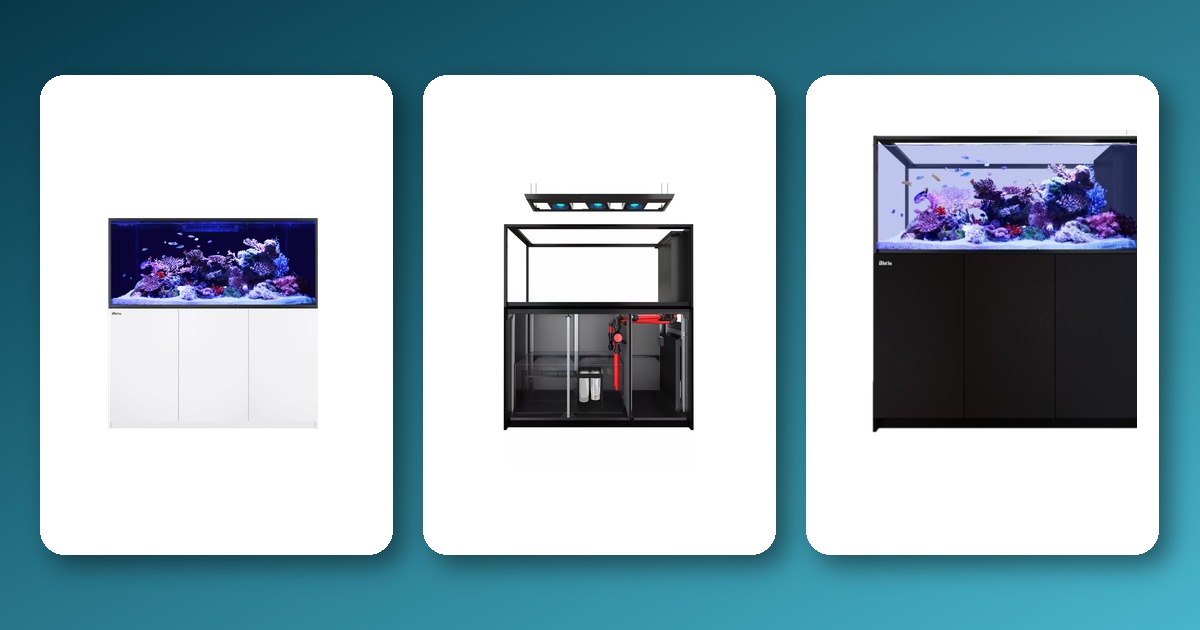
This is the filtration style behind IndieFur’s own Red Sea REEFER systems: all-in-one reef tanks that ship with a purpose-built sump integrated into the cabinet rather than requiring a separate DIY build. The REEFER S-700 G2+ Deluxe System and the REEFER G2+ S-700 Peninsula Deluxe are both real, current stock, genuine examples of sump-based filtration rather than a hypothetical setup.
Sumps are largely a marine and reef proposition. A freshwater community tank rarely needs the extra equipment room or the water-volume buffering, and the plumbing, overflow and drilling involved add cost and a real flood risk if a return line or overflow ever fails. Reserve a sump for a system where you are already running skimmers, reactors and dosing equipment that genuinely benefit from the extra space and stability.
When Each One Still Makes Sense
| Format | Best for | Avoid when |
|---|---|---|
| Sponge filter | Fry, shrimp tanks, quarantine/hospital tanks | You need real turnover on a heavily stocked display tank |
| Undergravel filter | Simple, low-tech freshwater community tank on coarse gravel, budget-first | Planted tanks, fine sand substrates, or anything you want to spot-clean rather than tear down |
| Sump | Marine and reef display tanks running skimmers, reactors, and dosing equipment | Freshwater tanks with no equipment load that would benefit from the extra room |
If none of these three descriptions match your setup, a canister filter, hang-on-back filter, or internal filter is almost certainly the better starting point: those three cover the vast majority of freshwater and reef tanks that don’t have one of the specific needs above.
Frequently Asked Questions
Can I run a sponge filter alongside a canister filter? Yes, and it is a common combination rather than a redundant one. Running a sponge filter in the same tank as a canister gives you extra biological capacity, a safe intake for any fry or shrimp in an otherwise adult-fish tank, and a ready-seeded sponge you can move to a hospital tank at short notice without disturbing the canister.
Are undergravel filters bad for planted tanks? Functionally, yes, for the substrate most planted tanks actually use. Root-feeding plants generally need a nutrient-rich, often fine-grained substrate, and pulling water constantly down through and around root systems works against both the plant roots and the anaerobic micro-zones some planted-tank methods rely on. A UGF is not the right filtration choice for a serious planted setup.
Do I need a sump for a small reef tank? Not necessarily. Many small and nano reef tanks run well on an internal or hang-on-back filter plus a compact protein skimmer, with no sump at all. A sump becomes worth the plumbing and cost once the equipment list grows (multiple reactors, dosing pumps, a larger skimmer) to the point where display-tank space and single-body water volume start working against stability.
Is a sponge filter enough on its own for a shrimp tank? For a lightly stocked shrimp-only tank, yes, and it is the standard recommendation precisely because of the intake safety already covered above. For a mixed shrimp-and-fish tank with a moderate bioload, a sponge filter is often paired with a second filter rather than run alone.