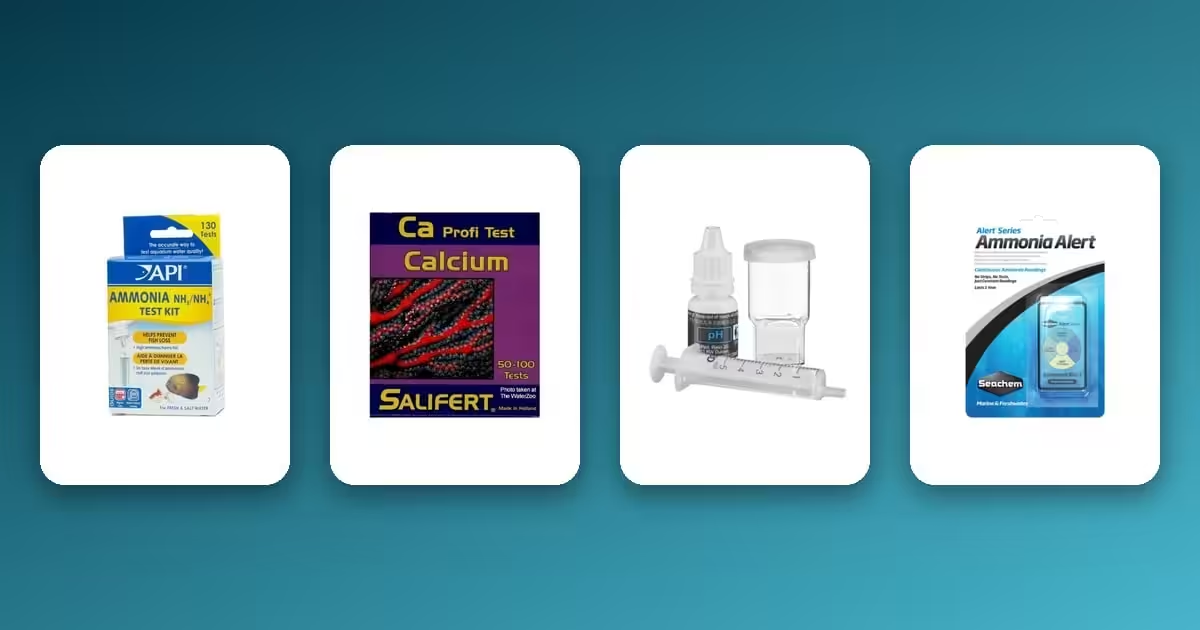
Before you medicate, know that this guide covers general freshwater fish disease treatment information and isn’t a substitute for a proper diagnosis of your specific fish. How a fish responds to treatment varies by species, size and water conditions. If your fish stops eating, is bleeding, or shows no improvement within 48 hours of starting treatment, stop and get species-specific advice before continuing. Always follow the dosage printed on your bottle’s physical label. The figures below are a starting reference sourced from the manufacturer, not a replacement for it. When in doubt, a quick consult with an aquatic veterinarian or fish-health specialist is worth it before you start any medication.
Catching disease early is half the battle
Freshwater fish disease treatment works best when it starts the moment something looks off, not once a single white spot has spread across the whole tank. Most freshwater fish diseases are far easier to treat in their earliest stages than after they’ve spread across a tank. Stress from poor water quality, temperature swings, overcrowding, or a recently added fish that wasn’t quarantined is almost always the underlying trigger, even when the visible symptom is a specific parasite or infection. If your tank’s temperature has been unstable, it’s worth reviewing our heater buying and setup guide. Consistent, stable temperature is one of the simplest ways to reduce disease-triggering stress in the first place. For general tank setup fundamentals, our complete aquarium guide is also a useful reference.
Use the table below as a first read on what you’re likely seeing, then jump to the matching section for the full treatment steps.
| What you’re seeing | Likely cause |
|---|---|
| Small white spots like grains of salt; fish flicking against décor | Ich (white spot); see below |
| Cotton-wool-like white or grey tufts on body, fins or mouth | Fungal infection; see below |
| Fraying, blackened or reddened fin edges receding toward the body | Fin rot (bacterial); see below |
| Gold or rust-coloured dust-like sheen, best seen under torchlight at an angle | Possibly velvet, not ich; check “Is it really ich?” below |
| Fish rubbing or scratching with no visible spots or marks | Could be a water-quality irritant rather than disease; see “Before you medicate” below |
Before you medicate: test your water first
Fin rot and fungal infections in particular are frequently a symptom of a water-quality problem rather than a standalone disease: treating the infection without fixing the cause usually means it comes back once the course finishes. Before reaching for medication:
- Test ammonia, nitrite and nitrate with a liquid test kit. Any ammonia or nitrite reading above 0 ppm in an established tank points to a cycling problem that needs fixing alongside, not instead of, treating the disease.
- Check your heater is holding a stable temperature: swings are a major stress trigger. See our heater guide if you’re not sure your current setup is adequate.
- Do a 25-30% water change with a water conditioner if parameters are off, before or alongside starting medication.
- For a true parasitic or fungal infection, medication is still needed even once water quality is corrected, but you’ll get a faster, more lasting recovery treating both at the same time rather than one after the other.
Is it really ich? Diseases that look alike
Several conditions get mistaken for each other, and treating the wrong one wastes your treatment window while the real problem keeps progressing. Check this table before starting a medication course.
| Condition | Appearance | Key difference |
|---|---|---|
| Ich (white spot) | Distinct, raised white dots, salt-grain sized | Spots are individually visible and raised, not a haze or film |
| Velvet | Fine gold or rust dusting, best seen under a torch held at an angle | Reads as a sheen rather than distinct spots; fish often clamp their fins and breathe rapidly |
| Epistylis | Fuzzy white or grey patches, often on the head or back | Patchier and less uniformly round than ich spots |
| Cotton or body fungus | Cotton-wool tufts, usually anchored at a wound or torn fin | Tufted, stringy texture rather than a spot or film |
| Columnaris | White or grey film, often starting at the mouth (“mouth fungus”) or as a saddle patch on the back | Spreads fast and is frequently mistaken for fungus, but is bacterial: needs an antibacterial, not a pure antifungal |
| Breeding tubercles | Small white bumps on the gill covers or head of some male fish (barbs, danios and similar) | Not a disease: symmetrical, doesn’t spread, no other symptoms present |
If you’re still not confident which one you’re looking at, DiscusX Bactocide 1 is a reasonable broad-spectrum starting point since it covers bacterial, protozoal and fungal causes at once. See “Choosing between treatments” further down this guide.
Ich (white spot disease)
Ich is one of the most recognisable freshwater diseases, appearing as small white spots resembling grains of salt scattered across the body and fins. Affected fish often flick or rub against decorations and substrate (“flashing”) as the parasite irritates the skin.
Why single-dose treatments fail
Ich has a life cycle where the visible parasite eventually drops off the fish to reproduce in the substrate before re-infecting the tank as a new wave of free-swimming parasites. A single dose only kills what’s on the fish at that moment; it does nothing to the next generation incubating in the substrate. That’s why the medication needs to be maintained across multiple days to catch newly hatched parasites as they emerge, and why stopping as soon as visible spots disappear is one of the most common reasons ich comes back within a week.
Treatment steps
- Remove carbon filtration media, since it will absorb the medication and reduce its effectiveness.
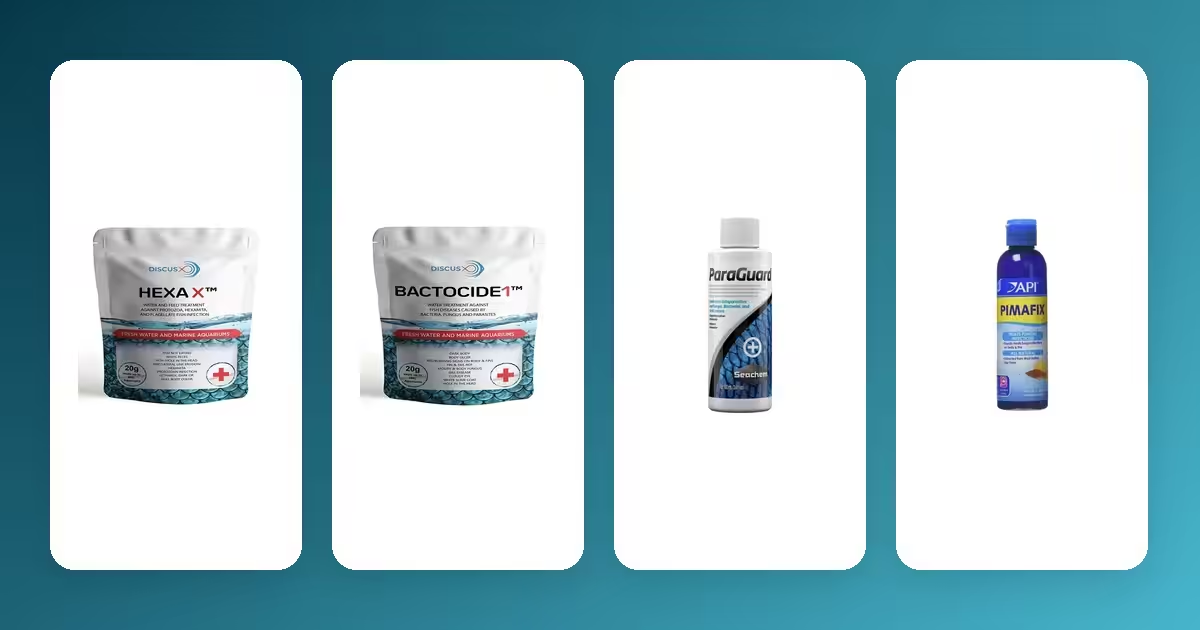
- DiscusX HexaX is formulated to treat protozoal and flagellate infections including whitespot (ich), Hexamita and Trichodinia. Per the manufacturer’s label: use one level measure of the included spoon (1 gram) per 20 US gallons (80 litres) of aquarium water.
- After 24 hours, do a 70-100% water change and re-dose the full amount for your total tank volume, not just the new water.
- Repeat daily for at least 6 days, up to 10 if spots are still visible. The manufacturer is explicit that stopping at the first sign of recovery risks re-infection.
- Optional, per the label: add 1-2 grams of aquarium salt per litre alongside HexaX, and raise temperature slightly within your fish species’ safe range, to speed up the parasite’s life cycle so the medication has more chances to interrupt it.
Fungal infections
Fungal infections typically appear as cotton-wool-like white or grey tufts on the body, fins, or around the mouth, often taking hold on fish that already have an open wound, torn fin, or are otherwise immune-compromised from stress or poor water quality. Because fungus is frequently secondary to another problem, treating the underlying cause, usually water quality, alongside the fungal treatment gives better long-term results than treating the fungus alone.
Malachite green was long the standard aquaculture treatment for fungal infections, but it’s carcinogenic and has been phased out of food-fish farming: Norway stopped permitting it for fish raised for human consumption in 2002. The Norwegian Veterinary Institute has been researching alternatives ever since, since nothing has fully matched its effectiveness. That history is part of why ornamental-fish products are now specific about dosing and species restrictions rather than treating it as a universal cure.
True fungus vs. columnaris
Not everything that looks like fungus is fungus. Columnaris (sometimes called “mouth fungus”) is bacterial, not fungal, and responds better to a product built for bacterial coverage. True fungus is stringy and cottony, usually anchored at a specific wound. Columnaris tends to spread as a flatter white or grey film, often starting at the mouth or as a saddle-shaped patch on the back, and can progress faster than true fungus. If you’re not sure which you’re looking at, a broad-spectrum product covering both bacterial and fungal causes is the safer starting choice.
Treatment steps
- Remove carbon filtration media.
- DiscusX Bactocide 1 covers bacterial, protozoal and fungal disease in one product, a reasonable first-line option when you’re seeing a combination of symptoms. Per the manufacturer’s label: use one level measure of the included spoon (1 gram) per 10 US gallons (40 litres) of water.
- After 24 hours, do a 70-100% water change and re-dose for your total tank volume. Repeat daily for at least 6 days, up to 10.
- Bactocide affects the biological filter, so the manufacturer recommends dosing in a separate hospital container where possible rather than the main display tank. See “Setting up a quarantine or hospital tank” below.
Fin rot and bacterial infections
Fin rot shows up as fraying, discoloured (often blackened or reddened) edges on the fins that progressively recede toward the body if untreated. It’s usually bacterial in origin and commonly triggered by poor water quality, overcrowding, or fin damage from aggressive tankmates.
Early vs. advanced fin rot
Caught early (a slight fray or a thin discoloured edge), fin rot often reverses with a water change and improved water quality alone, no medication needed. Once damage has progressed past the fin rays toward the body, or the edges look inflamed rather than simply frayed, water-quality fixes alone usually aren’t enough and a targeted antibacterial is needed.
Treatment steps
- Fix water quality first (see “Before you medicate” above); this alone resolves many mild cases.
- For established fin rot, Seachem ParaGuard treats external fungal, bacterial and parasitic lesions including fin rot. Per Seachem’s label: remove invertebrates and chemical filtration first, then use 5 mL (one capful) per 40 litres (10 US gallons), repeated daily as long as the fish shows no stress from the treatment itself.
- For a gentler, more natural option, particularly for sensitive species or as an early intervention, API Pimafix is a tea-tree-oil-based remedy long used for fin and tail rot and mouth fungus. Per the manufacturer’s label: dose 5 mL per 10 US gallons (38 litres), daily for 7 days, then do a 25% water change.
- Complete the full course even once fins stop receding; regrowth takes longer than the infection takes to stop spreading. Stopping early leaves the hardiest bacteria behind rather than clearing them: the Merck Veterinary Manual notes that antimicrobial use in general reduces the susceptible population but tends to leave a resistant one behind, which is exactly the population a partial course lets rebound.
Medication dosage and safety reference
All figures below are transcribed from each product’s own manufacturer label as listed on this site. Always check the physical label on your bottle before dosing, since formulations can be updated.
| Product | Treats | Dose | Course | Remove carbon? | Invertebrates |
|---|---|---|---|---|---|
|
DiscusX HexaX (20g) |
Ich, Hexamita, flagellate parasites | 1g per 80L (20 US gal) | Daily, 6-10 days minimum | Yes | Not stated by manufacturer; isolate shrimp/snails as a precaution |
|
DiscusX Bactocide 1 (20g) |
Bacterial, protozoal & fungal infections incl. columnaris | 1g per 40L (10 US gal) | Daily, 6-10 days minimum | Yes | Not stated by manufacturer; isolate shrimp/snails as a precaution |
|
Seachem ParaGuard (100ml) |
External fungal, bacterial & parasitic lesions incl. fin rot | 5mL per 40L (dip: 3mL per 4L, 1 hr) | Daily as needed while fish shows no stress | Yes (label says remove chemical filtration) | Label explicitly says remove all invertebrates before dosing |
|
API Pimafix (118ml) |
Fungal infections, fin/tail rot, mouth fungus | 5mL per 38L (10 US gal) | Daily for 7 days, then 25% water change | Manufacturer states it won’t harm biological filter | Manufacturer states it’s safe in reef aquariums; still isolate sensitive species as a precaution |
As an extra safety note, scaleless and thin-scaled species (loaches, some catfish, some tetras) are generally more sensitive to medication than typical scaled fish. Seachem’s own product page singles out eels, loaches, rays and sharks by name as especially sensitive. When in doubt, start at a partial dose and build up over several days, as the ParaGuard label itself recommends for sensitive fish. Never combine two full-dose medications at the same time without at least a partial water change and a gap between them. Keep aeration up during treatment, since both the disease and some medications can lower dissolved oxygen.
Setting up a quarantine or hospital tank
Treating in the main display tank medicates every fish, plant and beneficial-bacteria colony in the tank, whether they need it or not. DiscusX’s own instructions note Bactocide affects the biofilter and is better run in a separate container where possible. A simple hospital setup avoids that:
- A bare container or spare tank with no substrate, so leftover medication and waste are easy to see and remove; per DiscusX’s own guidance, an air stone for aeration and a heater if needed is really all it takes.
- A sponge filter rather than a carbon-based filter, since carbon strips medication out of the water.
- Match temperature to the main tank to avoid adding thermal stress on top of the illness.
- See our glossary entry on quarantine tanks for the full setup rationale. Seachem specifically recommends around 2 weeks of ParaGuard treatment during quarantine to clear possible external infections before a new fish joins the main tank.
- In India, a mid-summer power cut is a common reason a rushed hospital setup crashes on ammonia within a day; test ammonia daily for the first few days of use, especially if it isn’t already cycled.
Choosing between treatments
Work through these questions in order:
- Is it isolated to one fish, or tank-wide? One fish → use a hospital tank (see above) so you’re not medicating fish, plants and biofilter that don’t need it. Tank-wide → treat the display tank directly.
- Do you have shrimp, snails, or scaleless fish in the tank? If yes, isolate them before dosing, or lean toward the gentler API Pimafix and watch closely.
- Which symptom matches?
- Ich, protozoal & flagellate parasites: DiscusX HexaX, best when symptoms suggest whitespot (ich), Hexamita, or Trichodinia.
- Broad-spectrum bacterial, protozoal & fungal coverage: DiscusX Bactocide 1, best when you’re not entirely sure which infection you’re dealing with, or want one product covering multiple bases.
- Bacterial fin and tail issues: Seachem ParaGuard, best when fraying, reddened or receding fins are the clear primary symptom, alongside possible fungal or parasitic involvement.
- Gentle, natural first response: API Pimafix, best for mild fin damage or fungal patches, as a preventive after introducing new fish, or for species sensitive to stronger medications.
A full 6-10 day course of HexaX or Bactocide 1 is inexpensive enough to keep on hand before you need it, rather than sourcing it mid-outbreak when a fish is already stressed.
General treatment best practices
- Quarantine affected fish where possible, both to treat them more precisely and to prevent spreading disease to the main tank.
- Remove carbon filtration media before dosing most medications, since activated carbon will absorb the treatment and reduce its effectiveness.
- Follow the full treatment course even if symptoms appear to clear early; stopping early is one of the most common reasons for relapse, especially with ich.
- Maintain oxygenation during treatment, since some medications and the disease itself can reduce dissolved oxygen levels, and increase surface agitation or air stone use if fish appear to be gasping.
- Do a partial water change after completing treatment before returning to a normal maintenance schedule, to clear out residual medication.
Stop and consult a veterinarian if the fish stops eating and shows no interest in food after 2-3 days of treatment; there’s active, ongoing bleeding; breathing becomes rapid or laboured beyond what the disease itself would explain; or there’s no improvement at all after the full recommended course. These are signals a home guide like this one isn’t enough on its own.
Prevention is cheaper than treatment
The single most effective disease prevention step is quarantining every new fish for two to three weeks before adding it to an established tank, long enough to catch most incubating infections before they reach your main display. Combined with stable water parameters, consistent temperature, and not overcrowding your stocking, most freshwater disease outbreaks become rare rather than routine.
A 20g pack of DiscusX HexaX or Bactocide 1 covers a full treatment course and, stored correctly, lasts well beyond a single outbreak. Compare that to the cost of losing an established fish, or having to re-medicate an entire tank because an unquarantined new arrival introduced disease to fish that were otherwise healthy. Keeping a broad-spectrum treatment on hand is the cheaper outcome on every measure. Early intervention is consistently the difference between a quick recovery and a tank-wide outbreak.
Frequently asked questions
How long does freshwater fish disease treatment usually take?
Most bacterial, fungal and parasitic treatments on this page run 6-10 days per the manufacturer’s instructions. Stopping earlier, even if symptoms look resolved, is a common reason diseases like ich return within a week.
Can I treat multiple fish with different symptoms in the same tank at once?
If they’re in the same water, yes: dose for the dominant or most severe symptom using the broad-spectrum options above. Isolate any invertebrates or scaleless fish first.
Is it safe to medicate a planted tank?
API Pimafix is stated by the manufacturer not to harm live aquarium plants. DiscusX products don’t make the same claim: treating a heavily planted tank in a separate hospital container avoids the question entirely.
My fish looks sick but the water tests are all normal. What now?
Work through the “Is it really ich?” comparison above to narrow down the likely cause, then use the matching treatment section. If nothing matches or the fish stops eating, that’s a sign to get species-specific advice rather than guess further.
Do I need to treat the whole tank, or just the sick fish?
See “Choosing between treatments” above: isolating a single sick fish in a hospital tank is usually better when only one fish is affected, since it avoids medicating fish, plants and bacteria that don’t need it.
Will these medications harm my biological filter?
DiscusX Bactocide 1 is noted by the manufacturer to affect the bio-filter, which is why a hospital tank is recommended over the display tank where possible. HexaX, ParaGuard and Pimafix don’t carry the same warning, but removing carbon media and monitoring ammonia during any treatment course is good practice regardless.
Is it normal for fish to act stressed during treatment?
Some response is expected, but ParaGuard’s own label says to repeat dosing only “as long as fish show no stress.” If a fish is clearly struggling rather than just adjusting, stop dosing and do a water change.