Choosing a planted-tank fertilizer means comparing actual formulations: NPK content, dosing volume, and price per ml, not choosing a retailer. This guide compares five fertilizer brands sold for the Indian planted-tank market (Tropica, Seachem, Masterline, Easy Life, and 2HR Aquarist APT) on real specs sourced from manufacturer product pages, so you can match a product to your tank instead of a store to another store. Last updated August 2026.
A Note on Who Wrote This
This guide is published by IndieFur, which sells several of the fertilizers compared below (Tropica, Seachem, Easy Life, ISTA, and Aquavascular). We do not stock Masterline or 2HR Aquarist APT, and we’ve included them anyway because they’re genuinely relevant options; see the “Where Each Brand Is Honestly the Better Fit” section for cases where a product we don’t sell is the right call.
Why do planted aquariums need fertilizer?
Aquatic plants need nutrients for photosynthesis, tissue development, root growth, and overall health. Fish waste and substrate can provide some nutrients, but these sources rarely meet the needs of a densely planted aquarium on their own.
Plant nutrients fall into two groups. Macronutrients, meaning nitrogen, phosphorus, and potassium, are needed in comparatively larger quantities and drive growth, cellular processes, root development, and foliage health. Micronutrients, meaning iron, manganese, zinc, boron, and other trace elements, are needed in smaller quantities but are still essential. The actual requirement depends on plant species, tank size, lighting, substrate, CO₂ availability, and plant density, which is why choosing a fertilizer should start with understanding your tank rather than picking the most popular bottle.
Fertilizer brand comparison: NPK by product
The table below uses NPK figures published by each manufacturer (or, where IndieFur stocks the product, pulled directly from the product’s own listed guaranteed analysis). Where a manufacturer doesn’t publish an exact percentage, that’s stated rather than estimated. Current pricing is available on each product’s own page rather than repeated here, since it changes independently of this guide.
| Product | Brand | Type | N / P / K | Best for |
|---|---|---|---|---|
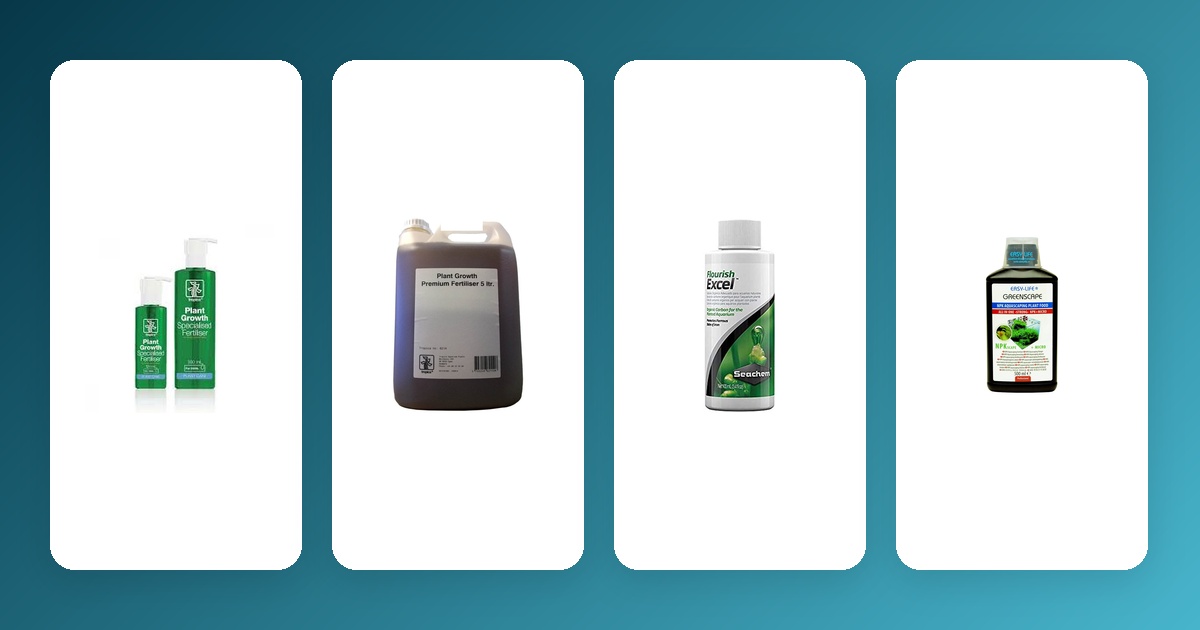
| Specialised Nutrition | Tropica | All-in-one liquid (with N & P) | N 1.3% / P 0.1% / K 1.0% | Heavily planted, lightly stocked tanks |
| Premium Fertiliser | Tropica | All-in-one liquid (N & P free) | 0% / 0% / trace K | Fish-heavy tanks with few or slow-growing plants |
| Flourish Excel | Seachem | Liquid carbon source | Not an NPK product (organic carbon) | Low-tech tanks without pressurized CO₂ |
| Flourish Nitrogen | Seachem | Single-nutrient liquid | N only | Targeted nitrogen dosing (Estimative Index-style routines) |
| Flourish Potassium | Seachem | Single-nutrient liquid | K 5.8% (as K₂O) | Targeted potassium dosing without adding N or P |
| GreenScape NPK+Micro | Easy Life | All-in-one liquid | Adds 20 mg/L NO₃, 2 mg/L PO₄, 13 mg/L K per 10 ml/50L dose | Densely planted, low-fish aquascapes |
| RedScape | Easy Life | All-in-one liquid, lower nitrate | Lower NO₃ than GreenScape by design | Bringing out red coloration without pushing nitrate up |
| Macro Elements | Aquavascular | All-in-one liquid | “Balanced NPK” (exact % not published) | Budget-conscious dosing for larger tanks |
| Water Plant Fertilizer | ISTA | All-in-one liquid | Not published as a % breakdown | Historically the lowest-cost all-in-one in this comparison; currently out of stock at IndieFur across all sizes |
| Masterline II | Masterline | Macro liquid | Contains N, P, K, Mg; exact % not published by the manufacturer | Hobbyists already running a Masterline dosing system (not currently sold in India by either retailer) |
| APT Complete (APT3) | 2HR Aquarist | All-in-one liquid | N 0.75% / P₂O₅ 0.69% / K₂O 4.52% | Medium-to-high-tech tanks wanting a single bottle (not currently sold in India; import/international only) |
Two gaps are worth being upfront about: Masterline doesn’t publish exact NPK percentages for its macro line anywhere we could find (product pages describe it only as “nitrogen, phosphorus, potassium and magnesium”), and neither Masterline nor 2HR Aquarist APT currently ship to India through IndieFur or, as far as we can tell, Back Water Aquatics, so there’s no reliable price to quote for either yet.
How we compared these fertilizers
We compared products on three factors: published NPK/nutrient content (from the manufacturer’s own listing wherever possible), dosing frequency and volume relative to tank size, and stated best-fit use case (fish-heavy vs. plant-heavy, low-tech vs. CO₂-injected). IndieFur sells several of the products in this comparison (Tropica, Seachem, Easy Life, ISTA, and Aquavascular), and that’s disclosed here rather than left implicit. Where a brand IndieFur doesn’t stock is the better fit for a given setup, we’ve said so directly rather than routing around it.
Root tabs vs. liquid fertilizer: which does your tank need?
The right format depends on how your plants actually feed, not on which one sounds more “complete.”
Liquid fertilizers add nutrients to the water column and suit plants that absorb through their leaves and the surrounding water: stem plants, mosses, floating plants, epiphytes (Anubias, Java Fern, Bucephalandra), and densely planted aquascapes generally.
Root-based products, like Seachem Flourish Tabs, sit in or near the substrate and feed root-feeding species directly. Flourish Tabs are currently out of stock on IndieFur at time of writing; check the product page for current availability before planning a routine around them.
| Plant type common in Indian aquascaping | Feeds primarily through | Fertilizer format |
|---|---|---|
| Cryptocoryne species | Roots | Root tabs or nutrient-rich substrate |
| Vallisneria | Roots and leaves | Root tabs plus light liquid dosing |
| Java Fern | Leaves (rhizome, not roots) | Liquid/water-column fertilizer only; do not bury the rhizome in root tabs |
| Anubias | Leaves (rhizome, not roots) | Liquid/water-column fertilizer only |
| Stem plants (Rotala, Ludwigia, Hygrophila) | Leaves and water column | Liquid, dosed regularly |
Neither format is universally better; many aquascapes use both, root tabs for the substrate feeders and liquid dosing for everything drawing from the water column.
Dosing schedule by tank size (in liters)
Scaling manufacturer-stated dosing rates to common Indian tank sizes, using each product’s own published ratio:
| Tank size | Tropica Specialised/Premium (6 ml/50L/week) | Easy Life GreenScape (10 ml/50L/week) | Seachem Flourish Potassium (5 ml/125L, 2-3x/week) |
|---|---|---|---|
| 20 L (nano) | ~2.4 ml/week | ~4 ml/week | ~0.8 ml, 2-3x/week |
| 50 L | 6 ml/week | 10 ml/week | ~2 ml, 2-3x/week |
| 100 L | 12 ml/week | 20 ml/week | ~4 ml, 2-3x/week |
| 200 L | 24 ml/week | 40 ml/week | ~8 ml, 2-3x/week |
| 300 L | 36 ml/week | 60 ml/week | ~12 ml, 2-3x/week |
These are starting points scaled directly from each manufacturer’s own dosing instructions, not universal rules. Treat them as a baseline and adjust based on plant response, exactly as each label recommends.
How to choose the right fertilizer for your tank
Work through these in order:
- Whether you’re running pressurized CO₂ matters a lot: without it, plants can’t use nutrients as fast, so a lighter-dosing or carbon-supplement product like Flourish Excel fits better than a heavy NPK line like GreenScape. Browse CO2 kits for planted tanks if you’re deciding whether to add pressurized CO₂ first.
- Light level matters too: high light drives faster growth and higher nutrient demand, while low light needs less, and over-dosing under low light is a common cause of algae.
- Plant density and type play a role as well: a few slow-growing plants in a fish-heavy tank (Tropica Premium’s use case) needs less, and different N-P-K, than a dense aquascape with fast stem growth (GreenScape/Specialised territory).
- Fish load matters too: more fish means more ambient nitrogen from waste already, so a nitrogen-free product (Tropica Premium, Flourish Excel) avoids compounding it.
Avoiding over-fertilizing (and reading algae as a warning sign)
More fertilizer is not automatically better. Adding excess nutrients without matching lighting, plant demand, and CO₂ availability can push a tank out of balance. If algae appears after changing your fertilizer routine, don’t immediately increase or decrease dosage in isolation. Review lighting duration and intensity, CO₂ availability, water parameters, plant density, water-change schedule, substrate, and fertilizer dosage together. Healthy plant growth depends on the balance between all of these, not fertilizer dosage alone.
Where each brand is honestly the better fit
No single brand wins every scenario:
- Masterline is the right choice if you’re already running a Masterline dosing system from a previous tank, or specifically want separate Masterline 1 (micro) and Masterline 2 (macro) bottles for independent control. As of this writing you’ll need to source it through an importer, since neither IndieFur nor Back Water Aquatics currently stocks it with Indian pricing.
- 2HR Aquarist APT is the right choice if you want a single, calibrated-pump bottle with a well-documented dosing system and don’t mind sourcing it internationally. Its solid K₂O content (4.52%) suits medium-to-high-tech tanks well, but again, it’s not currently available through an Indian retailer with local pricing.
- ISTA Water Plant Fertilizer is the right choice if price is your main constraint. It has historically been the least expensive all-in-one liquid in this comparison, though all bottle sizes are currently out of stock at IndieFur, so check back for availability.
- Easy Life GreenScape/RedScape is the right choice if you want a fully-specified dosing table (mg/L per dose is printed on the product page) and a heavily planted, low-fish tank.
- Tropica Premium or Seachem’s single-nutrient Flourish line is the right choice if your tank is fish-heavy and you specifically need to avoid adding more nitrogen or phosphorus.
Verdict: which fertilizer fits your setup
If price is your main constraint: ISTA Water Plant Fertilizer historically ran the lowest cost per ml among these, though it’s currently out of stock at IndieFur across all sizes. If you want a fully-documented, mg/L-labeled dosing table: Easy Life GreenScape or RedScape. If your tank is fish-heavy with light planting: Tropica Premium or a nitrogen-free Seachem Flourish line. If your tank is densely planted with light fish load: Tropica Specialised or Easy Life GreenScape. If you already run a Masterline or 2HR Aquarist system, or want to evaluate them, they remain genuinely worth considering, just budget for import sourcing since neither is stocked with Indian pricing by IndieFur or, as far as we’ve found, Back Water Aquatics. You can shop the full range of planted-aquarium fertilizers to compare current stock and pricing directly.
Frequently asked questions
Which aquarium fertilizer is best in 2026?
There’s no single best fertilizer. The right choice depends on plant species, lighting, CO₂ availability, fish load, and water conditions. Use the comparison table above to match NPK content to your setup, and check current pricing on each product’s own page.
Is this comparison biased since IndieFur sells some of these products?
We sell Tropica, Seachem, Easy Life, ISTA, and Aquavascular products, which is disclosed above. We don’t sell Masterline or 2HR Aquarist APT and included both anyway, with an honest note on where each is the better choice.
Do I need fertilizer if I don’t use CO₂?
Often yes, but at a lower dose. Low-tech tanks still benefit from micronutrients and, in many cases, a liquid carbon source like Flourish Excel, dosed more conservatively than in a CO₂-injected tank.
Is fertilizer safe for shrimp tanks?
Copper is the main concern for shrimp. Check a product’s ingredient list for added copper before dosing a shrimp tank, and dose conservatively regardless of brand.
How much fertilizer does a 20-liter nano tank need?
Scaled from manufacturer dosing rates: roughly 2.4 ml/week of Tropica Specialised/Premium, or about 4 ml/week of Easy Life GreenScape. See the dosing table above, and treat it as a starting point to adjust from.
Can too much fertilizer cause algae?
An unbalanced tank can develop algae, but fertilizer alone isn’t usually the sole cause. Lighting, CO₂, nutrients, water quality, and maintenance all play a role together.
Should beginners choose an all-in-one or separate macro/micro fertilizers?
Beginners often find an all-in-one formulation (Tropica, GreenScape, RedScape) simpler to manage. Separate macro/micro dosing (Seachem’s individual Flourish line) gives more precise control but requires more attention to avoid imbalance.
What’s the difference between GreenScape and RedScape?
RedScape carries less nitrate than GreenScape by design, which helps bring out red plant coloration; Easy Life recommends GreenScape for normal use with occasional RedScape dosing for red effects.
Do root tabs replace liquid fertilizer?
No. Root tabs feed root-absorbing species like Cryptocoryne and Vallisneria, while rhizome plants like Anubias and Java Fern feed through their leaves and need liquid/water-column dosing instead. Most aquascapes benefit from both.
About this guide
This guide was compiled and reviewed for accuracy by the IndieFur content team, using NPK and dosing figures published directly on manufacturer and retailer product pages for Tropica, Seachem, Easy Life, Aquavascular, and ISTA, plus published third-party guaranteed-analysis data for Masterline and 2HR Aquarist APT products not currently stocked in India. It is general information; always confirm current pricing, stock, and dosing instructions on the product’s own label before dosing your tank. Last updated August 2026.