Why water movement matters as much as filtration
It’s easy to assume that once a tank has a good filter running, water movement is taken care of. In practice, filtration and circulation are two different jobs. A canister or external filter moves water through media to clean it, but it often can’t generate enough broad, even flow to reach every corner of a large or heavily aquascaped tank. A dedicated submersible pump fills that gap, eliminating dead spots, keeping detritus in suspension until it reaches the filter intake, and, in reef and planted tanks, delivering the flow that corals and plants need to actually thrive rather than just survive. If you haven’t finalized your core equipment yet, our complete aquarium setup guide covers the basics before you get into flow-specific gear.
Plan and shop
Setting up a marine tank? Choose fish only, soft coral and LPS, or SPS reef. The equipment list for your tank size follows.
Pump or wave maker: which one are you shopping for?
A submersible pump pushes water from one place to another, usually through the tank or between the tank and a sump. A wave maker is a smaller motor that stirs water where it sits. Some people point a pump at the glass and pulse it from a controller, and that works. Others run a pump for turnover and add a wave maker for surface and mid-water movement.
Here is a simple way to choose. If water has to travel, to or from a sump, up a return line, or along a long tank, you want a pump. If you only need to break up still pockets and make the tank feel alive, a wave maker is usually enough. Big reef tanks end up with both.
Flow rate: matching pump output to tank volume
Submersible pumps are rated in litres per hour (LPH), and the right output depends heavily on what you’re keeping:
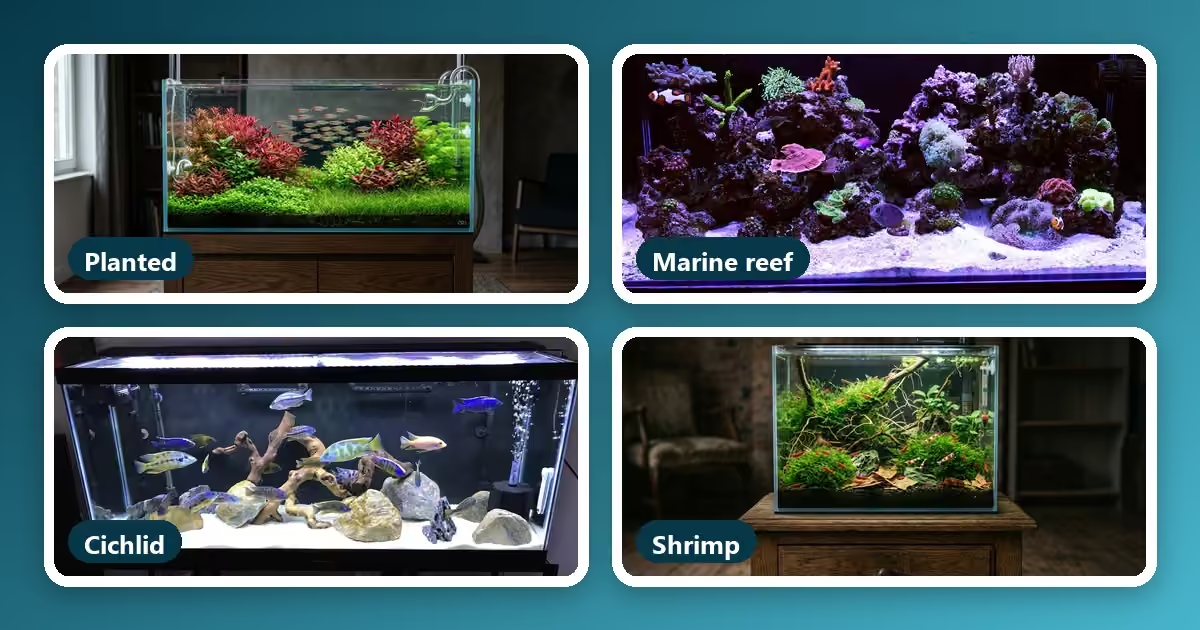
- In freshwater community tanks, a gentle turnover of roughly 4-6x the tank volume per hour is usually enough to keep water moving without stressing slow-swimming fish or disturbing planted substrate.
- In planted tanks, moderate flow in the 6-10x range helps distribute CO2 and fertilizers evenly across the tank, preventing dead zones where plants receive neither.
- Reef and marine tanks often need much higher flow for corals, commonly 10-20x turnover or more, since many species rely on turbulent, randomized water movement to feed and to prevent detritus from settling on their tissue.
Pump Flow Rate Calculator
Enter your tank size and setup type for a suggested flow rate, using the same turnover multipliers covered above.
A high-output pump like the Sicce Syncra SDC Pump 9.0 is built for larger reef and marine setups where high, adjustable turnover is a requirement rather than a nice-to-have. Its DC drive and ContrALL app control also allow fine-tuning flow patterns without opening the hood or reaching into the sump.
How to read pump specs
The number on the box is the maximum flow at zero head. That means a pump sitting in open water with nothing to push against. Once you add tubing, a climb up to a return nozzle, or water rising from a sump, the real output drops, sometimes by a lot. Head height is the vertical distance the water has to climb, and every bend, valve and narrow fitting adds resistance on top of that.
If your pump sits inside the tank and blows water around, the rated flow is close to what you get. If it feeds a sump return, find the maker’s flow chart for your head height and buy using that figure instead of the headline one. Check the tubing or nozzle size the pump expects too. Squeezing a big pump through a small outlet wastes power and adds noise.
Look at how the pump mounts, whether that is suction cups, a magnet or a bracket. Check the cable length before you buy.
DC vs AC pumps: why controllability matters
Older-style AC pumps typically run at a single fixed speed: you get one flow rate, full stop or full on. Modern DC-driven pumps, by contrast, let you adjust speed across a wide range, and many support programmable modes such as pulsing, wave patterns, or feeding-mode pauses that temporarily cut flow so food doesn’t get blasted around the tank during feeding time. The Sicce Syncra SDC Pump 9.0 is an example of this DC category, with high maximum output and the flexibility to dial flow down for smaller systems or quieter operation when full power isn’t needed.
Sizing down: mid-range and compact options
Not every tank needs a pump capable of pushing thousands of litres per hour. For smaller reef tanks, nano setups, or as a secondary circulation pump alongside a larger main pump, a mid-range model such as the Sicce Syncra SDC Pump 7.0 offers strong flow without the size, noise, or power draw of a full-size unit. For even smaller tanks or as a third point of circulation to eliminate a specific dead spot, the Sicce Syncra SDC Pump 6.0 is worth considering, since running two or three smaller pumps at different points in the tank often creates more natural, randomized flow than a single large pump blasting from one direction. To size a wave maker by tank length, see our wave maker guide, which has a table of the tank sizes each maker lists.
Single large pump vs multiple smaller pumps
This is one of the most common questions when planning flow for a reef or heavily planted tank. Both approaches work, but they solve slightly different problems:
- A single large pump is simpler to install, cable, and maintain, and is usually enough for softer coral or fish-only setups that don’t demand highly randomized turbulence.
- Multiple smaller pumps placed at different points and angles create the chaotic, multidirectional flow that stony corals and demanding plant carpets respond to best, and they also provide redundancy: if one pump fails, you still have circulation rather than a completely still tank.
A practical middle ground many hobbyists use is one primary high-output pump (like the Syncra 9.0) for bulk turnover, supplemented by one or two smaller pumps (like the Syncra 7.0 or 6.0) placed to eliminate specific dead spots behind rockwork or dense plant growth.
Installation and placement tips
- Avoid pointing pumps directly at each other at full force, which can create a “dead zone” where opposing flows cancel out rather than mixing.
- For randomized turbulence in reef tanks, angle pumps slightly off-axis from the glass and from each other rather than in straight parallel lines.
- Keep pumps clear of substrate and any loose debris, since drawing in fine gravel or sand can damage the impeller over time.
- Use a controller or app where available, as with DC pumps, to set feeding-mode pauses, reducing flow briefly at feeding time so food remains available to fish and corals rather than being swept into overflow or filter intakes.
- Check impellers periodically for calcium buildup in marine tanks or algae growth in freshwater tanks. A partially blocked impeller reduces output and shortens motor life.
Noise, heat and keeping your pump running well
Cutting down noise
The mount causes most pump noise. A pump pressed straight against glass will hum through the whole tank. Use the rubber pads or suction cups that come with it, and leave a small gap where you can. If you hear rattling, check for a loose impeller cover or a stray snail shell inside the housing. A gurgling sound usually means air is being pulled in near the surface, so keep the intake fully under water.
Heat from the pump
Every pump adds a little heat to the water. A large pump running all day in a small tank can warm it noticeably, particularly if your room is already hot. A pump you can turn down helps here, since you are not running flow you do not need. Watch the thermometer for a few days after fitting a new one.
Cleaning routine
Every month or two, switch the pump off, lift it out and take the impeller apart as the maker shows. Rinse the parts in clean water and use a soft brush on any algae. Never wash them in soap or household cleaners. For hard calcium crust in marine tanks, check what the maker says about descaling before you use any cleaning solution, and rinse every part very thoroughly so no residue goes back into the tank. Look at the rubber ring or shaft for wear while it is apart, and replace anything cracked.
Power cuts
When the pump stops, the water stops moving, and the surface agitation that lets oxygen in and gas out stops with it. A heavily stocked tank can run short of oxygen faster than you expect. If outages are common where you live, keep a battery-run air pump ready, since it keeps the water surface disturbed and puts air into the tank even when mains power is gone.
Common questions about submersible pumps
Can I run a pump all day and night?
Yes, aquarium pumps are made to run continuously. Keep enough surface movement going so oxygen exchange does not suffer.
Will too much flow hurt my fish?
It can. If fish are constantly fighting the current, hiding in corners or looking worn out, the flow is too strong for them. Turn the pump down, or redirect it at the glass or a rock to soften the push.
Can a submersible pump run dry?
It should not. Running dry can damage the impeller and burn out the motor quickly. After a big water change, or when evaporation drops the level, make sure the pump is fully covered before you plug it back in.
Quick reference: matching pump to setup
| Setup Type | Suggested Turnover | Pump Type |
|---|---|---|
| Freshwater community tank | 4-6x volume/hour | Compact circulation pump |
| Planted tank (CO2 injected) | 6-10x volume/hour | Mid-range DC pump for even distribution |
| Small-to-medium reef tank | 10-15x volume/hour | Sicce Syncra SDC 6.0-7.0 (single or paired) |
| Large reef/marine tank | 15-20x+ volume/hour | Sicce Syncra SDC 9.0 |
Getting flow right is an iterative process. Start with manufacturer turnover guidelines, observe how detritus settles and how your fish or corals respond, then adjust pump placement and output accordingly. A tank with well-matched circulation stays cleaner, keeps oxygen levels higher, and gives both fish and corals the healthy, natural water movement they’d experience in the wild.