A small tank looks easy because there is so little water to look after. That is also why it goes wrong first. Ten litres of water takes in a fish’s waste or a hot afternoon far faster than a 100 litre tank does.
A betta needs about 20 litres. Beyond that, how many fish fit comes down to how big they grow and whether they need a school.
Why small tanks swing
Every fish makes ammonia. In a big tank that ammonia is spread through a lot of water, and the filter bacteria have time to catch up with it before the fish notice anything wrong. In a 10 litre tank the same fish pushes the reading up within a day, which is fast.
Temperature moves quickly as well. A small tank on a balcony shelf can lose several degrees overnight in a north Indian winter and gain them again by afternoon in summer. Fish cope with a steady temperature much better than with a swing.
Delhi summers are too hot. Room temperatures with no AC reach 35 degrees easily, so you need a fan or a chiller to keep the tank in the range your fish want. In winter, around mid November is when the heaters start kicking in, since night room temperature starts going below 20 degrees.
Rough guide by tank size
Treat these as starting points for a cycled, filtered, planted tank.
| Tank volume | What fits | What to skip |
|---|---|---|
| 10 litres | A small shrimp colony, a few snails | Betta, any fish that needs a school |
| 20 litres | One betta, or 8 to 10 chilli rasbora | Guppies in numbers, rummy nose rasbora |
| 40 litres | One betta with snails or shrimp, or a school of 8 to 10 small tetras or rasbora | Mixing male guppies with a betta |
| 55 litres | One betta with a school of 8 small peaceful fish, or a guppy group | Fish that grow past 6 cm |
The old rule of one centimetre of fish per litre falls over quickly. It ignores how much the fish eats and whether it needs company. A 5 cm rummy nose rasbora and a 5 cm goldfish are not the same load on a filter.
It depends on the species, but you can start with a single schooling species, 8 fish. Fish that grow to 4 cm and above need at least 40 litres. Fish that grow to 2 cm at most can be kept in 20 litres.
The betta question
A single betta needs about 20 litres to do well. Hobbyists commonly give 19 litres, which is 5 US gallons, as the floor. A bowl or a 5 litre jar will keep one alive for a while, but not healthy.
What a betta needs beyond water volume:
- A heater. Bettas are tropical fish and do well at 26 to 28 °C. The heater matters mostly in winter.
- A gentle filter. Long fins and strong flow do not mix. A sponge filter or a hang-on filter with the outflow baffled works, and the filter sizing guide covers how much flow a tank needs.
- A lid. Bettas jump, and they breathe from the surface, so the lid should leave a layer of warm air above the water.
- Plants. Soft leaves to rest on keep them calmer than bare glass.
For a 20 to 40 litre tank, a 100 watt heater is about right. Our heater sizing guide has the wattage by tank size. The Fluval E Heater 100 Watt is a common pick for tanks this size.
I suggest a minimum of 20 litres for a betta. If you want to keep a fish in a bowl or a 5 litre jar, think how you would feel living in a 6 x 6 room with the bed, the kitchen and everything else crammed into that space.
Schooling fish need a school
People often suggest rummy nose rasbora for 15 litre tanks. They reach about 5 cm and swim hard in a tight group, and they are fussy about water quality. Six of them need a long tank of 60 litres or more.
Chilli rasbora are the better fit for a small tank. They stay around 2 cm and a group of 8 to 10 is comfortable in 20 litres. A group fills the tank with movement and comes out into the open, while a pair spends most of the day hiding behind the plants.
A school of two is not a school. If the tank only has room for two or three of a species that needs eight, pick a different species.
Cycle the tank before the fish
New tanks have no bacteria to process ammonia. Until they grow, ammonia and then nitrite climb and the fish suffer. Cycling takes 3 to 6 weeks. The filtration guide explains what is happening in the filter.
Set the tank up and treat the tap water with a conditioner such as Seachem Prime 100 ml. Our water conditioner guide compares the types. Then add a source of ammonia and test every few days. The API Ammonia Test Kit reads ammonia, the first number to watch. You are ready when ammonia and nitrite both read zero and there is some nitrate.
Early deaths in a new tank are often a cycle problem.
Add fish slowly
Even in a cycled tank, put in a few fish and wait a week or two before adding more. The bacteria grow to match the waste, so a sudden jump in fish outruns them, and the first sign is usually a reading above zero on the next test. Test after each addition.
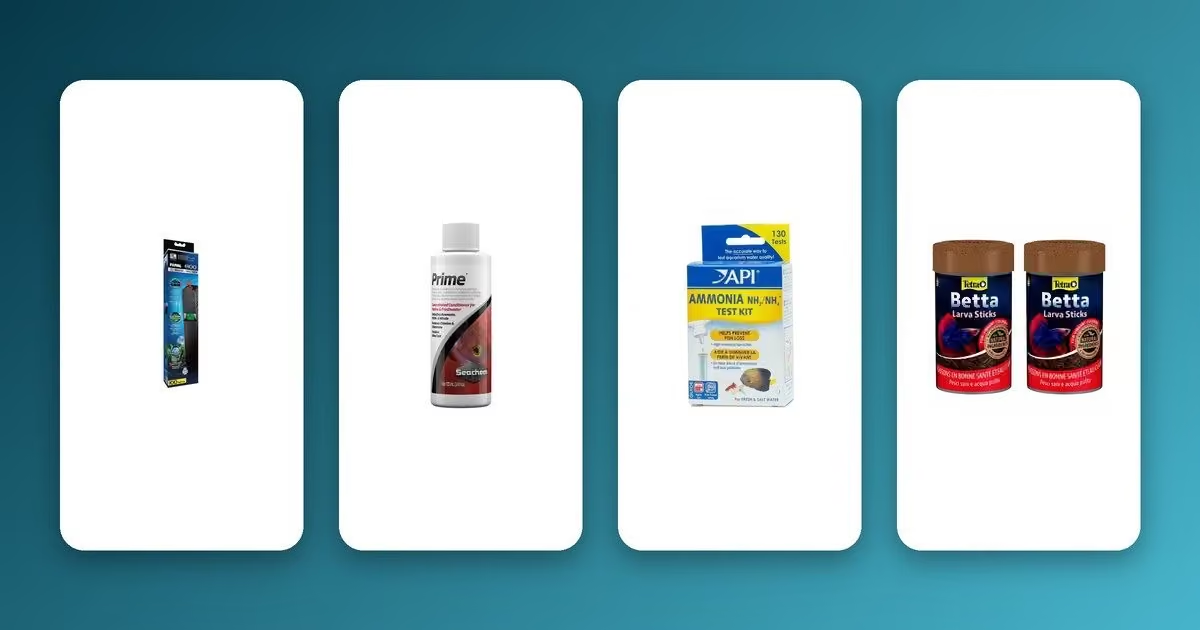
Feed small amounts. Betta pellets such as Tetra Betta Larva Sticks float, so you can see what is left and remove it. Two or three pellets, twice a day, is enough for one betta.
Signs you have too many fish
- Ammonia or nitrite reads above zero in a cycled tank.
- Water goes cloudy again a few days after a water change.
- Fish gasp at the surface in the morning.
- Plants and glass need cleaning every few days.
The usual response is more water changes, and a small tank takes 25 to 30 percent weekly without stress. If it still will not hold, rehome some fish.
Mistakes and lessons
The most common mistake we see is buying a tank based on the space available at home, then stocking it without thinking about the space those fish need. Just because it would look beautiful together does not mean the fish will stay healthy and happy crammed up.
If you lose a fish in a small tank, always look for the reason. Was it temperature, pH, ammonia or something else? The answer helps you not repeat the mistake.
The aquarium setup planner lists the equipment for each tank size.