Fish do not need special lighting. Plants do. If you keep live plants, the light over your tank decides whether they grow, stall or melt away, and whether algae gets an easy win. Below is what a planted tank asks of its light, so you can match a light to your plants and your tank instead of buying the brightest one on the shelf.
Do you need special lights for a planted aquarium?
Usually yes, but “special” mostly means three things: the right spectrum, enough usable light at the depth of your plants, and a fixture sized to your tank. A basic light that shows fish well may keep hardy plants alive, but it often gives weak growth, leggy stems and pale leaves. A light made for planted tanks is tuned to the colours plants use for photosynthesis, and it is built to cover the tank evenly.
Start with your plants, not the tank
Plants fall roughly into low, medium and high light groups, and this matters more than the size of your tank.
- Low light: anubias, java fern and cryptocoryne. They grow slowly, do well under moderate output, and mostly run into algae problems when the light is too strong.
- Medium light: many stem plants, vallisneria and swords. They want steady light and often benefit from fertiliser.
- High light: carpeting plants such as dwarf hairgrass, Monte Carlo and HC Cuba, and many red stem plants. They need strong, even light, and they usually need CO2 and regular feeding to keep up with it.
Pick the group first. A strong light over a tank of anubias is wasted, and a gentle light over a carpet will leave it thin and patchy.
Spectrum: what plants use
Plants use mainly red and blue light. A planted-tank fixture usually adds those channels to a balanced white, so the plants get what they need and the water still looks natural to your eye. A plain white light can grow plants too, but it often needs more output to deliver the same usable light. Very pink or purple lights make plants look vivid in photos, but a natural white is easier to judge plant health by.
Brightness: PAR matters more than watts
Wattage tells you how much electricity a light uses. It does not tell you how much light reaches your plants. The measure that does is PAR (photosynthetically active radiation), and it drops quickly as the water gets deeper. A shallow nano tank and a tall 60 cm tank need very different lights to give the plants on the bottom the same amount of usable light. Our glossary page on PAR in aquarium lighting explains how it is measured. When a manufacturer publishes PAR figures at a stated depth, use those over the wattage.
Light, CO2 and nutrients work as a set
Stronger light makes plants want more of everything else. Raise the light without extra CO2 and fertiliser and the plants cannot use it, and algae takes the surplus. That is why stronger lights are usually paired with CO2 injection and regular feeding. If you are not ready for CO2, pair a moderate light with slow-growing low-light plants. Our CO2 and aquascaping equipment guide walks through the equipment if you decide to add it later. Our planted aquarium fertilizer buying guide goes through the main brands one at a time.
How long to run the light
A fixed schedule of around 6 to 8 hours a day on a timer is a sensible starting point for most planted tanks. Longer hours do not make plants grow faster once they have all the light they can use. They mostly give algae more time to compete. Start at the short end, add time slowly, and change one thing at a time so you can see what helped. Some keepers add a midday break of a few hours (a siesta) when algae shows up despite good water quality.
Nano planted tanks
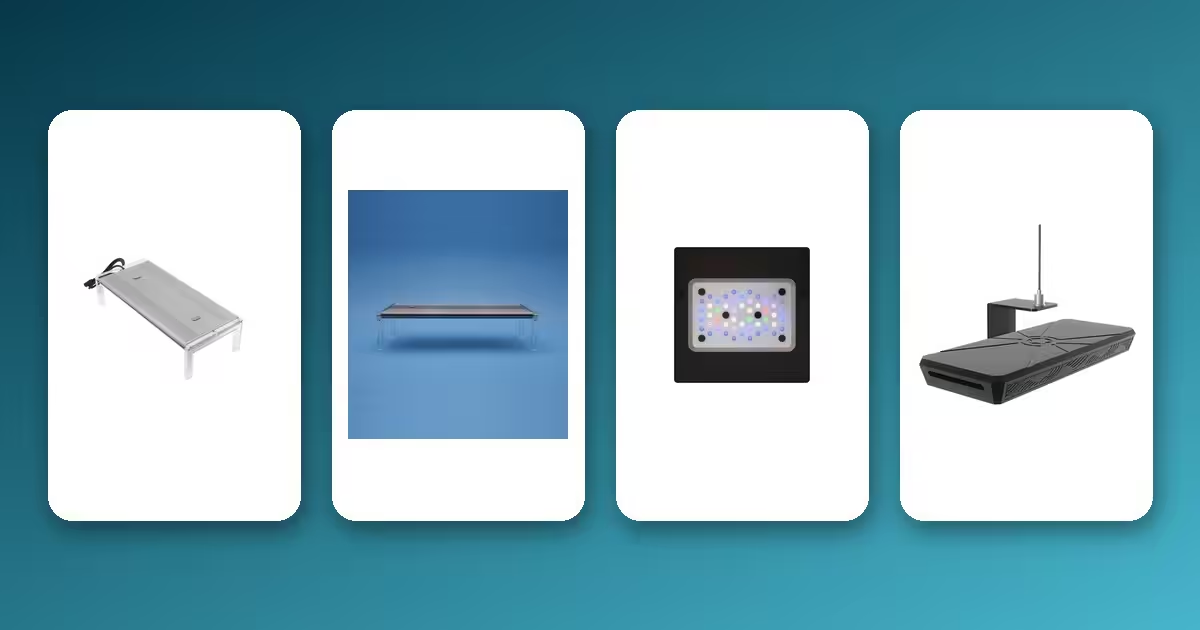
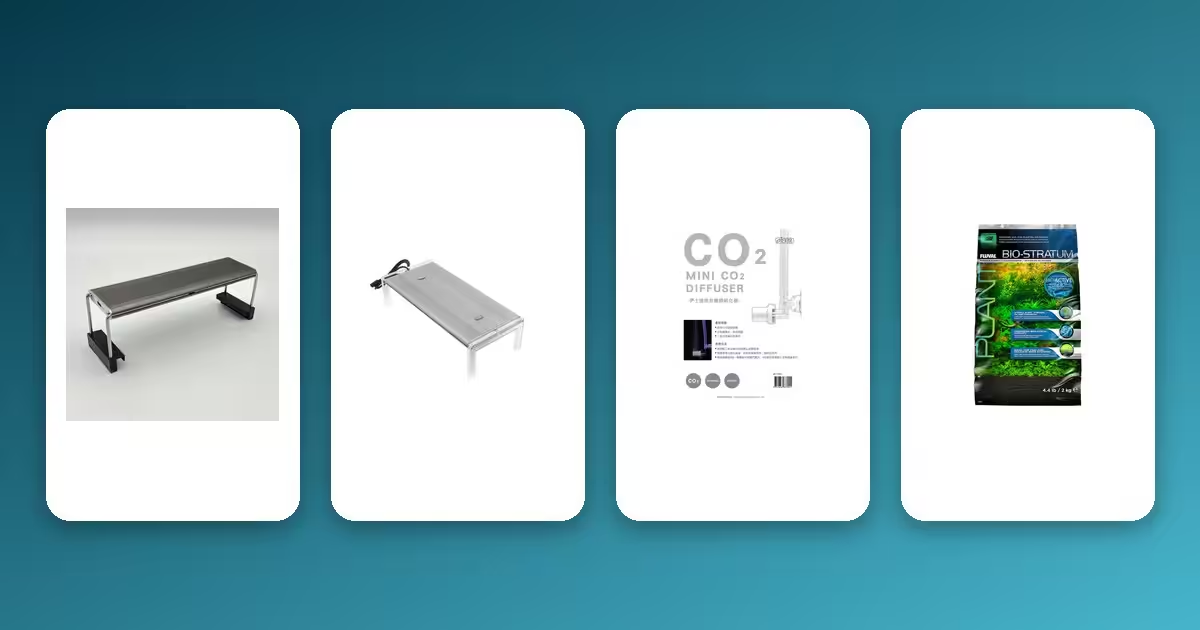
Small tanks are harder to keep stable. A small volume of water changes quickly, so a light that is slightly too strong or too long can bring algae fast. Pick a compact light sized for small tanks and keep the photoperiod on the shorter side. The NuniQ E Line 20E is a full-spectrum light aimed at small tanks and nano aquascapes. For a slightly larger tank, the NuniQ M Line 60M is a full-spectrum RGB light with silent passive cooling, built for aquariums from 30 cm to 150 cm. Both are part of our planted aquarium lights category, where you can match a fitting to your tank length.
Match the fixture to the tank
Match the light’s length to your tank so it spreads evenly, and check how it mounts: on the rim, on a hanging kit or on a lid. A light that is too short leaves dim corners where plants struggle. If you plan to keep high-light plants, leave room to raise or dim the fixture, since that gives you a way to adjust later without buying again.
The rest of the planted setup
Light is one part of the system. Plants also need something to root in and a source of carbon. A nutrient-rich soil such as Fluval Bio-Stratum, a natural volcanic soil infused with nitrifying bacteria, or an inert, porous gravel such as Seachem Flourite, supports root growth. For CO2 in a small tank, the compact ISTA Mini CO2 Diffuser is one option. You can see more choices in our planted aquarium substrate category. If you are still deciding on a layout, the Aquascaping Styles guide shows what each style asks of its light, and our wider aquarium lighting guide covers LED types and marine tanks.
Common problems and what they usually mean
- Algae on glass, leaves or hardscape: too much light, too many hours, or light running ahead of CO2 and nutrients. Shorten the photoperiod first.
- Tall, thin stems reaching for the surface: not enough light reaching that depth. Check the fixture against the tank depth.
- Pale new leaves or slow growth: weak light, or missing nutrients. Look at both.
- Plants melting after a change: a new light, a new tank or a sudden jump in output. Some plants drop leaves while they adjust. Change the light in small steps.
FAQ
Do I need special lights for a planted aquarium?
For anything beyond hardy low-light plants, a light made for planted tanks is the better choice. It supplies the colours plants use and covers the tank evenly.
What lighting do I need for a planted aquarium?
Choose by plant group (low, medium or high light), then by tank length and depth. Use PAR figures where the maker publishes them.
How do I light a planted aquarium?
Fit a light sized to the tank, put it on a timer for about 6 to 8 hours a day, and adjust slowly while watching plant growth and algae.
Is LED light enough for aquarium plants?
Yes. A good LED made for planted tanks can grow plants well. What matters is the spectrum and how much usable light reaches the plants, not the lamp type.
What is the best light for a nano planted tank?
A compact, full-spectrum light sized for a small tank, run for a shorter photoperiod. Small tanks react quickly to too much light.
Can I use a household bulb?
A household bulb is not rated for the humidity around a tank and does not give plants the light they use. Use a fitting designed for aquariums.