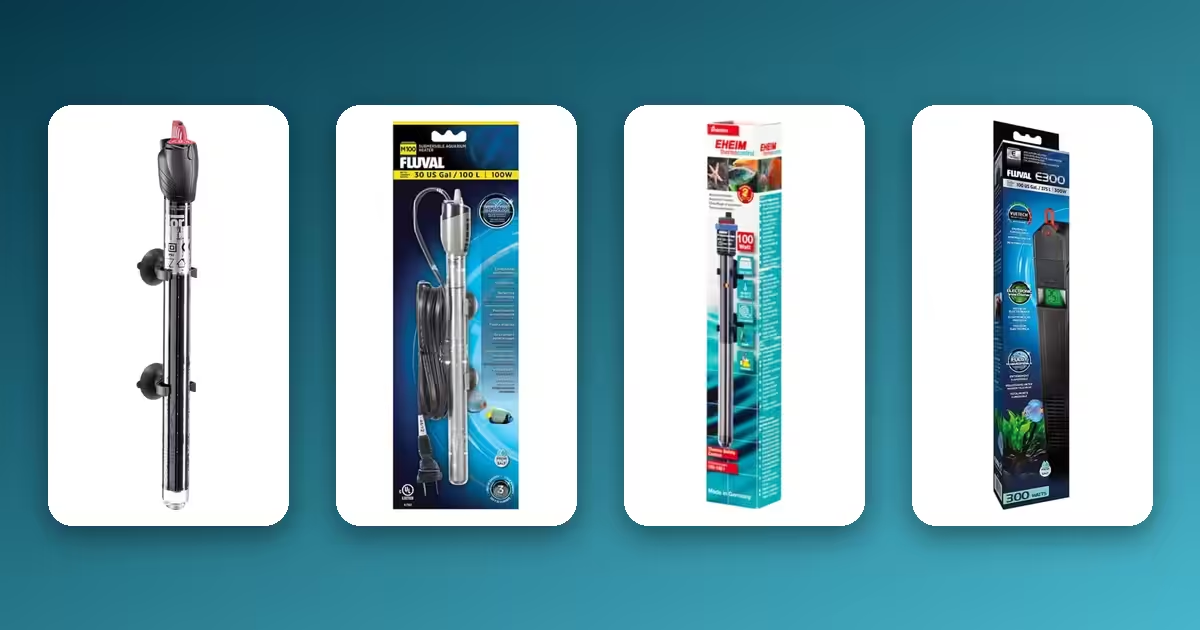
Most tropical fish and reef corals need a stable water temperature, and the biggest mistake in choosing a heater is picking the wrong wattage for the tank. Too small and it cannot keep up in a cold room. Too large and it can overshoot and harm livestock. Below is a sizing guide by tank volume, followed by the heaters in stock right now.
How to size a heater by tank volume
A commonly used rule of thumb is about 3 to 5 watts per litre at a typical indoor room temperature, and more if the tank sits in a consistently cool room or the target temperature is high (reef tanks are usually kept around 25 to 26 degrees Celsius). As a starting point:
- Up to 50 L: 50 to 100 W
- 50 to 150 L: 100 to 200 W
- 150 to 300 L: 200 to 300 W
- Over 300 L: use two heaters at opposite ends of the tank rather than one large unit, for even heat distribution and a backup if one fails
Always check each product’s own rated tank-size range, since housing and thermostat design vary by model. For a calculation based on your own tank and room, see our aquarium heater buying and setup guide.
In stock, by wattage
100 W
- Hydor Theo Heater 100 Watt
- Fluval M Heater 100 Watt
- EHEIM Jager Heater 100 Watt
- Fluval E Heater 100 Watt
200 W
- ISTA Electron Heater Explosion Proof 200 Watt
- Sicce Scuba Heater 200 Watt
- EHEIM Jager Heater 200 Watt
- Fluval E Heater 200 Watt
300 W
- Hydor Theo Heater 300 Watt
- EHEIM Jager Heater 300 Watt
- Fluval M Heater 300 Watt
- EHEIM Thermocontrol e 300 Watt
- Fluval E Heater 300 Watt
What to look for beyond wattage
Check each product page for the thermostat type. The other practical differences are the housing material (glass, or shatterproof titanium or plastic if livestock could knock into it), a temperature display or a dial, and whether the unit is fully submersible.
FAQ
Can I use the same heater for a freshwater and a marine tank?
Yes. A heater only controls temperature, so the same models work in either.
Do I need a heater in India’s climate?
Often yes, especially with air conditioning or during winter in northern India, since tropical fish and reef corals need a stable temperature above typical unheated room temperature.
How do I know if my heater has failed?
Check the tank thermometer regularly. A heater that is stuck on (tank overheating) or has stopped heating (temperature drifting down) both need replacing immediately, since livestock can die from either failure within hours.