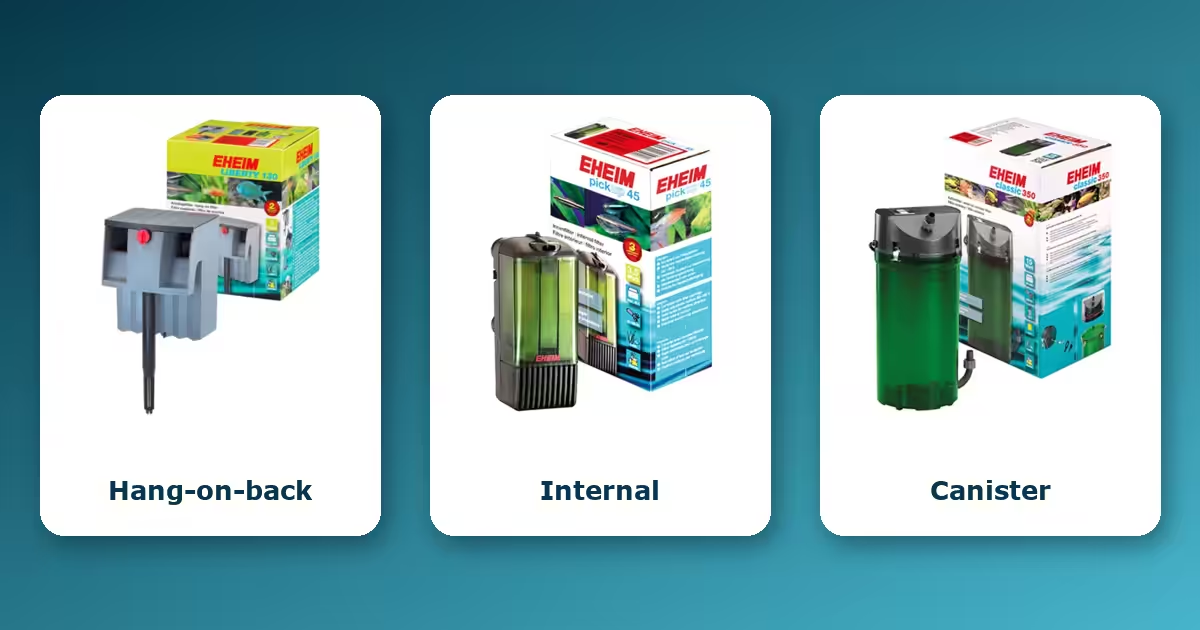
Filtration is the one piece of equipment every freshwater tank needs, and the right choice depends mostly on tank size and how much maintenance you want to do. IndieFur stocks three types of freshwater filter: hang-on-back, internal and canister. Each suits a different kind of tank.
Plan and shop
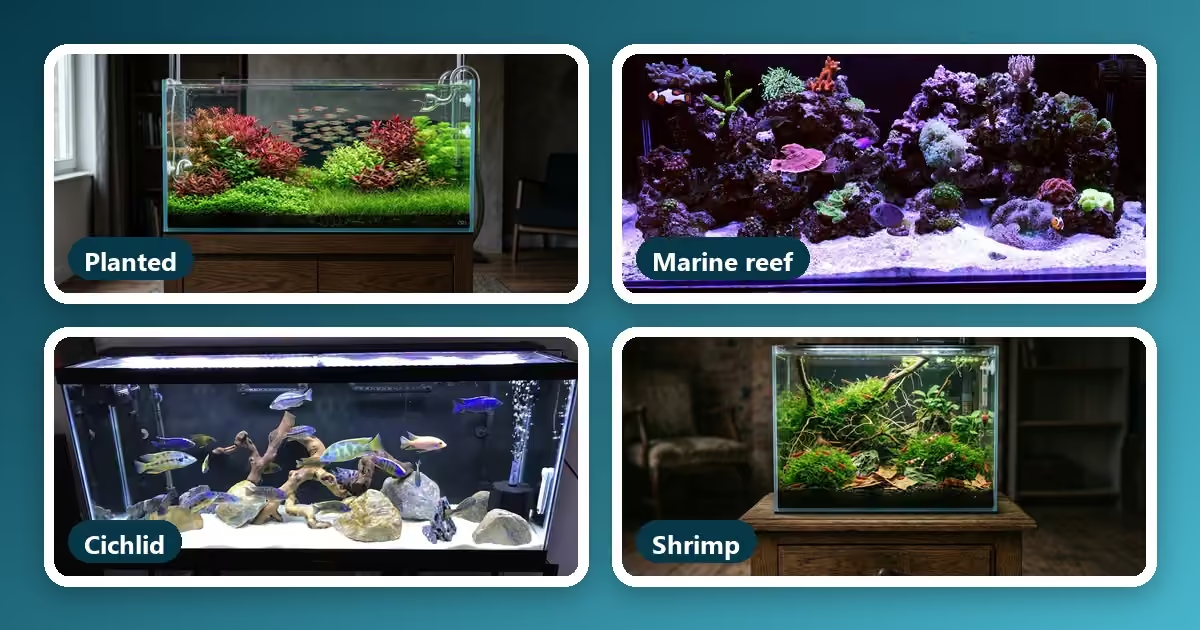
Starting or upgrading? Choose your tank size and type, planted, community, shrimp, cichlid or marine, then add the equipment list to your cart.
Hang-on-back (HOB) power filters, best for tanks up to 200 litres
A hang-on-back filter sits on the rim of the tank and is the easiest option to install and maintain. No plumbing, no priming; lift it out and rinse the media when it slows down. It suits a first aquarium or any tank up to about 200 litres where you want simple upkeep.
Models we carry: ISTA Hang On Filter 180, 280, 380, 450 and 600 (a full size ladder by tank volume), plus EHEIM LiBERTY Hang On Filter 75 L and 130 L.
Hang-on filters by flow rate
ISTA publishes a flow rate for each of its hang-on filters but no recommended tank volume. The last column below is our own arithmetic and not an ISTA rating: the flow divided by 6 and by 4, which matches the 4 to 6 turnovers an hour rule in the FAQ.
| Filter | Flow (litres an hour) | Tank volume at 4 to 6 turnovers an hour |
|---|---|---|
| ISTA Hang On Filter 180 | 150 to 180 | 25 to 45 L |
| ISTA Hang On Filter 280 | 250 to 280 | 42 to 70 L |
| ISTA Hang On Filter 380 | 350 to 380 | 58 to 95 L |
| ISTA Hang On Filter 450 | 450 | 75 to 113 L |
| ISTA Hang On Filter 600 | 600 | 100 to 150 L |
On that arithmetic the largest ISTA suits tanks up to about 150 litres. For bigger tanks the AquaClear 70 is rated by Fluval for 152 to 265 litres at up to 1,136 litres an hour, and EHEIM rates its LiBERTY hang-on range for tanks up to 75, 130 and 200 litres.
Internal filters, best for nano and small tanks
An internal filter sits fully submerged inside the tank. It is the quietest option and takes up the least visible space, which makes it the standard choice for nano tanks, breeding tanks, and quarantine setups. See our quarantine tank guide for why a dedicated small filter matters there.
Models we carry: ISTA Aquarium Ceramic Internal Filter, Eheim Internal Filter Pick Up 45, 60 and 200, Fluval U1 Underwater Filter, and Sicce Internal Filter Shark Pro 500 and 700.
Canister (external) filters, best for tanks over 200 litres or heavy bioloads
A canister filter sits outside the tank and pumps water through a sealed external unit packed with far more filter media than a HOB or internal filter can hold. It is the right choice once a tank gets large, houses big or messy fish (goldfish, cichlids, plecos), or is a planted tank running CO2 where surface agitation from a HOB filter would degas it.
Models we carry: Hydor Prime External Canister Filter 10, 20 and 30; EHEIM Classic Filter 150, 250, 350 and 600; Fluval 107 and 207 Performance Canister Filters; and ISTA Canister Filter 1080. Owners of a Fluval 106, 206 or 306 can check which current model fits in our replacement comparison.
Note: canister filters are also used on marine and reef tanks. The mechanics are the same, which is why this range overlaps with our marine equipment range.
What a filter does
A filter does three jobs. It traps debris (mechanical), it houses the bacteria that remove fish waste (biological), and it can hold carbon or other media that pull dissolved material out of the water (chemical). The biological job matters most. Fish release ammonia through their gills and waste, the filter bacteria convert ammonia to nitrite and then to nitrate, and ammonia and nitrite are both toxic.
In a new tank, ammonia rises and then falls over several weeks as the bacteria establish. The University of Florida’s IFAS Extension advises testing nitrite every other day at set-up and weekly once the filter is established, which takes about 4 to 6 weeks. In an established tank, ammonia and nitrite should both read zero, and any reading above zero can harm fish (UF/IFAS freshwater testing sheet). Our test kit buying guide covers which kits to use.
The full filtration guide explains the three jobs a filter does and how many weeks a new one needs to settle.
Loading and rinsing media
In an EHEIM Classic canister the water meets the coarse pad first, then the biological media, then the fine pad directly under the pump head. The fine pad clogs first, so rinse or replace that one when flow drops. Rinse biological media in tank water and never in tap water, and never rinse all of it at once, because that is where the bacteria live.
How to choose
- Up to 200 L, low-maintenance: a HOB filter, moving up the ISTA ladder (180 to 600) as the tank gets bigger.
- Nano, breeding or quarantine tank: an internal filter (Eheim Pick Up, Fluval U1).
- Over 200 L, or a heavy bioload such as goldfish or cichlids: a canister filter (EHEIM Classic, Fluval Performance range).
- Already running one of the above and just need spares or extra media: see Filter Media and Filter Spares.
Canister filters by rated tank volume
| Canister filter | Maker’s tank rating | Pump output (litres an hour) |
|---|---|---|
| EHEIM Classic 150 (2211) | 50 to 150 L | 300 |
| Fluval 107 | 40 to 130 L | 550 |
| Hydor Prime 10 | 80 to 150 L | 580 |
| EHEIM Classic 250 (2213) | 80 to 250 L | 440 |
| Fluval 207 | 60 to 220 L | 780 |
| Hydor Prime 20 | 100 to 250 L | 1,000 |
| EHEIM Classic 350 (2215) | 120 to 350 L | 620 |
| Fluval 307 | 90 to 330 L | 1,150 |
| ISTA Canister Filter 1080 | 200 to 350 L | 960 (1,080 at 110 V) |
| Hydor Prime 30 | 200 to 450 L | 1,320 |
| EHEIM Classic 600 (2217) | 180 to 600 L | 1,000 |
| Fluval 407 | 150 to 500 L | 1,450 |
Use the rated range for a canister and the turnover rule for hang-on and internal filters.
Which filter for which tank
Volumes are gross (length times width times height). Subtract about 10 percent for glass, substrate and decor, and go up one size for goldfish, cichlids or other heavy bioloads.
| Tank (L x W x H) | Gross volume | Filter type | Examples |
|---|---|---|---|
| 1 ft x 1 ft x 1 ft | about 28 L | Hang-on or internal | ISTA 180, Fluval U1 |
| 2 ft x 1 ft x 1 ft | about 57 L | Hang-on or internal | ISTA 280, EHEIM Pick Up 60 |
| 2 ft x 1.5 ft x 1.5 ft | about 127 L | Hang-on, internal or small canister | ISTA 600, Hydor Prime 10, EHEIM Classic 150 |
| 3 ft x 1.5 ft x 1.5 ft | about 191 L | Canister or large hang-on | AquaClear 70, Hydor Prime 20, Fluval 207 |
| 4 ft x 1.5 ft x 1.5 ft | about 255 L | Canister | EHEIM Classic 350, Fluval 307, Hydor Prime 30 |
| 4 ft x 2 ft x 2 ft | about 453 L | Canister | EHEIM Classic 600, Fluval 407 |
FAQ
How often should I clean a freshwater filter?
Rinse HOB and internal filter media in tank water, never tap water, since tap water kills the beneficial bacteria. Do this every 2 to 4 weeks. Canister filters can go longer, 4 to 8 weeks, since they hold more media.
Can I use a canister filter made for freshwater on a marine tank?
Yes. The filtration mechanics are identical. What changes is the media you run through it.
What size filter do I need for my tank?
Match the filter’s rated flow rate to roughly 4 to 6 times your tank’s volume per hour for a HOB or internal filter, or use a canister filter’s own capacity rating. Most product pages here list the tank-size range each model is rated for.
How long does a new filter take to work?
The bacteria that remove ammonia and nitrite take several weeks to establish. The University of Florida’s IFAS Extension puts it at about 4 to 6 weeks before nitrite testing can drop to weekly. Until then, test often and feed lightly.
What happens to a hang-on filter in a power cut?
ISTA says its hang-on filters have a patented no-backflow valve, so water does not run back out when the power goes off. Check the product page of the model you buy for the same feature.