Aquarium lighting lets you see the tank and sets the day and night rhythm for the animals. In a planted or reef tank it also powers growth. A common buying mistake is mixing those jobs up, for example buying the brightest light for a fish-only tank and getting an algae problem.
1. Start with what the tank needs
- Fish-only freshwater tank: you need a light that shows the fish well and a steady schedule. A basic full-spectrum LED is enough.
- Low-tech planted tank: slow, undemanding plants such as anubias, java fern and cryptocoryne do well under moderate light. Stronger light mostly feeds algae.
- High-tech planted tank: carpeting plants and red stem plants want stronger light, usually with CO2 and fertiliser. Light, CO2 and nutrients need to stay in balance, or algae takes over.
- Marine and reef tank: corals depend on light, and different corals need different intensity and spectrum. Start from the needs of the corals you keep, not from the wattage on the box.
2. LED, T5 or T8
LED is the default for new tanks. It runs cooler, uses less power, lasts for years and can be dimmed or programmed. T5 and T8 fluorescent tubes are still around on older hoods and are cheap to replace, but their output fades over months and the tubes need regular changing. If your hood takes tubes and you are happy with it, there is no need to switch. For anything new, choose LED.
3. Match the light to the tank length
Light fittings are sold by tank length, and the fitting should cover most of the tank so the light is even. A small 1 foot tank and a 4 foot tank need very different fittings. In India, tanks are mostly sold in feet (1, 2, 3, 4 and above), so look for a fitting built for your tank’s length, and check how it mounts: clip-on over the rim, a hanging kit, or a lid.
Light size by tank length
Tanks in India are sold by length in feet, and fittings are sold by the matching length in centimetres. One foot is 30.5 cm, so the sizes below are rounded to the sizes lights are made in. The NuniQ range is shown because it has a fixture for every length. Power and lumen figures are the specifications we hold for each fixture.
| Tank length | Fixture size | NuniQ E Line (low-light tier) | NuniQ M Line |
|---|---|---|---|
| 1 foot | about 30 cm | 30E: 11 W, 700 lumens | 30M: 35 W, 1,950 lumens |
| 2 feet | about 60 cm | 60E: 20 W, 980 lumens | 60M: 68 W, 3,150 lumens |
| 3 feet | about 90 cm | 90E: 31 W, 1,500 lumens | 90M: 98 W, 4,650 lumens |
| 4 feet | about 120 cm | 120E: 40 W, 1,800 lumens | 120M Plus (WiFi): 7,326 lumens |
| 5 feet | about 150 cm | No E Line size | 150M: 150 W, 8,160 lumens |
At the same length the M Line puts out about three times the lumens of the E Line at 30 to 90 cm, which is why the E Line suits fish-only and low-tech tanks and the M Line suits planted tanks that want more. Lumens measure brightness to the human eye, so use them to compare fixtures from one family and not to predict plant growth.
Rim-mounted or hanging
Most planted-tank LEDs rest on the tank rim. NuniQ fixtures ship with adjustable legs that sit on the rim and side brackets for fixing to the tank, so one fixture fits a range of tank widths. A hanging light suits an open-top or rimless tank, or a tank where you want the light higher for a wider spread. Micmol sells hanging kits for its own lights, the Thor Pro Hanging Kit and the Aqua Air Hanging Kit, each with 150 cm of stainless steel wire rope. The ceiling fixing is yours to supply, so fit it into something solid. A higher light covers more of the tank but gives less PAR at the plants, so check the maker’s figures for the height you plan to use.
You can browse every size in the planted aquarium lights category and the marine aquarium lights category.
4. Spectrum, kelvin and what the numbers mean
Spectrum is the mix of colours in the light. A full-spectrum white LED looks natural and suits most freshwater tanks. Planted tanks do well with a balanced white that also carries red and blue. Marine lights add strong blue channels, which make corals fluoresce and match what reef corals receive in the sea.
Colour temperature is measured in kelvin (K). Lower numbers look warmer and more yellow, and higher numbers look cooler and bluer. Freshwater setups often use neutral to cool white, and reef tanks run bluer lights. Check the manufacturer’s guidance for your plants or corals, then adjust by eye and by how they respond.
5. PAR matters more than wattage
Wattage tells you how much electricity a light uses, not how much usable light reaches the plants or corals. PAR (photosynthetically active radiation) measures the light that organisms can actually use, and it falls off quickly with depth. A deep tank needs a stronger light than a shallow one to give the same PAR at the bottom. Our glossary page on PAR in aquarium lighting explains how it is measured and what levels different plants and corals need.
PAR by plant class
There is no official standard for low, medium and high light in a planted tank, and hobby guides give overlapping numbers. The table shows the pattern most of them agree on. Values are in µmol/m²/s, measured at the plants and not at the water surface. Some guides quote lower figures, for example 10 to 20 for low light, so the order of the classes matters more than the exact numbers.
| Plant class | Examples | PAR at the plants (about) | CO2 and fertiliser |
|---|---|---|---|
| Low light | Anubias, Java fern, cryptocoryne, mosses | 15 to 30 | Not needed |
| Medium light | Most common stem and rosette plants | 30 to 60 | Helps |
| High light | Carpeting plants and red stem plants | 60 and above | Needed to keep algae in check |
PAR drops with depth, so a 45 cm tall tank needs a stronger light than a 30 cm one for the same reading at the plants. The only way to know is to measure with a PAR meter at the substrate, or to ask the maker for PAR at a stated height.
Reef tanks run higher and leave less room for error. Bulk Reef Supply quotes researcher Dana Riddle’s figure of 100 to 200 PAR as an ideal average for corals, and gives 150 to 250 as a starting point. Red Sea, a reef light maker, points out that PAR alone does not show whether a light suits corals, because it counts all visible light and not only the colours corals use. Its published target, stated as PUR, is about 450 at the water surface and 90 at the bottom of its tanks (Red Sea REEF-SPEC). Whatever the figure, raise intensity in small steps.
6. How long to run the light
Run a fixed schedule on a timer, around 6 to 8 hours a day, then adjust to the tank. Reef tanks often run somewhat longer, with the intensity ramped up and down through the day. Long hours are a common cause of algae in a new tank, so start short and add time slowly. A timer or controller is worth having, because it keeps the schedule steady even when you are away.
Planted tank keepers sometimes add a “siesta”, a break of a few hours in the middle of the day, to starve algae while the plants keep growing. Try it if you see algae despite good water quality.
7. Marine and reef lighting
Corals set the requirement in a reef tank. Soft corals and many LPS corals tolerate moderate light, while most SPS corals need strong, well-spread light. Whatever the coral, introduce a new light gradually, raising the intensity in small steps over time, because a sudden jump can bleach corals. See our EcoTech Radion reef lighting guide for Radion fixtures and their mounting options.
8. Lights worth a look
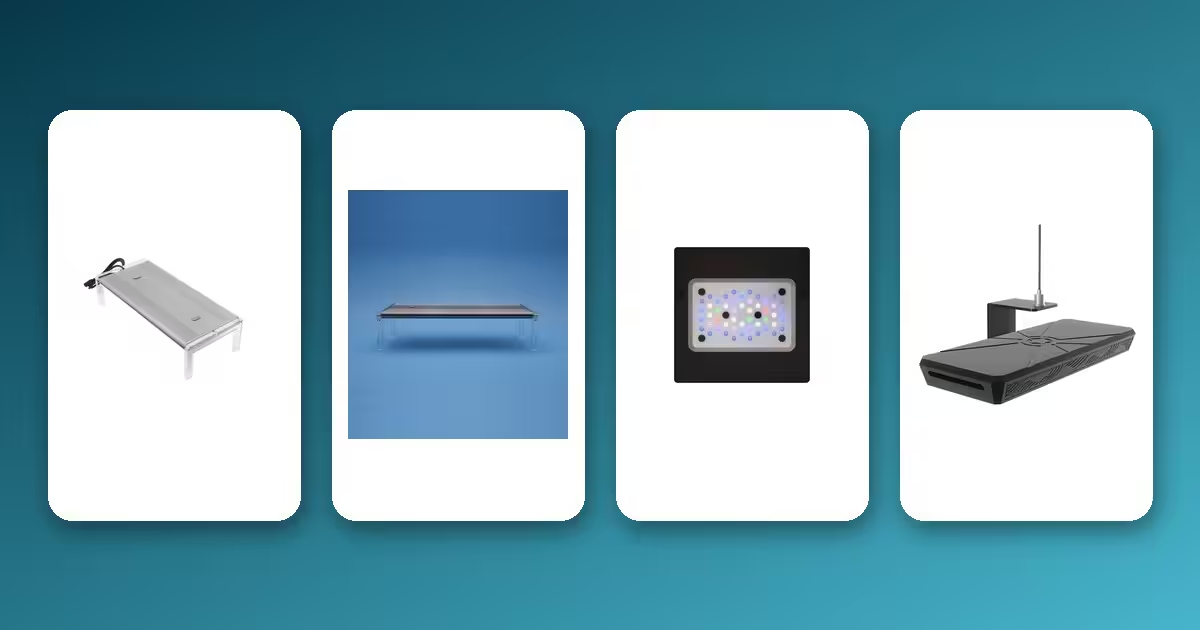
For a freshwater or planted tank, the NuniQ M Line (shown here in the 60M size) is a full-spectrum RGB light with fanless passive cooling, built for aquariums from 30 cm to 150 cm. If you want to control the light from your phone, the NuniQ M Plus with WiFi app control is made for planted tanks up to 120 cm and suits low to medium light aquascapes.
For a reef tank, the EcoTech Marine Radion XR15 G6 Pro uses an LED cluster with hybrid lensing, and the Micmol Thor Hanging Kit is a compact reef LED that works with a controller.
FAQ
How many hours should an aquarium light be on? Around 6 to 8 hours a day on a timer is a common starting point. Start shorter if you see algae, and check the guidance for your plants or corals.
Do fish need a special light? No. Fish only need a normal day and night cycle. Special spectrum and higher intensity matter for live plants and corals.
Can I use a household bulb on an aquarium? A household bulb is not made for the humidity and splashes around a tank and is not designed for plant growth. Use a fitting made for aquariums.
Is a higher wattage always better? No. Wattage is power use. Plants and corals respond to the light that reaches them, and that depends on PAR and tank depth rather than the wattage.
How often should I replace the light? LED fittings last for years, while fluorescent tubes lose output with use, so change tubes on the manufacturer’s schedule even if they still glow.
What size light do I need for a 2 foot tank? A fixture sold for about 60 cm. In the NuniQ range that is the 60E (20 W) for fish-only or low-light plants, or the 60M (68 W) for planted tanks that want more light.
How much PAR does a low-tech planted tank need? Roughly 15 to 30 at the plants for anubias, Java fern and cryptocoryne. More than that mostly feeds algae unless you add CO2 and fertiliser.