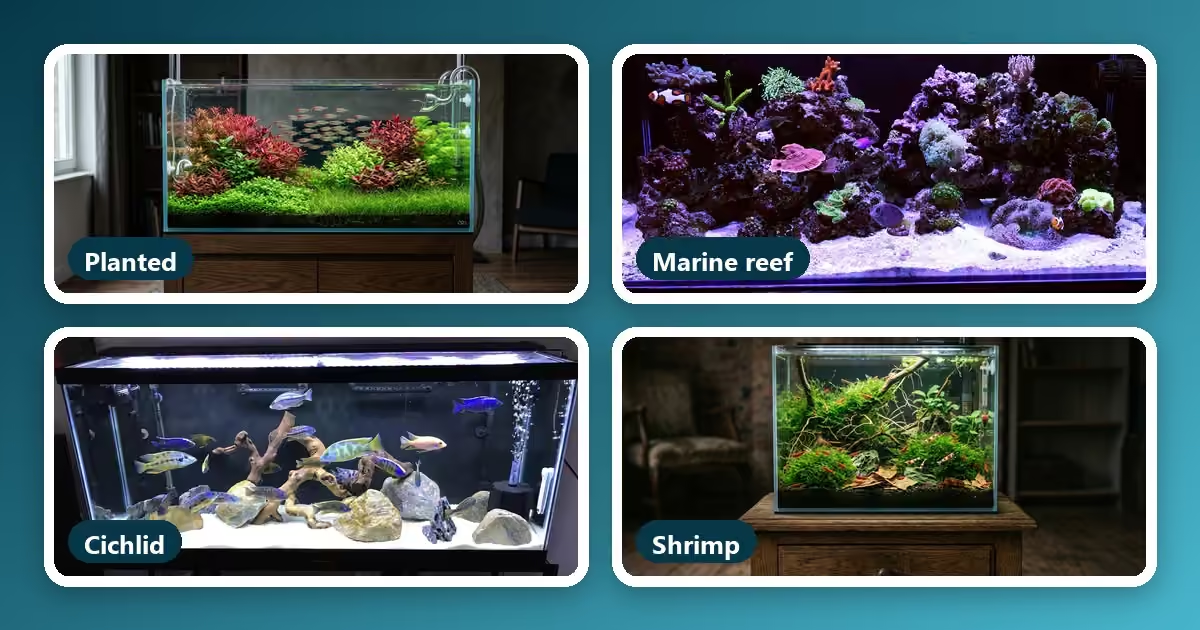
A tank and water aren’t enough on their own. The accessories around them are what keep an aquarium stable long-term. This guide covers the core categories every setup needs, what changes between freshwater and marine tanks, and real products and prices from IndieFur’s catalog for the pieces that are easiest to get wrong.
Plan and shop
Starting or upgrading? Choose your tank size and type, planted, community, shrimp, cichlid or marine, then add the equipment list to your cart.
Where to Put the Tank
The Merck Veterinary Manual says the tank should be located out of direct sunlight, which helps limit algae growth. Sunlight can also cause the water temperature to rise. The warmer the water becomes, the less oxygen it will hold.
Per the same manual, 1 gallon (3.8 L) of water weighs 8.3 pounds, and even a small aquarium can be extremely heavy relative to its size. Outlets matter for the lights, filters and pumps. The manual raises grounding, a ground fault interrupter and enough sockets close by, and says you should consider a surge protector.
The Ornamental Aquatic Trade Association (OATA) advises a flat, level surface or stand that can take the weight of a full tank indefinitely, away from loud noises, vibrations and sudden movements. Larger aquariums contain more water, which makes them more stable and less susceptible to variations in temperature and pH than small ones, and its leaflet adds that the aquarium should ideally be able to accommodate the chosen fish once they are fully grown.
Essential Accessories for Any Aquarium Setup
Every tank, freshwater or marine, needs the same six-item foundation before anything else gets added:
- Filter system
- Heater and thermometer
- Air pump and air stone
- Lighting
- Substrate
- Water conditioner
For the heater, the Sicce Scuba Heaters 200 Watt (₹2,310, in stock) covers mid-to-large freshwater and marine tanks reliably. For aeration, the ISTA Wooden Airstone (₹411, in stock) produces finer bubbles than standard airstones, which improves gas exchange without excess surface disturbance.
Heaters carry a safety rule from the Merck Veterinary Manual: do not plug one in until the tank is full of water. Most heaters sit in a glass tube that may shatter if not surrounded by water. A heater is necessary for both freshwater and saltwater tropical fish, and filters, pumps and lights should not be turned on until after the tank is filled either.
A separate thermometer in the tank monitors temperature independently from the heater. Fish need a day and night cycle. Leaving the lights on 24 hours a day, 7 days a week stresses fish and leaves them more susceptible to disease.
Filtration: The Accessory Everything Else Depends On
Filters remove waste, uneaten food, and dissolved toxins across three mechanisms working together: mechanical (removes debris), biological (beneficial bacteria break down ammonia and nitrite), and chemical (removes dissolved impurities like odors and discoloration). A tank missing any one of the three will struggle even if the other two are working fine.
The ISTA Net Bag of Filtering Material (₹220, in stock) is a low-cost way to hold loose mechanical or biological media inside most canister and hang-on-back filters, and it wears out with regular cleaning, so it’s worth keeping a couple of spares on hand.
Test Kits and Water Conditioner
OATA’s leaflet describes kits that each separately test pH, ammonia, nitrite, nitrate, phosphates and water hardness. They come as liquids, tablets or strips. All work on the same principle: each changes colour, and you compare the result to a colour chart. Take the sample from the main body of the aquarium, rather than the filters, and test regularly.
OATA recommends monitoring water quality ideally at least once a week. It also says to test if fish are behaving unusually.
Fish need oxygen. So do the bacteria that convert ammonia and nitrite. Levels should be maintained as high as possible by aeration, for example bubbles, waterfalls or a large surface area, with a minimum of 6 mg per litre.
Tap water can carry chlorine or chloramine. Both are harmful to fish and to the beneficial bacteria in your filter, and water conditioners will convert these chemicals to a form that is not toxic.
Freshwater-Specific Accessories
Freshwater aquarium supplies generally cost less and require less precision than marine setups. Beyond the core six, the accessory most freshwater owners underinvest in is substrate. For planted tanks specifically, a nutrient-rich substrate matters more than most other single purchases. Fluval Bio Stratum Plant Soil is available in 4 kg (₹2,799) and 8 kg (₹3,599) bags, both in stock, and feeds root-growing plants like Amazon Sword directly rather than relying on water-column fertilizer alone.
Live plants such as Java Fern and Anubias are worth adding regardless of substrate choice: they absorb nitrate and compete with algae for the same nutrients, which reduces how often you need to intervene manually.
For gravel, the Merck Veterinary Manual says it is usually placed at a proportion of 1 pound per 1 gallon of water and should be rinsed thoroughly to remove any accumulated dust, which can prematurely clog filters and damage water pumps.
Marine-Specific Accessories
Marine aquarium supplies need more precision because saltwater fish, corals, and invertebrates tolerate a narrower range of water conditions than freshwater fish do. Two accessories that freshwater tanks don’t need but marine tanks generally do:
Protein skimmers pull dissolved organic waste out of the water column before it breaks down into ammonia. Sizing matters here more than with most accessories, since a skimmer built for a smaller marine or reef tank won’t keep pace with a larger one, and an oversized unit is an unnecessary expense.
Activated carbon handles the chemical filtration marine tanks lean on more heavily than freshwater does, removing dissolved organics, odors, and discoloration. Korallen-Zucht Activated Carbon 1000ml (₹4,200) is currently on backorder, worth ordering ahead of when you’ll actually need it rather than waiting until carbon is exhausted.
Daily Maintenance Tools
| Tool | Purpose | Price | Stock |
|---|---|---|---|
| ISTA Compact Syphon Cleaner | Gravel/substrate cleaning, smaller tanks | ₹966 | In stock |
| Fluval FX Gravel Cleaner Kit | Gravel/substrate cleaning, larger tanks | ₹5,799 | In stock |
| ISTA Net Bag of Filtering Material | Holds loose filter media | ₹220 | In stock |
| ISTA Wooden Airstone | Aeration, gas exchange | ₹411 | In stock |
Algae scrapers, fish nets, and thermometers round out a basic maintenance kit. None of these are precision purchases, so buy on size fit for your tank rather than brand. The aquarium cleaning tools guide pairs gravel and glass algae jobs with a tool each.
Cycling a New Tank Before Adding Fish
The beneficial nitrifying bacteria that break down ammonia and nitrite into much less toxic nitrates are not present in a new aquarium filter. Maturing the filter means growing a population of these bacteria in the filter media.
OATA names two common methods. One adds a small number of hardy fish. Use it only with great care, under guidance from a retailer. The other adds a calculated dose of ammonia over several weeks, using an ammonia based maturation product and the instructions included with it.
Ammonia and nitrite levels should initially rise and then fall. Once both have dropped to zero and stay at zero continually, the filter is mature. Stocking can then continue slowly.
Overstocking or stocking too quickly can result in new tank syndrome, leading to unhealthy levels of ammonia and nitrite. Each added fish or increase in feeding also calls for a mini maturation process, because the bacteria population has to build up to handle the extra waste.
Buying Tips
- Size equipment to your actual tank volume, not the tank you plan to eventually upgrade to
- Don’t over-decorate: every ornament and plant reduces the water volume your filtration is actually working with
- Buy chemical media (activated carbon, phosphate removers) before you run out, since some marine-specific products go on backorder
- Clean mechanical media on a schedule; leave biological media alone except for a gentle rinse in tank water
IndieFur carries the full range across freshwater, marine, and planted-tank categories if you’re assembling a setup from scratch rather than buying one piece at a time.
Frequently Asked Questions
1. What accessories does a beginner freshwater tank actually need?
Filter, heater, thermometer, air pump, lighting, and substrate: the same six-item foundation as any tank. Live plants and testing kits help but aren’t strictly required to start.
2. Why do marine tanks need more accessories than freshwater tanks?
Marine fish, corals, and invertebrates tolerate a much narrower range of water conditions, so marine setups generally add a protein skimmer and heavier chemical filtration (activated carbon, phosphate control) that freshwater tanks can usually do without.
3. Is the Korallen-Zucht Activated Carbon in stock?
It’s currently on backorder. If your marine tank relies on carbon filtration, order ahead rather than waiting until your existing carbon is exhausted.
4. How often should filter media and maintenance tools be cleaned or replaced?
Mechanical media (filter floss, net bags) should be rinsed or replaced regularly since it physically traps debris. Biological media should be disturbed as little as possible: a gentle rinse in removed tank water, never tap water, protects the bacteria colony.
5. Do I need a gravel cleaner for a small tank?
Yes, but size it down: something like the ISTA Compact Syphon Cleaner is a better fit for smaller tanks than a larger kit built for bigger volumes.