A filter does three jobs. It traps solid waste, it gives bacteria somewhere to live, and it can pull dissolved material out of the water. The bacteria matter most. They turn the ammonia from fish waste into less harmful compounds, and without them a tank poisons its own fish.
The three stages
Mechanical filtration is a sieve. Floss or foam traps the larger particles floating in the water before they break down. It’s the layer our cleaning guides tell you to rinse.
Chemical filtration binds dissolved particles to a media so they leave the water. Activated carbon is the usual one. EHEIM says carbon takes up toxins and traps remains of chlorine, cleaning agents, medicines and dyes. Fluval adds heavy metals, odours and discolouration.
Biological filtration is bacteria on porous media such as foam and ceramic. One group converts toxic ammonia to nitrite. Nitrite is also toxic, so a second group converts it to nitrate. Nitrate is where the filter’s job ends.
A canister runs all three in sealed chambers, and our canister buying guide notes it holds far more media than an internal or hang-on filter.
Why a new filter needs weeks
A new filter has no bacteria. Ammonia from the fish builds up until the colonies catch up, and that gap is the cycle. Researchers put the line at 0.1 mg/L of unionised ammonia: above it, fish can suffer chronic stress and disease (Applied and Environmental Microbiology, 2024).
How long does the gap last? Three sources, three answers. EHEIM says the maturing phase can last up to three weeks and suggests waiting two to three before adding fish. Fluval gives about ten days for the ammonia step, then another 21 to 30 days before nitrite is gone. A 2025 study followed three home aquariums for 12 weeks: ammonia and nitrite were undetectable by week 3 in two of them and by week 8 in the third (ISME Communications, 2025).
Your tank will land somewhere in that spread. Use a test kit to see when ammonia and nitrite read zero, and add fish after that, not on a date.
On a fresh setup I rinse the new media in tap water or RO water. It has no bacteria on it yet, so there are none to lose. When I replace an existing filter, I rinse the media in water from the old filter’s tank instead.
Flow: how fast the water should pass through
The usual target is a flow rate of four to six times the tank volume per hour. Take a 100 L tank at five turnovers, the middle of that range. That’s 500 L an hour. Our filter sizing guide then adds 25%, so you shop for about 625 L an hour. Our hang-on guide explains the extra: rated flow is measured with an empty chamber, so real output is lower once the media is packed in.
Heavy feeders such as goldfish and cichlids need more, and the sizing guide uses six to eight turnovers for them.
Filter types
| Type | Where it sits | What it suits | Example | Guide |
|---|---|---|---|---|
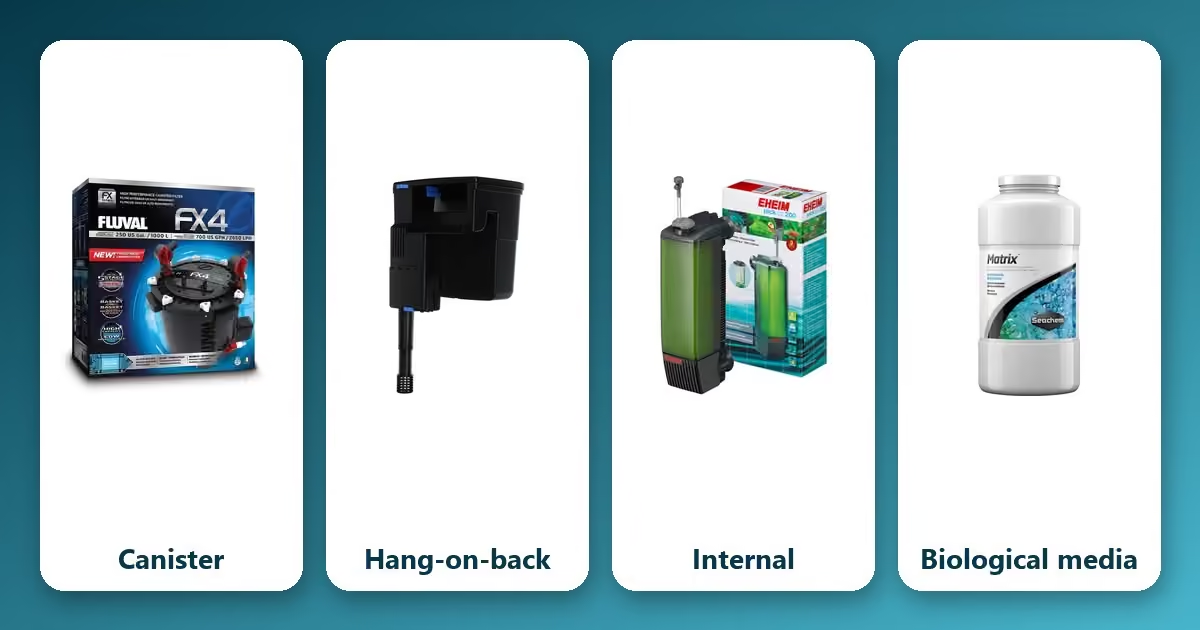
| Canister | Outside the tank, sealed chambers | Far more media than internal or hang-on | Fluval FX4 | Canister buying guide |
| Hang-on-back | Clips to the tank rim | Moderate stocking, up to roughly 150 to 200 L | Seachem Tidal 55 | HOB filters explained |
| Internal | Inside the tank | No leak risk, but a small media volume | EHEIM Pick Up 200 | Internal filters explained |
| Sponge | Inside the tank | Fry, shrimp and quarantine tanks, with gentle flow | Not available | Sponge, undergravel and sump filters |
| Sump | A second tank below the display | Mostly marine; typically adds 20 to 50% more water volume | Not available | Sponge, undergravel and sump filters |
Our advice to a first-time buyer is the same for every format: buy a good product from a good brand, not a cheap alternative with no consistency.
Other canisters include the EHEIM Classic 350 and the Hydor Prime 20. Among hang-ons, the EHEIM LiBERTY restarts by itself after a power cut, according to our hard water and power cut guide. For internals there is also the Sicce Shark Pro 700.
Cleaning without killing the bacteria
Start with the water, and with whether the media has bacteria on it yet. Media that has been running in a tank should be rinsed in aquarium water instead of tap water, which is what Fluval says. Tetra explains why: the chlorine in tap water kills the ammonia and nitrite oxidising bacteria in a sponge. EHEIM’s guide says lukewarm water only. We follow Fluval and Tetra because they give the reason.
Never replace everything at once. Fluval says never change all the media at one time. Tetra says to clean or replace media at different times. EHEIM goes one step further and mixes about a third of the used media back in with the new.
Clean when output drops. EHEIM says to clean only when output drops significantly, and 1 to 2 weeks before or after a partial water change, never on the same day. Our cleaning guide puts the trigger at a 30% drop and has the steps. Our hang-on guide rinses the mechanical layer every two to four weeks, in tank water. If a canister is overdue, clean one basket, wait a week to ten days, then clean the next. The troubleshooting guide covers weak flow.
Carbon is where the makers split. EHEIM says use it for 1 to 2 weeks at most, normally only at start-up. Fluval says replace it every 4 weeks.
For chlorine, EHEIM points to a water conditioner: a good one will largely bind and neutralise chlorine and heavy metals. Seachem Prime removes chlorine and chloramine, and Seachem states it will not halt your cycling. Biological media options include Seachem Matrix and the Fluval Bio-Foam+.
Reading the test kit
Ammonia and nitrite are the two numbers to watch. A filter that’s doing its job reads zero on both, with nitrate as the end product. A spike on a settled tank can follow a heavy clean, since cleaning is where colonies get lost.
Prime detoxifies ammonia, nitrite and nitrate, but Seachem is clear that it does not remove them from the system. The test kit will still show them, and the reading is real.
Marine tanks
Reef and fish-only marine tanks run the same three stages. Our marine filter media guide sorts media by problem (phosphate, mechanical, biological and chemical polish) and notes that established reefs commonly run three layers. For the mechanical stage, the Red Sea ReefMat 1200 is a fleece roller.
Water changes still come first
Regular filter cleaning is not a substitute for partial water changes. Water changes are essential for any aquarium. They keep pH good and dissolved organic compounds low.
On my own tanks I change 5% of the water every week, or 10% every fortnight, and I turn the filter off while I do it.
Questions people ask
How many times an hour should a filter turn over my tank’s water?
Four to six times the tank volume. Lightly stocked tanks can sit at the low end, and heavy feeders need more. The sizing guide has the maths for each tank size.
Does a water conditioner kill the bacteria in my filter?
No. Seachem says Prime will not halt your cycling. Chlorine is what kills the bacteria, per Fluval and Tetra, and a conditioner removes it from new water.
Can I rinse filter media under the tap?
Rinse media that has been running in water taken from the tank. Tap water carries chlorine, and Fluval warns specifically against rinsing its bio media in any water that could contain it. Brand new media straight out of the box has no bacteria to lose, so tap or RO water is fine for its first rinse.
How long does a new filter take to cycle?
Anywhere from about two weeks to eight, depending on the source and the tank. EHEIM says up to three weeks. A study of three home tanks saw zero ammonia and nitrite at week 3 in two and week 8 in the third. Your test kit gives the real answer.
Do I still need water changes if my filter is good?
Yes. A filter turns ammonia into nitrate and removes particles. It doesn’t replace the water.