Marine filter media isn’t one-size-fits-all: phosphate control, mechanical filtration, biological capacity, and chemical polishing each need a different product, and running the wrong one (or none at all) shows up as algae, cloudy water, or a nitrate creep that never quite resolves. This guide breaks down real, currently stocked options by what problem they solve.
Phosphate Control
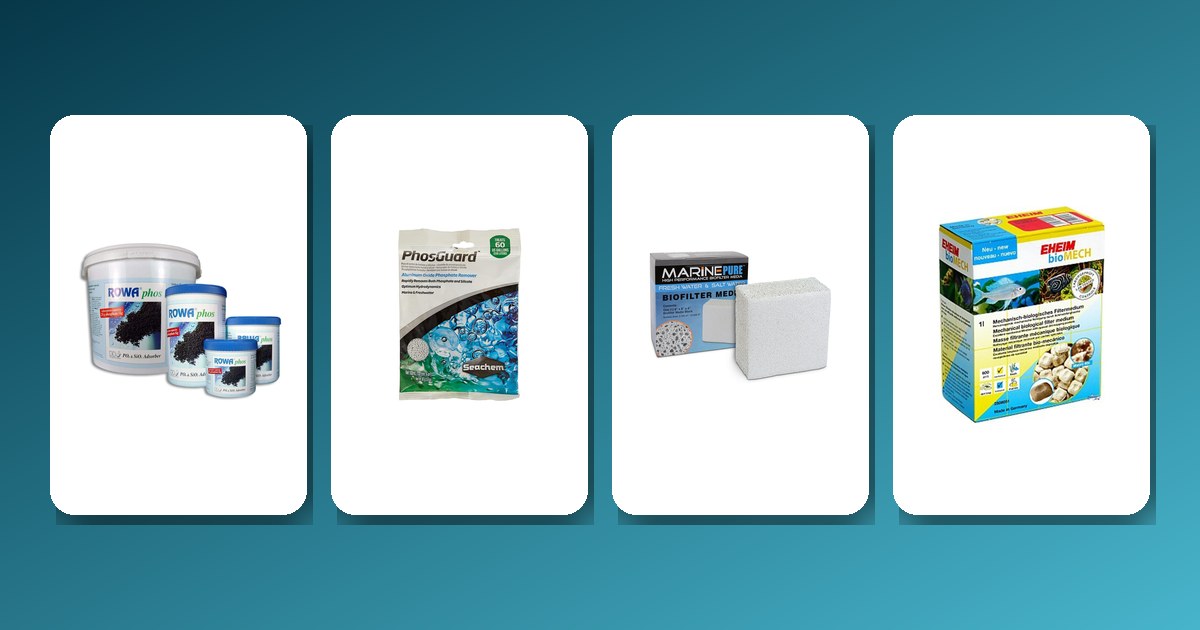
Elevated phosphate is one of the most common drivers of nuisance algae in reef tanks, and there’s a deep bench of media built specifically to pull it down. Rowaphos Phosphate Remover Media is a long-standing benchmark for iron-based phosphate adsorption. Seachem offers two related options: PhosGuard for both fresh and marine use, and PhosNet (also in 250gm), a mesh-bagged version that’s easier to handle and swap without media dust escaping into the tank. RP Aquatics rounds out the category with Phosphate Gone, formulated as a fast-acting alternative worth rotating in if you’re seeing a phosphate spike rather than managing a steady baseline.
Mechanical Filtration: Fleece Rollers
For tanks running a fleece roller instead of filter socks, the Red Sea ReefMat 500 and larger ReefMat 1200 automate roller advancement so mechanical filtration stays fresh without a daily manual swap. Keep the system running long-term with ReefMat 500 Replacement Fleece Rolls or the 1200 rolls on hand, since running out mid-roll means falling back to no mechanical filtration at all until a replacement arrives.
Biological Media
Live rock alternatives and bio-media provide the surface area bacteria need to process ammonia and nitrite, and increasingly to support denitrification in the tank’s low-oxygen pockets. CerMedia MarinePure Block is built with an extremely high internal surface area, positioning it as both a biological and mild denitrifying media in the same block. Seachem Matrix (also in 1L and 4L) works on the same principle with a porous rock media that supports both nitrification and denitrification. EHEIM’s bio range, Bio Mech, Bio Lav, and Bio Fix (each in 1L, 2L, and 5L sizes), gives canister and sump filter owners a scalable biological media option sized to the filter chamber they’re actually running.
Nitrate and Ammonia Control
Beyond general biological capacity, some media targets nitrogen compounds directly. Seachem denitrate (also in 4L) is engineered with a macroporous structure that hosts denitrifying bacteria in oxygen-poor zones inside the media itself. RP Aquatics’ Nitrate Remover and Ammonia Block address the two compounds separately, giving you the option to target whichever one your test results actually flag rather than running a broad-spectrum media for a single-parameter problem.
Organics and Chemical Polishing
Seachem Purigen (also in 250ml) removes dissolved organics before they break down into nitrate and phosphate in the first place, making it a preventative media rather than a reactive one. It also changes color as it exhausts, giving a visual cue for when to regenerate or replace it. Seachem Renew regenerates exhausted Purigen rather than requiring a full replacement each cycle. Chemipure combines activated carbon and a phosphate-adsorbing resin in one product for hobbyists who want organics, odor, and phosphate handled together in a single media bag. Seachem Phosbond is another phosphate-and-silicate combination media, and Seachem HyperSorb targets rapid adsorption of a broader range of dissolved contaminants, useful after a medication treatment when you want the tank cleared of both the medication and its breakdown products.
Reactor Housings
Loose granular media needs a reactor to actually make contact with tank water at a controlled flow rate rather than sitting inert in a filter sock. The Seachem Reef Reactor Md and larger Reef Reactor Lg are sized for small-to-medium and larger systems respectively, letting you run granular phosphate removers, Purigen, or carbon at the flow rate the media itself is rated for rather than free-floating it in a sump.
Quick Reference
| Problem | Media |
|---|---|
| Rising phosphate | Rowaphos, Seachem PhosGuard/PhosNet, RP Aquatics Phosphate Gone |
| Mechanical filtration (fleece system) | Red Sea ReefMat 500/1200 + replacement rolls |
| General biological capacity | CerMedia MarinePure Block, Seachem Matrix, EHEIM Bio Mech/Lav/Fix |
| Nitrate specifically | Seachem denitrate, RP Aquatics Nitrate Remover |
| Ammonia spike | RP Aquatics Ammonia Block |
| Dissolved organics (preventative) | Seachem Purigen (+ Renew to regenerate) |
| Carbon + phosphate combined | Chemipure |
| Running granular media at controlled flow | Seachem Reef Reactor Md/Lg |
Building a Media Stack
Most established reef tanks run three layers at once rather than one product doing everything: a biological media (Matrix or MarinePure) for the nitrogen cycle’s baseline, a phosphate control media (Rowaphos or PhosGuard) running continuously in a reactor, and Purigen or carbon for organics and polish, swapped or regenerated on a schedule rather than left in until it visibly saturates. If you’re just setting up a reactor for the first time, size it to your sump space and target flow rate before choosing which media to run through it. The reactor housing determines how much of any given media you can actually use. For the reasoning behind that three-layer split, our explainer on how mechanical, biological and chemical media divide the work in a saltwater tank takes each mechanism in turn.