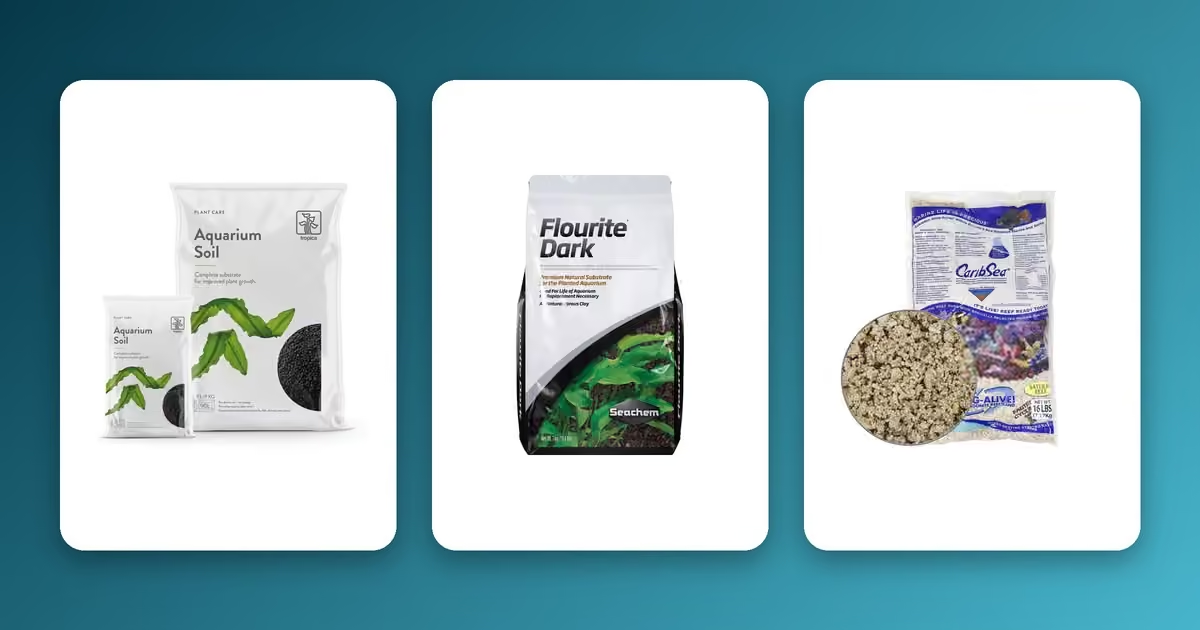
A planted bed runs shallow at the front and deep at the back, which changes the sum.
This calculator takes the inside length and width of your tank, the depth you want at the front and at the back, and gives you litres of soil, litres of gravel cap and the bags to buy. There is a second mode for a marine sand bed.
Aquarium substrate calculator
How the calculator works
It multiplies length by width by depth in centimetres, then divides by 1,000 to get litres. A 60 by 30 cm tank with 7 cm of soil is 60 x 30 x 7 = 12,600 cubic centimetres, which is 12.6 litres.
A soil bed is never one depth, so the calculator averages the front and back figures. At 5 cm in front and 9 cm behind, the average is 7 cm. That treats the slope as a straight line from front to back.
Measure the inside of the tank, glass to glass, and use those numbers instead of the size on the box. For the water side of the same tank, the water volume calculator is the one to use.
The planted bed: soil, slope and cap
We recommend a layer of soil with a layer of gravel on top. The soil goes down first and the gravel goes on top.
Our usual advice for the slope is about 5 cm at the front, rising to 8 to 10 cm at the back. The calculator takes both depths, so you can try 8 cm and then 10 cm at the back and see what each one costs in soil.
The cap is a thin layer, and its depth is your call. The calculator starts at 2 cm. Set it to zero if you are laying soil alone. The cap adds to the height of the whole bed, so 9 cm of soil plus a 2 cm cap puts the back of the bed 11 cm up the glass. Check that against the height of your tank, and against the water level you plan to run, before you buy.
Why you should buy more than the sum says
We tell people to buy 10 to 15 percent more than the maths gives. The calculator starts at 12 percent, and you can set any number you like.
The sum gives a plain box of soil, and the extra covers the gap between that and your real tank.
Example amounts for common tank sizes
These figures use the default bed: 5 cm at the front, 9 cm at the back, an average of 7 cm. The last two columns add 10 and 15 percent.
| Tank (cm) | Soil needed | With 10 percent | With 15 percent |
|---|---|---|---|
| 45 x 30 | 9.5 L | 10.4 L | 10.9 L |
| 60 x 30 | 12.6 L | 13.9 L | 14.5 L |
| 90 x 45 | 28.4 L | 31.2 L | 32.6 L |
| 120 x 45 | 37.8 L | 41.6 L | 43.5 L |
A 60 by 30 tank wants about 14 litres. That is two 9 litre bags of Tropica Aquarium Soil, or one 9 litre bag and two 3 litre bags if you want less left over. Tropica sells its soil by the litre, so the litres from the calculator are the litres on the bag.
A worked example: 90 x 45 cm
Take a 90 by 45 tank with the default slope and a 2 cm cap, at 12 percent extra.
The soil comes to 28.4 litres, or 31.8 litres once the extra is added. Three 9 litre bags and two 3 litre bags give 33 litres, which covers it. The cap is 90 x 45 x 2 = 8.1 litres, or 9.1 with the extra. Flourite runs about a litre to the kilogram, so you need about 9.1 kg. One 7 kg bag and one 3.5 kg bag give 10.5 kg.
A worked example for a small tank: 45 x 30 cm
Small tanks follow the same sums. With the default slope the soil is 45 x 30 x 7 = 9.45 litres, or 10.6 litres at 12 percent extra. One 9 litre bag and one 3 litre bag give 12 litres, which covers it.
A 2 cm cap is 45 x 30 x 2 = 2.7 litres, about 3.0 kg with the extra, so one 3.5 kg bag of Flourite is enough. For a marine bed at one inch, the same tank needs 3.4 litres, about 4.6 kg, or 5.1 kg with the extra. A single 7.26 kg bag of Natural Reef covers that.
On the 90 by 45 tank above, 10 percent gives 31.2 litres and 15 percent gives 32.6 litres, and the same 33 litres of bags covers both.
Soil sold by weight
Some soils are sold by the kilogram, and the calculator cannot turn kilograms into litres unless the maker says how much a bag holds. Fluval Bio Stratum and Prodibio AquaGrowth do not publish a figure that we could find, so the calculator does not guess one. For those, divide your litres by the litres printed on the bag.
For the cap it uses Seachem Flourite. A 7 kg bag occupies about 7,000 cubic centimetres, which is one litre to the kilogram, so the litres of cap are also the kilograms to buy. Seachem Flourite Dark 7 kg is the larger bag, and there is a 3.5 kg size for smaller tanks. A 60 by 30 tank with a 2 cm cap needs 3.6 litres. With 12 percent extra that is about 4 kg, so you would buy the 7 kg bag or two 3.5 kg bags. The cap depth moves this a lot: on the same tank, 1 cm needs 1.8 litres and 3 cm needs 5.4 litres before the extra.
If you are still choosing a soil, the aqua soil guide compares them. The aquarium setup planner lists the other equipment for your tank size.
The marine sand bed
For a marine tank we suggest a sand bed of half an inch to one inch, which is 1.3 to 2.5 cm. The calculator starts at the deeper end, 2.5 cm, and you can set any depth.
The calculator gives litres and kilograms for the depth you choose. The kilograms use 1.36 kg per litre, which comes from the 85 pounds per cubic foot that CaribSea publishes for its Natural Reef sand. We treat Red Sea Reef Base Aragonite as the same density, so the figure applies to it too. Other sands may differ, so treat the kilograms as a close guide and check the weight on the bag.
| Tank (cm) | Sand at 1.3 cm | Sand at 2.5 cm | 2.5 cm plus 10 percent |
|---|---|---|---|
| 60 x 30 | 3.2 kg | 6.1 kg | 6.7 kg |
| 90 x 45 | 7.2 kg | 13.8 kg | 15.1 kg |
| 120 x 45 | 9.5 kg | 18.4 kg | 20.2 kg |
A 60 by 30 tank at one inch needs about 7 kg with the extra, which is one 16 pound bag of CaribSea Arag-Alive Natural Reef. The bag weighs 7.26 kg. Red Sea Reef Base Aragonite comes in 10 kg bags, so the same tank takes one of those.
A worked example for sand: 90 x 45 cm
Take a 90 by 45 tank at 12 percent extra. A one inch bed is 90 x 45 x 2.5 = 10.1 litres, about 13.8 kg of Natural Reef, or 15.4 kg with the extra. That is three 7.26 kg bags, 21.8 kg in all, so plan for some left over or buy two bags and run the bed a little thinner.
A half inch bed is 90 x 45 x 1.3 = 5.3 litres, about 7.2 kg, or 8.0 kg with the extra. Two bags cover it, with 6.5 kg spare.
Reading the bag list
Under the result the calculator lists bag sizes for the products with a published volume or density. It rounds each product up to whole bags and shows the total you would end up with, so you can see how much is left over. If the list cannot load, you get a link to the range.
The list covers only products with a published volume or density, which is why Fluval and Prodibio soils are missing from it. We left them out until a published figure exists.