Why plants need more than just light
A common mistake in a new planted tank is assuming that good lighting alone will produce lush growth. Light drives photosynthesis, but photosynthesis is only half the equation. Plants also need a steady supply of dissolved nutrients to actually build new leaf and root tissue. Without those nutrients, strong lighting often backfires: the tank has enough energy to grow algae quickly, but not enough balanced nutrition to let plants out-compete it. If you’re just getting your tank cycled and stocked, our complete aquarium setup guide is a good starting point before layering in a fertilizing routine.
Macronutrients: the building blocks plants need in bulk
Macronutrients are the elements aquatic plants consume in the largest quantities, generally remembered by the acronym NPK plus a few others:
- Nitrogen (N) is used for leaf growth and chlorophyll production. In a fish-stocked tank, fish waste and uneaten food already supply some nitrogen through the nitrogen cycle, but heavily planted tanks often need supplemental nitrate to keep pace with fast-growing stem plants.
- Phosphorus (P) is essential for root development and energy transfer within the plant. Many hobbyists under-dose phosphorus out of fear of algae, but a genuine phosphorus deficiency shows up as stunted new growth and dark, aged-looking leaves.
- Potassium (K) regulates water movement within plant cells and is used up quickly by fast growers. Potassium deficiency often shows first as pinholes or yellow spotting on older leaves.
- Calcium and magnesium are structural nutrients that also affect general and carbonate hardness. Soft-water setups running RO or heavily filtered water often need these added back in, since they’re stripped out along with unwanted minerals.
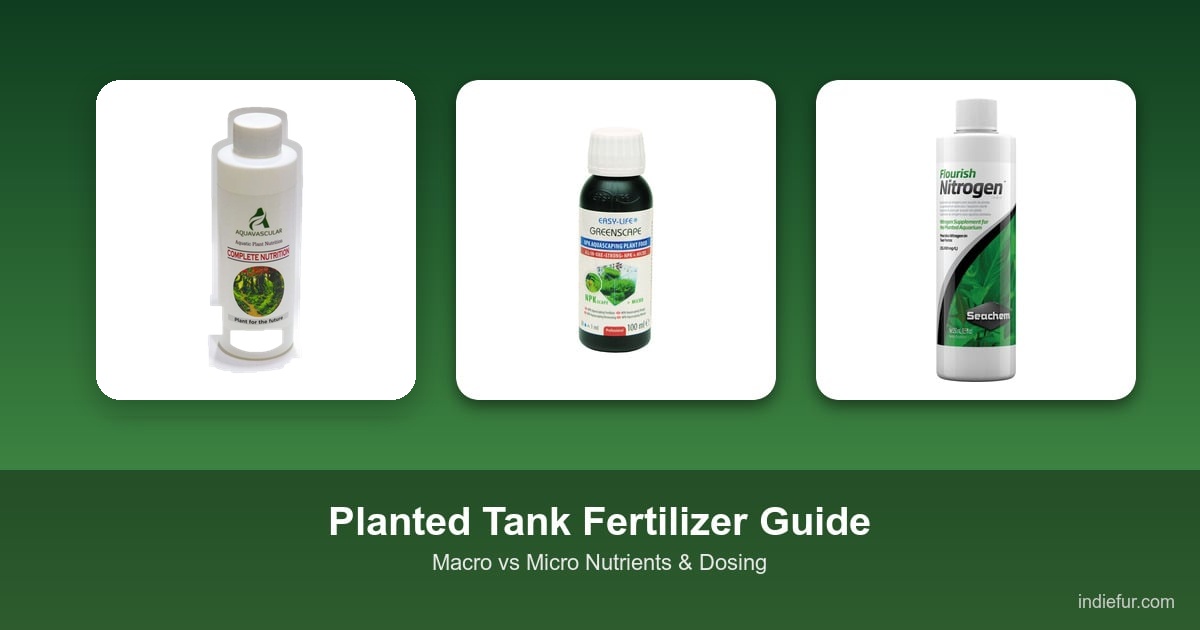
An all-in-one macro supplement like Aquavascular Macro Elements 250 ml is a practical way to dose nitrogen, phosphorus and potassium together without having to buy and balance three separate dry salts, especially useful for anyone new to dosing.
Micronutrients: small doses, big impact
Micronutrients (iron, manganese, boron, zinc, copper and molybdenum among others) are needed in far smaller quantities than macros, but a shortfall is just as visible. Iron deficiency is the one most hobbyists encounter first: new leaves emerge pale, yellow or almost white while the veins often stay green, a symptom called interveinal chlorosis. Because iron oxidises and becomes unavailable to plants fairly quickly in aquarium water, it typically needs more frequent, smaller doses rather than one large weekly dose.
A liquid micro/trace blend such as Easy Life GreenScape NPK+Micro 100 ml is formulated for exactly this: regular small doses of chelated trace elements that stay available to plants for longer, which suits nano and lightly stocked planted tanks where large weekly dosing swings are harder to manage.
Choosing between separate dosing and all-in-one fertilizers
There are two broad approaches to fertilizing a planted tank:
- All-in-one liquid fertilizers combine macro and micronutrients in one bottle, dosed on a simple schedule. These are the easiest entry point and work well for low-to-medium tech tanks without CO2 injection. A product like Aquavascular Complete Nutrition 250 ml falls into this category: one bottle covering the core nutrient bases for a community planted tank.
- Separate macro and micro dosing gives you independent control over each nutrient group, which matters more in high-tech, CO2-injected tanks with fast-growing carpet plants and stem plants that consume nutrients at very different rates. This is more work but lets you correct a specific deficiency, say nitrogen alone with a targeted product like Seachem Flourish Nitrogen 250 ml, without also increasing potassium or iron unnecessarily.
For most home aquariums in India running moderate lighting without pressurized CO2, an all-in-one fertilizer dosed two to three times a week is more than sufficient. Reach for separate macro and micro products only once you’re running CO2 and see specific, identifiable deficiency symptoms that an all-in-one isn’t correcting.
Water hardness, GH/KH and remineralizing
Fertilizer dosing works hand-in-hand with your water’s general and carbonate hardness (GH/KH). Very soft water (common when using RO water or in regions with naturally soft tap water) can leave a tank short on calcium and magnesium even if you’re dosing macros and micros correctly, since GH minerals are a separate piece of the puzzle from NPK fertilizers. A remineralizer such as Easy-Life Osmo Vital restores GH and KH in soft or RO-treated water, which benefits both plant health and the many freshwater fish and shrimp that need stable hardness to thrive (currently out of stock; check back or ask staff for an equivalent GH/KH buffer).
A simple weekly dosing routine
- Day 1, after your weekly water change: dose your macro fertilizer per label instructions based on tank volume.
- Day 2-3: dose your micro/trace fertilizer at a lighter, more frequent interval since iron and trace elements deplete faster.
- Day 4: repeat the macro dose if running a leaner “estimative index” style schedule, or skip if using a lower-dose all-in-one product.
- Day 5-6: repeat the micro/trace dose.
- Day 7: do a water change, then restart the cycle. This weekly reset prevents any single nutrient from building up to excess while keeping the overall supply steady.
Always start at the lower end of a product’s recommended dosing range in a new tank and increase gradually while watching for algae response. It’s far easier to correct an under-dosed tank than to recover from an algae bloom caused by excess nutrients paired with too much light.
Reading deficiency symptoms
| Symptom | Likely Cause |
|---|---|
| New leaves pale/yellow, veins still green | Iron deficiency |
| Pinholes or yellowing on older leaves | Potassium deficiency |
| Stunted new growth, dark curling leaves | Phosphorus or calcium deficiency |
| Overall pale colour, slow growth despite good light | General nitrogen shortfall |
| Melting or soft, mushy leaves in soft water | Low GH/KH: consider a remineralizer |
Getting fertilizing right is less about any single “perfect” product and more about consistency: a modest, regular dosing routine using a mix of macro, micro and hardness support will outperform an occasional large dose every time. Once your plants are growing steadily, they become one of the best long-term tools for keeping algae in check and water quality stable.