If you already understand the difference between macro and micronutrients and want the underlying chemistry, including what NPK does, how to read a deficiency symptom, and how to structure a weekly dosing routine, our Planted Tank Fertilizer Guide: Macro vs Micro Nutrients & Dosing covers that in depth. This guide starts from the opposite direction: you know you need to fertilize, and you’re standing in front of four or five different brands trying to work out which one to actually put in your cart. Here’s how Aquavascular, Easy Life, Seachem Flourish, and Tropica differ in practice.
Before you pick a brand: three questions to ask
A few basic questions settle most of the decision before you ever compare labels. Spend a minute on these first.
Do you have CO2 or not?
Fertilizer, light and carbon have to move together. A tank with no pressurized CO2 and gentle lighting grows slowly, so it uses nutrients slowly. Dose heavily there and the surplus feeds algae instead of plants. A tank with injected CO2 and strong light gets through nutrients fast, and that is where separate macro and micro bottles start to earn their space on the shelf.
What are you actually growing?
Rooted plants like swords and crypts pull a lot from the substrate, so root tabs are a natural fit for them. Fast stem plants and floaters feed mostly from the water column, which means liquid dosing does the work. Red stems want extra iron and trace elements to keep their colour. Look at your plant list first, and the brand choice gets much easier.
How much time will you really give it?
Be honest here. A weekly routine you skip every second week does worse than a simple one you never miss. If you travel a lot or tend to forget, lean toward fewer bottles and slow-release options.
Aquavascular: a full modular range
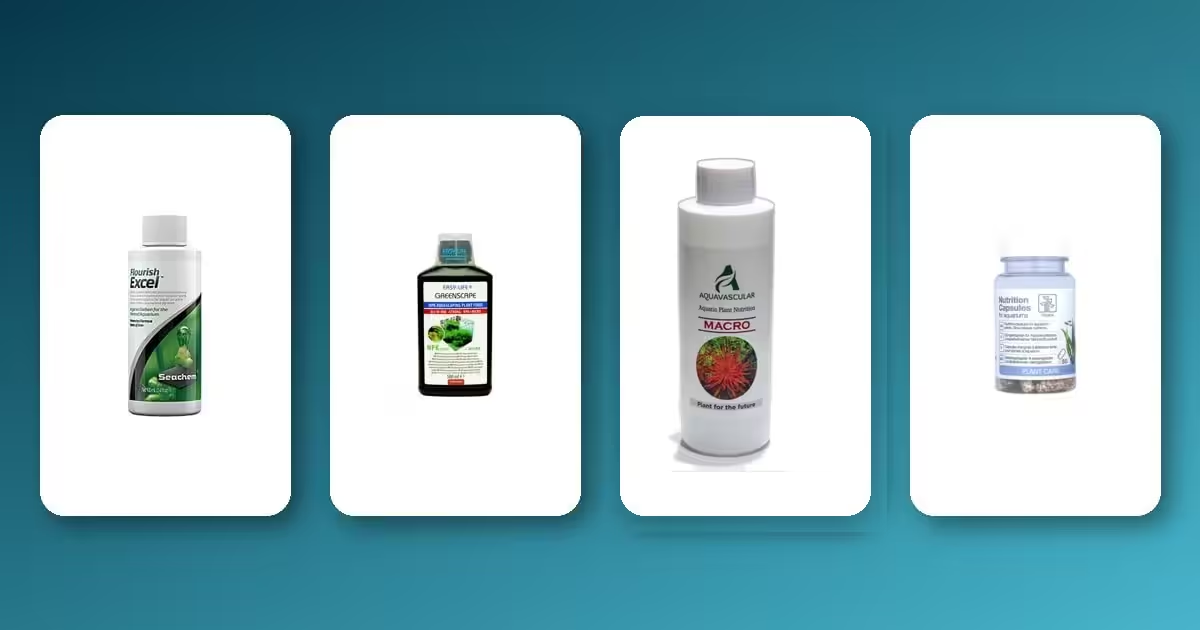
Aquavascular is built as a complete, mix-and-match dosing system rather than one or two flagship bottles. Aquavascular Macro Elements and Aquavascular Micro Elements dose the two core nutrient groups independently, which suits CO2-injected tanks where you want separate control over each. For hobbyists who’d rather dose one bottle, Aquavascular Complete Nutrition combines both into an all-in-one. The range goes further than most competitors on hardness support too: Aquavascular KH Booster and GH Booster (Cal Mag) restore carbonate and general hardness independently of NPK dosing, and Aquavascular Kalrich and Ferropure isolate potassium and iron for hobbyists chasing a specific deficiency rather than a broad-spectrum top-up. For carpeting plants and heavy CO2 setups specifically, Aquavascular PGR1 and PGR2 are formulated as a two-part growth regime.
This range is the best fit for hobbyists who want granular, element-by-element control and don’t mind managing several bottles.
Easy Life: two distinct product families
Easy Life splits its planted-tank range into two purposes that are easy to confuse by name alone. The GreenScape NPK + Micro Fertilizer (available in 250ml and 100ml as well) is a genuine all-in-one, covering macro and micronutrients in one bottle for straightforward weekly dosing. The RedScape Aquascaping Fertilizer line (also in 250ml and 100ml) is positioned specifically for red-leaved stem plants, which need proportionally more iron and trace elements to hold their coloration than green plants do.
Beyond the two headline fertilizers, Easy Life’s supporting range covers carbon and problem-specific dosing: Easy Life EasyCarbo Bio and standard Easy Carbo supply a liquid carbon source for tanks without pressurized CO2, Easy Life Profito and Ferro round out trace and iron dosing, and Easy Life AlgExit targets algae outbreaks that sometimes follow an over-fertilized tank rather than an under-fertilized one.
This range suits hobbyists who want one clearly-labeled bottle per goal (general growth vs. red coloration) rather than assembling a system from separate elements.
Seachem Flourish: buy the base, add what’s missing
Seachem’s approach is a base fertilizer plus a-la-carte additions. Seachem Flourish is the foundational all-in-one, covering a broad range of trace elements for general planted tank health. From there, Flourish Iron, Flourish Nitrogen, Flourish Potassium, Flourish Phosphorus, and Flourish Trace let you supplement a single nutrient once you’ve identified a specific deficiency, the same principle behind Aquavascular’s element-by-element bottles, but built around a Flourish base rather than a standalone macro/micro split. Seachem Flourish Excel is Seachem’s liquid carbon source, directly comparable to Easy Life’s EasyCarbo, and Flourish Advance is a newer growth stimulant aimed at root and overall plant development.
Seachem Flourish is the natural pick for hobbyists already using other Seachem products (Prime, Stability) who’d rather standardize on one brand across water conditioning and fertilizing.
Tropica and ISTA: low-maintenance options
For hobbyists who don’t want to manage a weekly liquid dosing schedule at all, Tropica Nutrition Capsules are pre-measured root-tab capsules pushed into the substrate near root-feeding plants, delivering a slow-release dose without any liquid measuring. ISTA Water Plant Trace Elements (120ml, also in 250ml) is a straightforward trace element top-up that pairs well with any of the all-in-one fertilizers above if you’re seeing early micronutrient deficiency signs between doses.
CO2 support without pressurized injection
If you’re not running a pressurized CO2 system, API CO2 Booster and API Leaf Zone offer a lower-cost entry point than a full liquid carbon line, though EasyCarbo and Flourish Excel above are generally considered more concentrated options for the same purpose.
Starting dose and how to adjust
Every bottle in this guide carries its own dosing instructions, and you should follow the label for your tank volume. Maker guidance differs between brands, and no single figure would fit all of them. What follows covers how to behave around that starting point.
- Start at the low end of the label range, especially in a new tank with few plants.
- Change one thing at a time. Raise the dose and add more light in the same week, and you will never know which one caused the algae.
- Give any change a couple of weeks before judging it. Plants respond slowly, and fresh growth tells you far more than the old leaves do.
- Keep up with water changes. Fertilizer left to build up is a common reason a once healthy tank turns green and hazy.
Signs you are overdosing, and signs you are underdosing
Too little tends to show as pale or stunted new growth, or holes appearing in older leaves. Yellowing on the oldest leaves while the rest of the plant looks fine is another common hint. Pinning down which nutrient is short from one symptom is harder, and the deficiency section of our fertilizer guide walks through it in detail. Too much usually looks like sudden algae, hair algae on leaf edges, or a film that returns days after you clean it. Livestock can react too. If fish start gasping or behaving oddly after a dose, stop and do a water change before anything else.
One more point catches people out. An algae bloom does not automatically mean you are overfeeding. Weak light, low CO2 and an unsteady routine cause it just as often. Check those before you cut the dose to nothing and starve the plants.
Mixing brands in one tank
You can mix, and plenty of hobbyists do. A common pattern is one all-in-one as the base, then a single targeted bottle to patch a gap, such as iron for red plants. The risk is doubling up without noticing. Two products can both contain the same trace element, and adding them together overshoots what either label expected. Read both labels. Keep a simple note of what went in and when. Add the second product slowly.
Root tabs and liquids together
These two work well side by side. Liquids feed through leaves and the water column, so they reach floaters, mosses and stem plants quickly. Root tabs sit in the substrate and feed heavy root feeders at the source, which keeps nutrients out of the water where algae can grab them. A tank with a rich substrate and a mix of plant types often does well with tabs for the rooted plants and a light liquid routine for the rest.
Common questions
Do I need fertilizer if I have a nutrient rich substrate?
Yes, eventually. A good substrate feeds roots for a while, but it runs down over time, and plants that feed from the water still need something in the column. Watch your plants. When new growth slows or pales, that is your cue to start liquid dosing or push in root tabs.
Can I fertilize a tank with no CO2?
Yes, but go light. Slow growth means low demand. A gentle routine with an all-in-one, or just root tabs, is usually enough, and a liquid carbon product can help if you want a little more growth.
Is it safe to use fertilizer in a tank with shrimp?
Many hobbyists keep shrimp in planted tanks without trouble, but invertebrates can be touchier than fish. Check the label of each product for any warning about invertebrates, dose at the low end, and watch the shrimp after the first few doses.
Quick reference
| You want | Product line |
|---|---|
| Element-by-element control | Aquavascular Macro/Micro Elements |
| One all-in-one bottle | Easy Life GreenScape, Aquavascular Complete Nutrition, Seachem Flourish |
| Red-leaved stem plants specifically | Easy Life RedScape |
| Liquid carbon (no pressurized CO2) | Easy Life EasyCarbo Bio, Seachem Flourish Excel |
| Targeted single-nutrient top-up | Seachem Flourish Iron/Nitrogen/Potassium/Phosphorus, Aquavascular Kalrich/Ferropure |
| GH/KH hardness restoration | Aquavascular GH Booster, KH Booster |
| No weekly dosing at all | Tropica Nutrition Capsules |
Making the call
If this is your first planted tank, pick one all-in-one (GreenScape, Complete Nutrition, or base Flourish) and dose it consistently for a month before adding anything else; a single well-dosed all-in-one outperforms three mismatched single-nutrient bottles used inconsistently. Once you’re running CO2 and pushing faster growth, that’s when it’s worth switching to element-by-element dosing (Aquavascular’s individual bottles or Flourish’s single-nutrient line) so you can correct a specific deficiency without over-dosing everything else. For the deficiency symptoms themselves and a suggested weekly schedule, our Planted Tank Fertilizer Guide walks through both in detail. To see how five brands compare on NPK content, dosing volume and cost per ml, read our aquarium fertilizer comparison. If you are still choosing the soil that goes under all this, our aqua soil guide compares the main options.