Freshwater shrimp are more sensitive to water parameters than most community fish, and a tank built with the same defaults as a fish tank often fails them within weeks. This beginner’s shrimp keeping guide walks through how to set up a shrimp tank in the order it should happen, starting with choosing a species.
Plan and shop
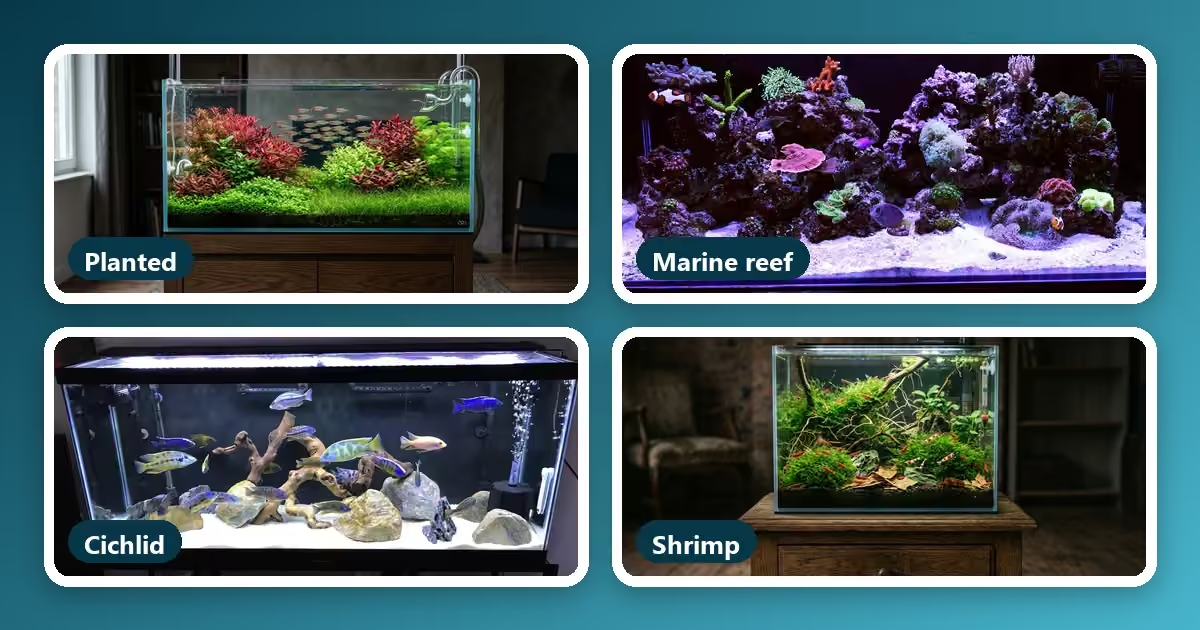
Starting or upgrading? Choose your tank size and type, planted, community, shrimp, cichlid or marine, then add the equipment list to your cart.
Neocaridina vs Caridina shrimp
Neocaridina shrimp (Cherry Shrimp, Red Rili, Blue Dream, and similar color morphs) are the right starting point for almost every beginner. They tolerate a wide GH/KH range, breed readily, and are forgiving of minor parameter swings that would stress more sensitive species.
Caridina shrimp (Crystal Red/Black, Sulawesi species, Bee shrimp) need soft, acidic water within a narrow range and are far less forgiving. They’re a second-tank project once you’ve got Neocaridina care down, not a first purchase. Remineralized RODI water is close to mandatory for keeping them long-term.
Choose the tank size and spot
Smaller tanks are harder to keep stable than larger ones, since less water volume means parameter swings happen faster. Start with at least 10-20 litres rather than a true nano tank, and go bigger if you have the space: a larger tank forgives a missed water change or a little extra food far better than a small one.
Put the tank on a level, sturdy stand, away from direct sun and from windows that catch afternoon light, which heat a small tank quickly and feed algae. Shrimp do sometimes climb or jump out, so keep a lid or cover on the tank.
Cycle the tank before adding shrimp
Shrimp are more sensitive to ammonia and nitrite than most fish, so a partial or rushed nitrogen cycle that a hardy fish might survive can wipe out an entire shrimp colony. Fully cycle the tank first (ammonia and nitrite both reading zero, nitrate present), and ideally let it run planted and stable for a couple of extra weeks beyond that before adding shrimp.
Cycling means growing the bacteria that turn ammonia into nitrite and then into nitrate. Set the tank up with its substrate, filter and plants, fill it with dechlorinated water, add a source of ammonia (a small pinch of fish food left to break down is the usual one) and test every few days. Go by the test readings to know when it is done, and expect it to take several weeks.
Substrate and hardscape
The substrate decides how much your water chemistry will drift. Inert sand or gravel leaves GH and KH where you set them. A buffering soil (our aquasoil glossary entry explains how they work) pulls the water softer and more acidic, which suits Caridina but can push a Neocaridina tank below the range you are aiming for. Fluval describes Fluval Bio Stratum Plant Soil 2 kg as suited to tropical fish and shrimp in planted tanks, and also says it softens water and reduces carbonate hardness, so test KH once the tank is filled.
Rinse driftwood and stones before they go in, and follow the pack instructions for your substrate. Driftwood and stones give shrimp surfaces to graze and places to hide while they molt, but pick stones that do not dissolve: a rock that fizzes when you drop vinegar on it is releasing minerals and will keep pushing GH and KH up.
Plants and moss
Plant heavily, or add moss (Java Moss, Christmas Moss), since shrimp are soft and vulnerable right after molting and baby shrimp need dense cover to hide. Plants and moss also hold the biofilm that shrimp graze on all day. Moss can be tied to wood or stone with cotton thread, or fixed with gel glue: the Seachem Flourish Glue page says it is safe for fish and shrimp once cured.
Fertilizer is a common way for copper to reach a shrimp tank. Some liquid fertilizers list copper among their trace elements, so read the label before you dose.
Filtration that is safe for shrimp
Shrimp, and especially shrimplets, get pulled into unguarded filter intakes, so the filter matters more here than in a fish tank. The safest design is an air-driven sponge filter, which has no impeller to pull anything in. Our guide to sponge, undergravel and sump filters explains how they work. The ISTA Aquarium Ceramic Internal Filter is built this way according to its product page, with a sponge over a ceramic ring base, and it runs off an air pump (ISTA does not publish a required pump output, so ask us before you pair one). Squeeze its sponge out in a bucket of old tank water, never under the tap, because chlorine kills the bacteria that do the filtering.
A powered filter also works if the intake is covered. The inlet sponge on the Ista Hang On Filter 280 stops small fish and shrimp being drawn in, according to its product page. Check its flow against your tank size. On any other filter, fit a sponge or fine mesh guard over the intake. Keep the flow gentle, since strong current wears shrimp out and blows food around.
Water source, GH, KH and TDS
Test GH and KH specifically, not just pH. Neocaridina generally do well around GH 6-8 / KH 2-4, while Caridina species need much softer water and stable, usually lower, GH/KH. Test your tap water before you buy anything, because tap water in India varies a lot between cities and can change with the season.
If the tap water tests close to the Neocaridina range, you can use it with a dechlorinator. The Seachem Prime page says it removes chlorine and chloramine. If your tap water is much harder than the target, or you plan to keep Caridina, use RODI water. RODI is stripped of almost all minerals, so it has to be remineralized before shrimp can live in it. Seachem Equilibrium 300g raises GH with calcium, magnesium and potassium and contains no sodium or chloride, and its page says it is meant for RO or DI water and goes into new water at water changes, not into top-ups. It does not set KH: Seachem recommends a separate buffer for that. Mixing RODI with a measured share of tap water is another common way to land on the target.
A TDS pen reads total dissolved solids. It shows when new water differs from tank water, but it cannot tell GH from KH.
The single most important rule: copper is lethal to shrimp even in trace amounts. Check that any fertilizer, medication, or tap water conditioner used in a shrimp tank is explicitly copper-free: many general fish medications and some plant fertilizers are not.
Temperature and lighting
Temperature in the 22-24°C range is safer than pushing warmer, since heat accelerates metabolism and shortens shrimp lifespan. In an Indian summer an unshaded room can run well above that, and a small tank follows the room, so keep the tank out of the sun and consider a fan blowing across the water surface, which cools by evaporation. A thermometer that shows tank and room temperature together helps: the Fluval Wireless 2-in-1 Digital Aquarium Thermometer sticks to the outside of the glass and reads both, within 1°C according to its page.
Shrimp do not need strong light. The light is for the plants and for the biofilm and algae the shrimp graze, so run it on a timer and keep the hours short and regular, since long days feed algae. Our freshwater planted tank lighting guide covers what plants actually need.
How to acclimate shrimp
Shrimp feel sudden changes in GH, KH, pH and TDS much more than fish do, so the water from the shipping bag should never go straight into your tank. Drip acclimation lets the shrimp adjust gradually.
- Check that the tank is cycled, and test GH, KH and temperature. Dim the room lights.
- Float the sealed bag for a short while so the temperature matches.
- Open the bag and pour the shrimp and their water into a clean plastic container or bucket that has never held soap or chemicals.
- Run a length of airline tubing from the tank to the container. Start the siphon, then slow it with a knot or a small valve until the water only drips.
- Let it drip until the water in the container has at least doubled. Take your time: longer is safer than shorter, especially if the shipping water was very different from the tank.
- Scoop the shrimp out with a fine net or a small cup and put them in the tank. Throw the container water away instead of tipping it in.
- Keep the lights low and skip feeding on the first day. Shrimp usually hide for a while before they start grazing.
Feeding shrimp
Shrimp graze biofilm and algae continuously and need far less supplemental feeding than fish. Overfeeding is a much more common mistake than underfeeding, since uneaten food fouls water fast in a small tank. A tank that has run planted for a few weeks already has biofilm to graze, so skip food on the first day. After that, offer a small pinch and watch: anything still sitting there the next day should come out.
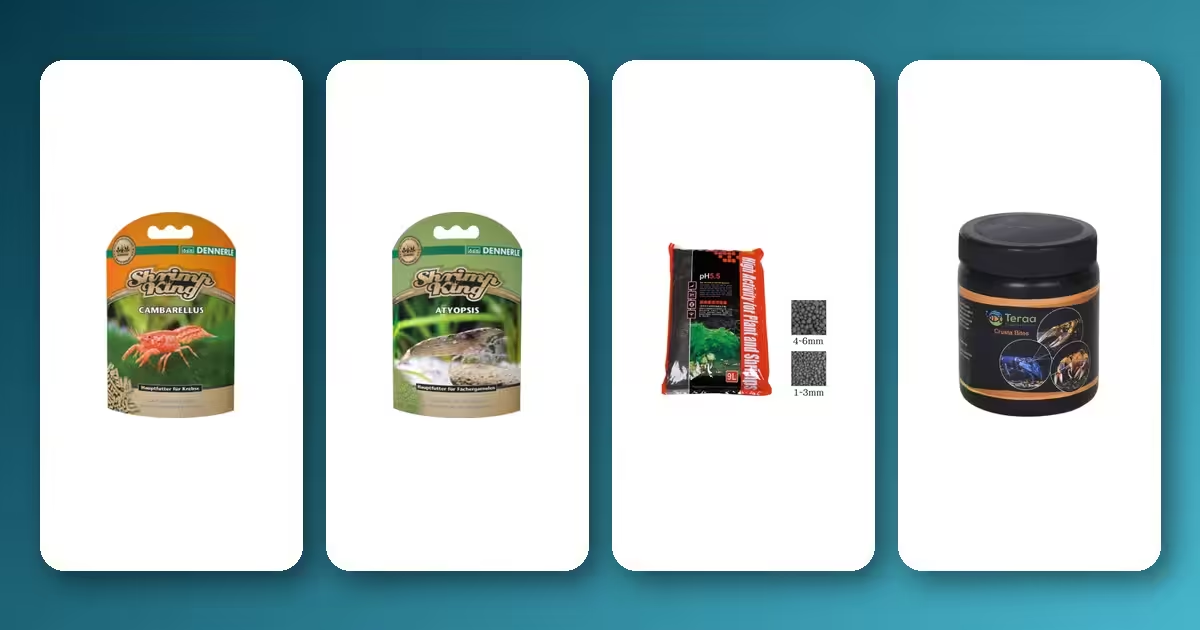
Purpose-made shrimp foods and mineral supplements (like the Shrimp King range) are formulated around this lower feeding volume, plus the mineral needs shrimp have that standard fish food doesn’t cover. For young shrimp, Shirakura Chi Ebi 20 gm is a powdered baby shrimp food that, according to its page, encourages the biofilm and microorganisms shrimplets graze on.
What to test and how often
- While cycling: ammonia, nitrite and nitrate every few days, until ammonia and nitrite hold at zero.
- Before the shrimp arrive: GH, KH, pH, TDS and temperature, so you know what the drip has to match.
- First few weeks with shrimp: ammonia and nitrite every few days, plus GH, KH and TDS regularly.
- Once the tank is settled: GH, KH, TDS and nitrate at each water change, and a glance at the thermometer every day.
The API Freshwater Master Test Kit covers pH, high range pH, ammonia, nitrite and nitrate according to its page, but not GH or KH, so add a separate GH/KH kit. Keep water changes small and regular, using conditioned water matched to the tank in temperature, GH, KH and TDS, added slowly. A big change shifts GH, KH, TDS and temperature all at once.
Common beginner mistakes
- Adding shrimp before the tank is fully cycled
- Using a copper-containing fertilizer or medication in a shrimp tank
- Overfeeding, which crashes water quality fast in low-volume tanks
- Mixing varieties that interbreed (different Neocaridina colors, or different Caridina varieties), which lose their color lines over generations, or keeping Neocaridina and Caridina together when they need different water
- Skipping GH/KH testing and only checking pH, which misses the parameters shrimp actually care about most
- Large water changes, or new water that differs from the tank in temperature or hardness
- Leaving a filter intake unguarded
- Tipping the shipping bag water into the tank, or skipping acclimation
- Putting the tank in direct sun or a hot room
When to add more shrimp
Wait until the first group has settled. Good signs are shrimp grazing in the open, empty molts on the substrate, no unexplained deaths over a few weeks, and GH, KH and ammonia holding steady. Add further shrimp in small groups, acclimate each batch the same way, and stay with one variety. A healthy colony grows on its own, so there is rarely a reason to overstock on day one.
Shop for your shrimp tank
Browse Freshwater Shrimp Food and Planted Aquarium Test Kits at IndieFur.
FAQ
Can I keep shrimp with fish?
Neocaridina can coexist with small, peaceful fish that won’t hunt them, but most fish will eat shrimplets given the chance, so a shrimp-only tank is the safest way to build up a breeding colony.
How many shrimp should I start with?
10-15 Neocaridina is a reasonable starting colony size for a 10-20L tank, enough to establish a breeding population without overloading a new setup.
When can I add shrimp to a new tank?
Once the tank has fully cycled (ammonia and nitrite at zero, nitrate present) and then run planted and stable for a couple of extra weeks.
How do I add shrimp to the tank?
Use drip acclimation: drip tank water slowly into a container holding the shrimp until the volume has at least doubled, then net them into the tank and discard the container water. The full steps are in the acclimation section above.
Why do my shrimp keep dying with no obvious cause?
Check for copper exposure first (fertilizers, tap water, medications), then verify the tank is fully cycled. Both are the most common invisible killers in shrimp tanks.