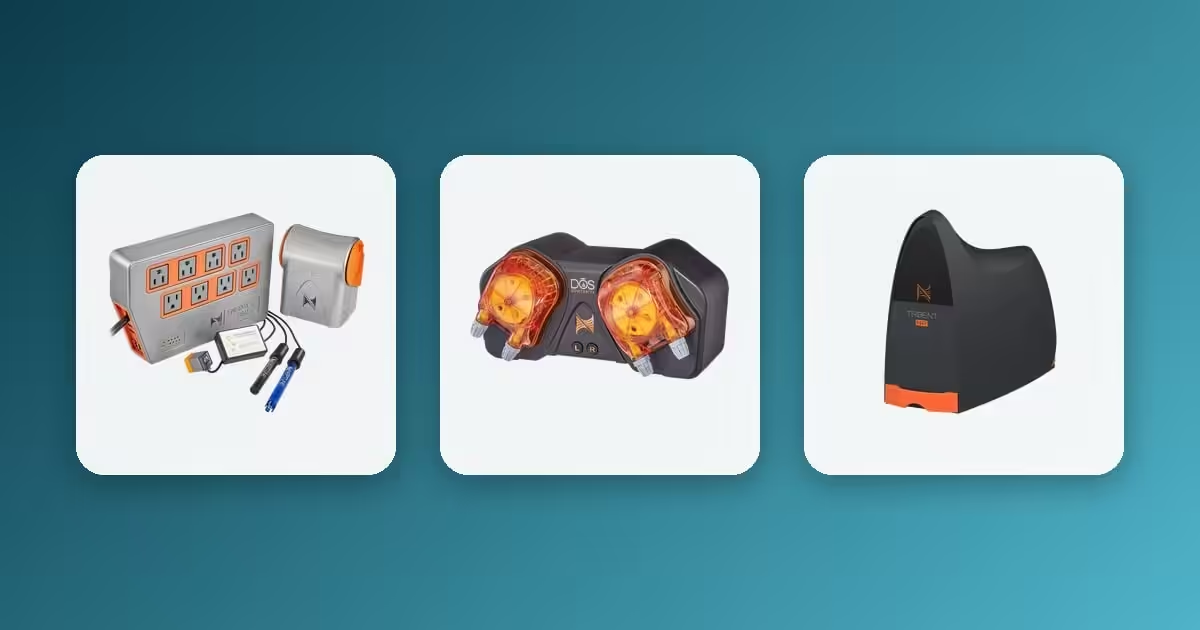
Neptune Systems builds around one idea. Put monitoring, dosing and equipment control under a single brain and a reef tank runs steadier than it does on a shelf of separate timers and testers. The Apex controller is that brain. Almost everything else Neptune makes plugs into it: dosing pumps, automated testers, probes, flow sensors, leak detectors. Below is the range, from the controller outward, using the Neptune Systems items IndieFur carries.
I run an Apex A3 Pro system along with Trident, Trident NP and an Autofeeder. If you still test calcium by hand, our Salifert Calcium Test guide shows the manual routine that Trident takes over.
The controller: where everything reports
The Neptune A3 Apex Aquarium Controller System is the current generation’s core unit. It monitors temperature, pH and other parameters and controls connected equipment through programmable outlets. The Neptune A3 Apex Jr Aquarium Controller System is the smaller version for nano and mid-size tanks that don’t need the full outlet count. The Neptune A3 Apex Pro Aquarium Controller System adds extra probe and expansion ports for larger, heavily automated systems.
Neptune also sells combination packages if you’d rather not piece it together. There’s an Apex system bundled with an extra Energy Bar 832 power bar for more controllable outlets. An EB4 and A3 Apex Jr bundle pairs the base unit with an Energy Bar 4 and essential probes. A Trident-and-Apex bundle covers control and automated testing in one purchase.
Automated testing: Trident
Hand testing is accurate. It’s also easy to fall behind on. Neptune’s Trident line automates the parameters coral health depends on most. The Neptune Trident NP Nitrate and Phosphate Tester and the Neptune Trident ACM Alkalinity, Calcium and Magnesium Tester run scheduled tests and log every result, so drift shows up as a trend instead of a surprise at your next manual test.
Both ship without reagents. The NP tester takes the Neptune Systems 2 Month Trident NP Reagent Kit, and the ACM tester takes the 2 Month Trident Reagent Kit.
What the Trident ACM reports, and how often
Neptune’s Trident FAQ, which covers the alkalinity, calcium and magnesium analyzer, gives a stated precision of plus or minus 0.05 dKH for alkalinity and plus or minus 15 ppm for calcium and magnesium. The measuring ranges are 5.0 to 15.0 dKH, 250 to 875 ppm calcium and 850 to 1,950 ppm magnesium, so a tank sitting outside those bands is beyond what the analyzer can measure.
The default schedule is four alkalinity tests a day, one every six hours, and two calcium and magnesium tests, one every twelve hours. The interval can be raised to 24 alkalinity tests and 12 calcium and magnesium tests daily. Each test uses about 7 mL of water per parameter on average, and the waste cannot be directed back into the aquarium.
Dosing: DOS and its replacement parts
The Neptune DOS Quiet Drive Dosing Pump is Neptune’s precision dosing pump. It runs calcium, alkalinity, magnesium or trace element supplementation on an automated schedule tied to Apex Fusion. Wear parts need replacing now and then. The replacement pump head assembly swaps tubing, roller and housing cap in minutes, and replacement tubing comes in 16-meter and 4-meter lengths for extending the run between pump and reservoir or tank. Check with IndieFur directly before ordering these parts.
Calibrating a DOS before it doses
Calibrate each pump before it doses. Neptune’s Dosing and Fluid Metering System (DS) setup guide, written for the original DOS, says an uncalibrated pump will not dispense an accurate amount of fluid. Calibration takes minutes. One pump at a time runs for a fixed period, and you measure what comes out in the graduated cylinder supplied with the unit. The original DOS guide has the pump run for about 90 seconds on tap water and expects roughly 40 mL, though a little more or less is normal, and it is that exact measured amount which becomes the calibration. Read the level at eye height, from the meniscus. Quiet Drive steps and timings are in its own manual.
Neptune says to recalibrate any time you change the fluid being pumped, change the tubing orientation or replace the pump tubing. The guide also says most users should build their schedules with the wizard in Apex Fusion, and keeps hand-written programming for advanced users.
The pumps have built-in limits. They exist to stop overheating. A “Too much dosing in too short a period” error appears when the dose interval is too short, and the guide’s rule is that the interval should be at least three times the time one dose takes to deliver. Its worked calcium and alkalinity example doses the two parts 30 minutes apart to avoid precipitation, and suspends dosing if pH rises above 8.40. Those are example figures. Set your own from the manual that came with your pump.
Test before you trust the doser
Dosing without proper testing causes problems when people start auto-dosing.
Don’t set dosing quantities from one type of test. Cross check with another test kit and take an average value.
When you first start dosing, test after 48 hours. Then test weekly. Then move gradually to monthly.
Feeding
The Neptune AFS Automatic Feeding System is built for reef tanks. It has a stay-dry food chamber and can pause skimmers and return pumps briefly at feeding time, so the food isn’t pulled into filtration before the fish get to it. For a wider look at automatic feeders, our Automatic Fish Feeder Guide covers the freshwater side of the category.
How the AFS gets programmed
Neptune’s AFS setup guide says no configuration is needed. Once the Apex creates the feeder outlet, you can start programming. To test it, set the outlet to ON. The drum should extend, rotate once and retract. An orange slider on the drum sets how much food drops on each rotation.
The feed wizard asks for a first feeding time, a repeat interval, drum rotations per feeding and feedings per day. Because the AFS understands the usual Apex commands, the guide shows an example line that stops feeding when ORP reads below 300, and another that suspends it while an email alarm outlet is on. It also notes that the drum turns once every time power is applied, and that picking a feed timer from the Display or Dashboard gives a single drum rotation feed.
Flow and return pumps
Neptune’s COR return pumps connect straight to an Energy Bar 832 or 1Link module. No separate power adapter. Paired with a controller, they open up advanced flow control through Apex Fusion. The COR-15 moves up to 1,500 GPH and the COR-20 up to 2,000 GPH.
Refugium lighting
The Neptune GRO Refugium Light has 84 LEDs in a growth-optimized spectrum, in a compact IP64 water-resistant fixture. It’s made for growing macroalgae like chaetomorpha as a natural nutrient export. Pick the flat bracket mount for a sump edge or the gooseneck pipe-clamp mount, whichever suits your sump layout.
Monitoring modules and probes
Neptune’s PM-series modules each add one kind of monitoring. The PM1 handles pH or ORP. The PM2 adds continuous real-time salinity monitoring, which gives early warning when a top-off unit sticks. The PM3 adds dissolved oxygen monitoring within the reef-safe range of 4.5 to 7 ppm.
The FMM Fluid Monitoring Module adds flow monitoring, leak detection and water level management across four ports. It pairs with Neptune’s FS-series flow sensors, made in 1/4″, 1/2″, 1″ and 2″ sizes to match different plumbing, for real-time flow readings on pumps and reactors. The LDK Leak Detection Kit adds expandable leak sensors through the AquaBus connection. A leak caught early can save a tank from total loss.
Expansion and utility
The 1Link Power and Communication Module lets a single outlet run up to three WAV pumps, or two WAV pumps plus a DOS pump, and unlocks Apex Fusion’s flow modes for them. The I/O Breakout Box adds up to six external switch connections for float switches, push buttons and magnetic switches. The Apex Display Module puts key water parameters on a backlit LCD at the tank and lets you trigger feed modes without a phone or computer.
The ATK V2 Auto Top Off Kit is a plug-and-play kit with dual optical sensors and a mechanical float valve backup. It works standalone, with no Apex controller at all.
Bridging to other brands: MXM Mobius
The Neptune MXM Mobius Wireless Control Module connects EcoTech Marine and AquaIllumination gear, pumps and lights, to an Apex wirelessly. Equipment from both brands then runs from one Apex Fusion interface. It works with all A2 and A3 Apex systems, and it’s the link between a Neptune-controlled tank and EcoTech lighting. Our EcoTech Marine Reef Lighting Guide covers the lighting side of that pairing.
Quick reference
| Need | Product |
|---|---|
| Core monitoring & control | A3 Apex, Apex Jr, Apex Pro |
| Automated water testing | Trident NP, Trident ACM |
| Precision dosing | DOS Quiet Drive Dosing Pump |
| Automated feeding | AFS Automatic Feeding System |
| Return flow | COR-15, COR-20 |
| Refugium growth | GRO Refugium Light |
| Salinity / DO / pH monitoring | PM1, PM2, PM3 modules |
| Flow & leak monitoring | FMM, FS flow sensors, LDK |
| Auto top-off without Apex | ATK V2 |
| Cross-brand light/pump control | MXM Mobius Module |
Building the system in order
Start with the Apex controller. Nearly everything else in the range either plugs into it or is far more useful once it does. After that, look at what’s still manual in your routine and error-prone. Hand-testing calcium and alkalinity keeps slipping? Add Trident. Dosing by hand every day? Add DOS. Feeding times drifting? Add the AFS.