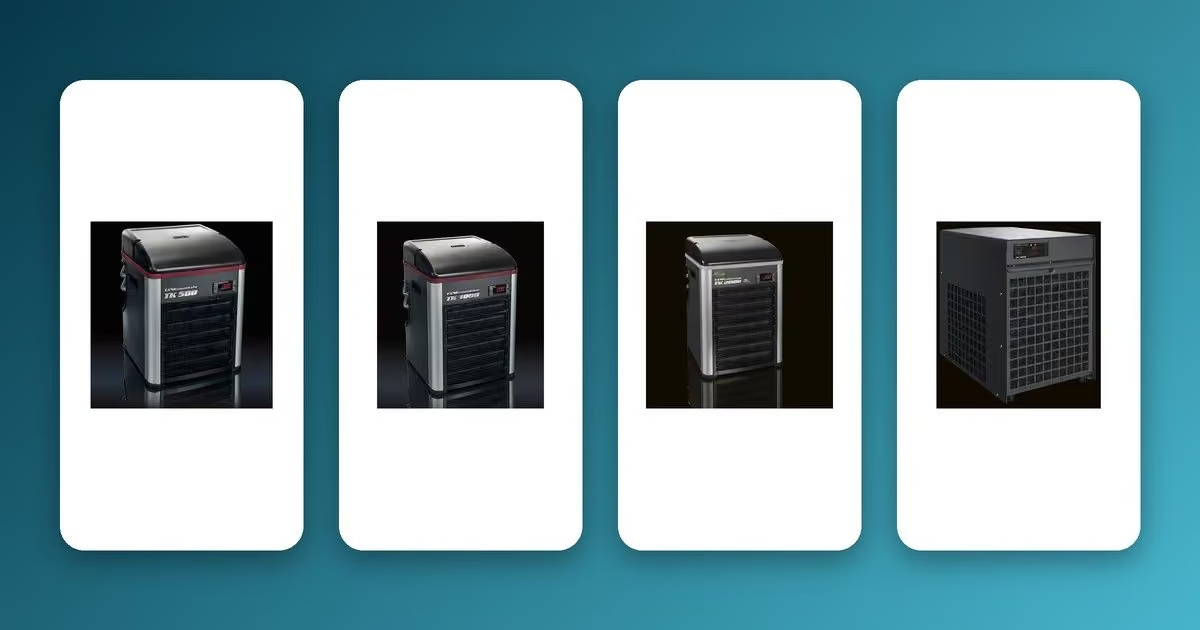
I run a Teco TK 2000 with heater on my own 525 litre Red Sea Reefer. The set point is 25°C. Teco’s catalogue rates that chiller for 2,000 litres. I run it on roughly a quarter of that volume.
A litre rating printed on a chiller and the tank it can hold steady in an Indian summer are two different numbers.
Room temperature decides
The first question is the room. My rule is that every tank needs a chiller where the ambient room temperature goes above 26 to 27°C.
Heat explains the rule. An aquarium with no cooling cannot sit below the air around it, and the lights, the return pump and any powerheads all add heat to the water on top of that. A room at 31°C means water at 31°C or warmer, which is past the comfortable range for most of what people keep.
So the first tool you need is a room thermometer. Put it near the tank, away from a window, and read it at about 3 pm on the hottest days of the year. Read it again late at night. Those two numbers tell you more than any species chart.
Two published figures show how narrow the margin is at the top end.
- NOAA’s Coral Reef Watch sets its bleaching threshold at 1°C above the highest normal summer monthly mean for a reef. NOAA’s own explanation describes ocean reefs, and a home tank is a different system, but it shows that corals live close to their upper limit.
- A PLOS ONE study on red cherry shrimp kept the animals at 24, 28 and 32°C. Survival was high at all three, and the authors put the optimum at 28°C. Cherry shrimp are the hardy end of the shrimp hobby. Bee shrimp and other Caridina are kept cooler, and our shrimp tank setup guide covers their water in detail.
Where a fan is enough
A clip-on fan blowing across the surface cools by evaporation. Water that evaporates carries heat away with it, and the tank temperature drops below where it would otherwise sit.
My rule for fans is that a fan is enough when the ambient room temperature at all times remains below 28 to 29°C. The words “at all times” carry the weight. A room that sits at 27°C through the day and creeps to 28°C in the afternoon is fan territory. A room that touches 33°C for three hours every afternoon in May is outside it, even if the average looks fine.
Before you rely on a fan, know its limits.
- Evaporation depends on dry air. In coastal cities during humid months the air already holds a lot of moisture, less water evaporates, and the fan does less.
- The water you lose has to be replaced. Top up with RO or dechlorinated fresh water every day, because salt and minerals stay behind when water evaporates. On a marine tank an auto top off system does this for you.
- A fan has no set point. It cools as much as the air allows, and the tank still follows the room up and down.
If the room spends part of every summer day above 28 to 29°C, a fan will not hold the tank steady. That is where a chiller comes in.
What a chiller does differently
A chiller is a small refrigeration unit. Tank water is pumped through a heat exchanger inside it, a compressor pulls heat out of that water, and a fan at the back throws the heat into the room. A thermostat switches the compressor on when the water passes your set temperature and off again when it comes back down.
You set a number and the tank holds it. The room can warm up through the afternoon and cool again at night while the water stays close to the set point, as long as the unit is big enough. Some models include a heater, so one controller handles cold nights as well. I run one of those on my Reefer at 25°C.
If you want a separate heater for winter, our aquarium heater buying guide covers wattage by tank size.
Undersizing, the common mistake
The common sizing mistake I see is undersizing the chiller.
The way ratings are written makes it an easy mistake. Teco’s TK catalogue gives each model a litre figure, and it states the conditions behind that figure: water held at 25°C in a room at 30°C, with a light equipment load. That is a 5 degree gap between room and water.
| Model | Catalogue rating at 25°C water, 30°C room | Rated pump flow through the unit |
|---|---|---|
| Teco TK 500 | 500 litres | 500 to 800 l/h |
| Teco TK 1000 | 1,000 litres | 500 to 800 l/h |
| Teco TK 2000 | 2,000 litres | 500 to 800 l/h |
| Teco TK 3000 | 3,000 litres | 3,000 to 4,000 l/h |
Now compare those conditions with a real tank in a real Indian room.
Start with the gap. A reef held at 25°C in a 35°C room is a 10 degree gap, double what the rating assumes, so the chiller has to pull out far more heat every hour.
The equipment load is heavier too. Reef lighting, a return pump inside the sump and wave makers all heat the water, and the catalogue figure assumes very little of that.
Lower set points cost capacity as well. The same catalogue rates the TK 500 for 100 litres at 8°C water and the TK 3000 for 500 litres at 8°C. Capacity falls sharply as the target drops, which matters to anyone keeping axolotls or other cold water animals.
Take a 450 litre reef. The TK 500 says “500 litres”, and on paper that covers it. In a 34°C room with full reef lighting, that unit may run without a break and still lose ground on the worst afternoons. A compressor that never cycles off draws power all day.
Sizing in three steps
1. Get the real water volume. Tank dimensions overstate it, because glass thickness, rock, substrate and the water line all take litres away, and a sump adds some back. Our water volume calculator handles display and sump together.
2. Work out the pull-down. Subtract your target temperature from the hottest reading on your room thermometer. Moving one litre of water by one degree takes about 1.16 watt-hours, so a 525 litre system needs roughly 610 watt-hours removed for every degree, before lights and pumps add their share.
3. Add the equipment heat and pick the model. The aquarium chiller size calculator does this arithmetic. You enter litres, the hot day temperature, your target, and the wattage of your lights and pumps. It returns the cooling power you need and the Teco model that covers it.
If the result lands near the top of one model’s range, take the next model up. A larger chiller reaches the set point quickly and then rests. For very large systems, or a tank that needs heating from the same unit, the Teco TK 3000 With Heater does both jobs.
Flow and air after you install it
A chiller only cools the water that passes through it. Teco’s manuals give 500 to 800 litres per hour for the TK 500, 1000 and 2000, and they mean the actual flow at the unit, after the pipe run and the height the pump has to push against. A pump rated 1,000 l/h on the box may deliver half of that through two metres of hose. Our guide to choosing a submersible pump explains how head height cuts flow.
The heat a chiller takes out of the water goes into the room through its rear grille. Shut it inside a closed cabinet and it breathes its own hot air, and cooling drops. Teco’s catalogue also sets a working ceiling of 38°C ambient, so a balcony or a west-facing closed room in peak summer can push the unit past its limit. Give it open space on the intake and outlet sides, and rinse the air filter whenever you clean your tank filter, because a dusty filter chokes the airflow the same way a closed cabinet does.
Common questions
Is there a mini chiller for a small tank?
The smallest Teco is the TK 500. On a 60 to 150 litre tank it has a large margin over its catalogue rating, and in a room that goes well past 30°C that margin gets used.
Can I switch the chiller off at night?
Leave it on. The thermostat already stops the compressor when the water is at the set point. Switching it off by hand lets the tank drift up, and the unit then has to pull the whole swing back down.
Do I need a chiller if the room has AC?
If the AC holds the room below 26 to 27°C all day and all night, including the hours you are out, the tank has no heat problem. Most people run AC for part of the day. Go by the thermometer reading in the hours when it is off.
Will a chiller work during power cuts?
A compressor draws several hundred watts, far more than a filter or an air pump, so a small inverter will not run it for long. Plan for circulation and aeration on backup power, and let the chiller bring the temperature back when the mains returns. Our guide to filters for Indian conditions covers power cut planning.
Start with a thermometer
Take a week of room readings before you spend anything. If the room never passes 28 to 29°C, buy a fan and an auto top off. If it does, run the chiller size calculator with your hottest reading, then choose the model above the one it names if you are close to the line. The full range is in our aquarium chillers category, and readers planning a Reefer build can compare the systems in our Red Sea Reefer comparison.