Once a marine tank’s filtration, lighting, and skimmer are sorted, a second tier of equipment starts to matter: the accessories that automate routine maintenance, stabilize water chemistry between water changes, and keep equipment running longer. None of it is strictly required to keep a tank alive, but each item on this list solves a specific, recurring problem that would otherwise eat into your time or your tank’s stability. Here are the options, grouped by the job each one does.
Automating Top-Offs and Dosing
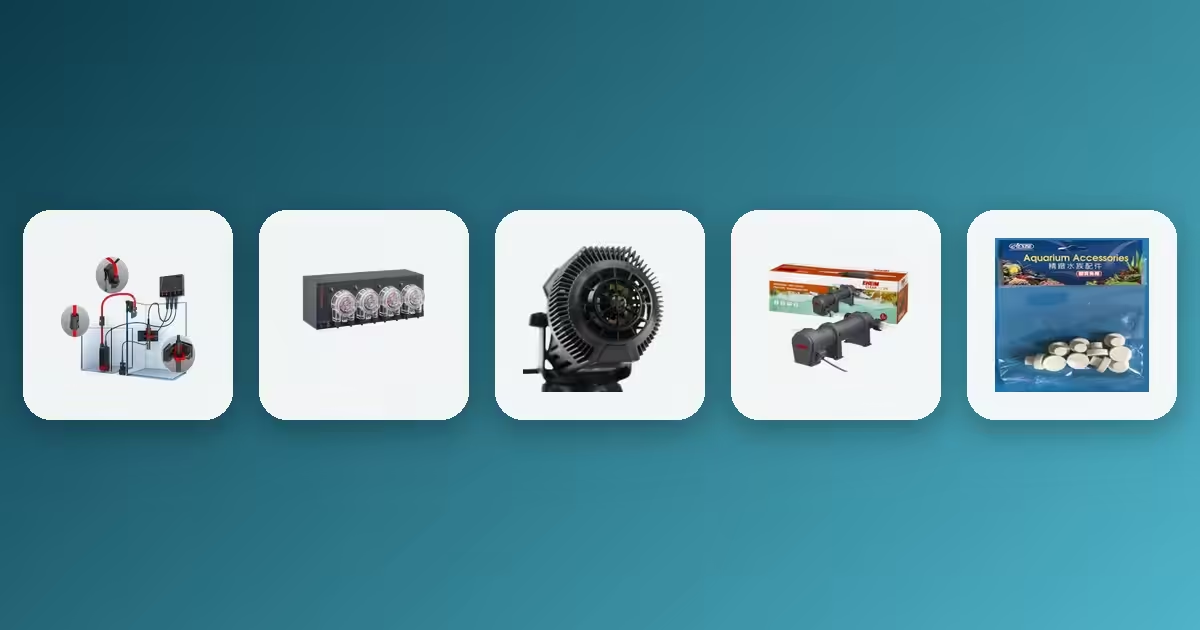
Evaporation tops off differently every day depending on humidity and photoperiod, which makes manual top-offs one of the easiest routines to fall behind on. The Red Sea ReefATO+ Auto Top Off System automates this with titanium probes that detect the water level, and the Red Sea ReefATO+ Upgrade Kit adds the same automation to an existing Red Sea Reefer aquarium’s sump.
For dosing calcium, alkalinity, or trace elements on a schedule rather than by hand, the Red Sea ReefDose 4 Dosing Pump runs up to four independent dosing lines, and the EcoTech Marine Versa Single Peristaltic Dosing Pump adds calibration and scheduling through the Mobius app. If you’re already running a ReefDose system, the ReefDose Deluxe 4-Color Tubing & Accessories Kit (in Red-Yellow or Blue-Green color coding) keeps four dosing lines visually distinct so you don’t cross-connect reagents during maintenance.
What a Top-Off System Is Built to Do
Red Sea describes the ReefATO+ as a system meant to hold a stable salinity and water volume by replacing the water lost to evaporation, with a digital thermometer and a leak detector sharing the same controller. It works in seawater only. The pump shuts down automatically if the sensor is not connected, if the pump runs significantly longer than normal, or if the RO reservoir runs dry.
A detected leak disables the auto fill straight away. Red Sea’s product page also lists an hourly record of the number of fills and the volume of water added, plus a record of minimum, maximum and average temperatures, each covering the last 28 days.
Water Movement
Steady, randomized flow keeps detritus in suspension long enough for mechanical filtration to catch it, and prevents dead spots where coral tissue can stagnate. The Sicce Voyager HP-8 and Sicce Voyager HP-10 Stream Wavemakers are submersible pumps built specifically for directional flow patterns in reef tanks, sized for small-to-mid and mid-to-large systems respectively. For a 2, 3, 4 or 5 foot tank, our guide to choosing a wave maker by size has a table of the tank sizes each maker lists.
UV Sterilization
A UV sterilizer clears free-floating algae and pathogens from the water column before they can establish in the tank. EHEIM’s ClearUVC line covers a wide range of tank sizes (the Eheim ClearUVC-24, ClearUVC-36, and ClearUVC-60) while the Reeflex range steps up to bigger systems needing higher flow-through capacity, from the EHEIM Reeflex UV 800 to the Reeflex UV 1500 and Reeflex UV 2000.
Lamp Life and Handling
EHEIM’s ClearUVC manual says to replace the UVC lamp after a maximum of approximately 8,000 operating hours, otherwise the UVC performance will dramatically decrease.
The lamp contains mercury. Handle it with care. Every appliance has to be disconnected from the power supply before any maintenance work starts. Never look into the light, the manual says. UVC radiation can cause injury to eyes and skin, even at low dosage levels, and the lamp must never run outside the appliance.
Calcium Reactors
For reef tanks that have outgrown liquid or powder calcium dosing, the Deltec Fluidized Bed Calcium Reactor line (PF501, PF509, and PF601) dissolves calcium media using CO2 injection, supplying calcium and alkalinity continuously rather than in periodic doses.
Running a Calcium Reactor Within the Manual
Deltec’s operating instructions for the PF series say the calcium level should be kept above 400 mg per litre, and preferably at 470 to 500. They call for Deltec Hy Carb Media only, because the reactor works on the fluidized bed principle. Wash the granulate first.
Setup starts with CO2 at about one bubble per second and the micro filter tap set to a drip of roughly 2 to 4 drops per second at the outlet hose. To adjust the DKH, the manual says to either increase the CO2 or decrease the water flow. It warns against too much CO2. Testing the water should wait until enough time has passed for any adjustment to take effect. Where a pH electrode and a suitable controller are fitted, normal operation sits at a pH of 6.2 to 6.5. Deltec says never to restrict or block the water flow from the outlet hose, since pressure inside the reactor could rise.
Ozone and Water Clarity
The Enaly Ozone Generator OZAC-PLUS 200 oxidizes dissolved organics and improves water clarity beyond what mechanical and biological filtration alone can achieve. It’s best paired with a protein skimmer and an ozone reactor or venturi, since ozone needs proper reaction time and off-gassing to be used safely. For the sump-side plumbing that pairs a fleece roller filter into an existing setup, the Red Sea ReefMat Sump Modification Kit adapts a standard sump to accept one.
Handling Ozone Safely
Ozotech’s guide for reef keepers says ozone can be harmful to humans and pets, so the generator belongs in a well-ventilated area. Breathing it in can irritate the respiratory system. Activated carbon goes on the skimmer air output and water return to neutralize residual ozone, and an ozone detector in the room is suggested.
Output should start low. It then rises gradually while water quality is watched, with an ORP controller to regulate the level. Lethargy, loss of appetite and discoloration in corals are listed as signs of ozone stress, and the advice is to reduce or pause ozone if corals show stress. For equipment failure there is a backup air pump with a carbon filter. Output settings come from the manual that ships with the generator.
Live Feed Support
For tanks feeding filter feeders or fussy fish, Ocean Prime Copepods are available in a 2mm size and a smaller 500-700 micron size, giving a live food option scaled to different mouth sizes across a mixed reef tank.
Why Copepods Show Up in Fish Rearing
Copepods are tiny crustaceans, with over 21,000 species described, according to University of Florida IFAS Extension. They are a major component of the marine zooplankton community. In the wild, marine fish larvae eat copepod nauplii while juvenile fish consume adult copepods, which makes copepods a major link in the nutrient pathway from primary producers to the young fish.
The publication adds that studies on feeding copepods to marine fish larvae have documented improvements in growth and survival of many species worldwide. Larval mouth gape and feeding response to various live feeds are species specific, according to the same fact sheet.
Handling and Frag Tools
Rounding out the smaller accessories: ISTA Instant Glue (also in a 25-tube pack) bonds coral frags to plugs or rock underwater, the ISTA Coral Frag Plug 10-pack gives you mounting bases on hand for fragging or rearranging a tank, and the ISTA Hydrometer is a simple, inexpensive way to spot-check salinity alongside a refractometer.
Trusting a Salinity Reading
Jay Hemdal, writing in Tropical Fish Hobbyist, calls dip and read plastic hydrometers generally reliable and less prone to breakage than glass, but says they can lose accuracy over time or be inaccurate when first purchased. New units tend to read falsely high because tiny air bubbles cling to the pointer. Older ones are suspected of reading low from mineral buildup at the pivot. Many reach a resolution of 0.0005 specific gravity units, though they need rechecking periodically. Tilt changes the reading.
Many aquarists assume an expensive refractometer must be accurate, yet that is only true if the device has been properly calibrated. Calibrating with distilled water alone gives only moderately accurate results. A better method is a calibration solution of 3.65 grams of sodium chloride in 96.35 ml of distilled water, with the refractometer adjusted to read 35 ppT. The article advises a model made for seawater with automatic temperature control, and says most people can reach 0.0005 specific gravity units with practice.
Precision Dosing for Smaller Systems
For nano and pico reef tanks that don’t need a full four-channel dosing pump, Aquavitro Sentia Doser Primary and Sentia Doser Secondary units scale dosing automation down to smaller volumes: the primary unit runs standalone, and secondary units expand the system one dosing line at a time as needs grow.
Quick Reference
| Problem | Product |
|---|---|
| Manual top-offs eating into your routine | Red Sea ReefATO+ System / Upgrade Kit |
| Hand-dosing calcium/alkalinity daily | Red Sea ReefDose 4, EcoTech Versa Single |
| Dead spots / poor flow | Sicce Voyager HP-8 / HP-10 |
| Free-floating algae or pathogens | EHEIM ClearUVC, EHEIM Reeflex UV |
| Outgrowing liquid calcium dosing | Deltec Fluidized Bed Calcium Reactor |
| Water clarity beyond mechanical filtration | Enaly Ozone Generator OZAC-PLUS 200 |
| Feeding filter feeders / fussy fish | Ocean Prime Copepods |
| Fragging and mounting corals | ISTA Instant Glue, Coral Frag Plug |
| Nano-scale automated dosing | Aquavitro Sentia Doser |
Prioritizing What to Add First
None of these accessories fix a struggling tank on their own; they remove recurring manual tasks from an already-stable one. If you’re deciding where to start, automate the task you’re most likely to skip: top-offs and dosing tend to be the first casualties of a busy week, which makes ReefATO+ or a dosing pump the highest-leverage first purchase for most reefers. UV sterilization and calcium reactors solve more specific problems (persistent algae blooms, or outgrowing manual calcium dosing) and are worth adding once you’ve identified that particular need rather than buying preemptively.